What are the precautions for repotting a Radermachera sinica?
The Radermachera sinica not only has lush, verdant leaves full of vitality and makes a very suitable prosperity plant for growing in home containers, but it also has high ornamental value and a great effect when used to accent a space. However, the Radermachera sinica likes a warm, humid growing environment with plenty of light, and it tolerates high temperatures but not cold.
If we want to grow the Radermachera sinica well, we generally need to repot it once every 2 years. By moving it into a pot one size larger, the roots can get more ample space to stretch out freely, and at the same time the pot can store more nutrients to promote the plant's growth. But repotting also requires mastering some techniques to ensure the plant takes to the pot and survives. Below, the editor will share with everyone the precautions for repotting a Radermachera sinica.
1. Carry out trunk pruning to reduce water and nutrient consumption
Cutting off the dried-up trunk can help preserve water and nutrients, but exactly how far should you cut, and which position is more suitable? Generally, you can use a small knife to slit the bark and check where the trunk is dried up, find the green and the withered yellow parts, and then cut off all the dried upper part.
And after cutting off the dried-up trunk, we also need to carry out the necessary treatment on the wound, such as sealing the wound with paraffin, which can reduce water loss from the wound area and also avoid wound infection.
2. Prepare a mixed potting soil to better help the plant take root and survive
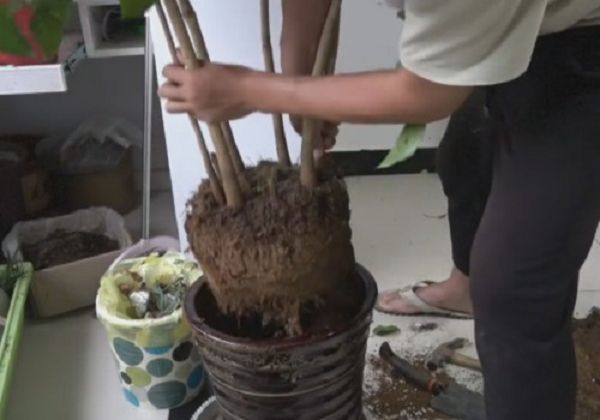
After cutting off the trunk, we then proceed with repotting. But when repotting, be careful to try not to damage the plant's roots. The soil used for potting is also quite important; some gardening friends say to use peat soil. However, the editor thinks that using peat soil alone is not suitable; a mixed soil should be used, and it is recommended to prepare peat soil, river sand, and garden soil in a certain ratio.
3. Avoid watering thoroughly; use a small amount of water to settle the roots
Replant the trunk-pruned Radermachera sinica in a new pot one size larger. Usually after finishing potting a container plant, you should immediately water it thoroughly once to settle the roots. However, for the Radermachera sinica, after repotting it is generally enough to water it lightly with a small amount of water. On the contrary, do not water it thoroughly, and the water temperature should also be kept as consistent with room temperature as possible, with no great temperature difference, otherwise it will affect the vitality of the plant's roots.
After finishing the first light watering after potting (note, not a thorough watering), do not water it again for a short period. This is because a Radermachera sinica that has just been repotted has very poor root vitality and has not yet grown new roots, so the roots' ability to absorb is limited. If too much water is given at this time, it is easy to inhibit the roots' respiration, causing them to suffocate and die.
4. Place it in a warm spot that receives scattered light to recover
Next, what we need to do is place the repotted Radermachera sinica in a warm spot that can receive scattered light to recover. Generally, keeping the temperature above 20°c is enough, because the Radermachera sinica relatively likes a warm growing environment, so providing scattered light for it at this time is more suitable, which is more conducive to forming the trunk's transpiration pull.
5. Water in time to avoid the potting soil becoming too dry and affecting survival
For the second watering, you usually need to wait a period until the potting soil becomes dry and cracks appear before doing it. And this watering cannot be done with a small amount of water like the first watering; you must water thoroughly until water flows out from the drainage hole at the bottom of the pot. In this way, you can ensure that the Radermachera sinica can smoothly survive after repotting and maintain good growth.