How to Prune a Potted Gardenia? Detailed Methods and Techniques
For potted flowering plants, pruning is a very important management task. Whether the pruning is done well or not will, to a large extent, affect the beauty of the plant's shape, and can even have a major impact on flowering. But for flowering plants, the focus of routine pruning is after flowering. Whether the post-bloom pruning is done well or not will directly affect whether the plant can quickly resume growth afterward, and also affects the next round of flowering.
As an ornamental potted plant, the gardenia's most frequently used management practice in daily care is watering. But if you want it to continue producing beautiful flowers later on, you also need to do a good job of pruning. However, pruning also requires mastering the methods; you must never blindly apply the pruning patterns of other flowering plants, otherwise problems are likely to arise.
For flowering plants, pruning is generally carried out promptly after flowering. After a gardenia finishes blooming, the extent of pruning is very small, and basically there is not much we need to prune. Generally, you only need to cut off the poor-quality branches in the pot, such as thin, weak twigs. As the plant resumes growth, it will sprout new shoots from beneath the flower receptacle where it previously bloomed, and these new shoots will keep growing.
After letting these new shoots grow for 1 month, we will find that the new branches formed have already grown very long. If we do not promptly control them at this point, these branches will continue to grow wildly, becoming increasingly long, thin and spindly, and with a slight misstep they may even topple over. This will inevitably affect its next round of flowering, and at the very least the number of flowers will be much smaller.
So, the first stage of pruning a potted gardenia is after flowering, the second stage is the growing season after flowering, and the third stage is right after the Beginning of Autumn. At other times afterward, it is usually not suitable to prune it, or at least not to prune it heavily, otherwise it will affect later flowering and may even cause the plant to fail to bloom. Therefore, when pruning a gardenia, you must grasp the timing well and do the right thing at the right time.
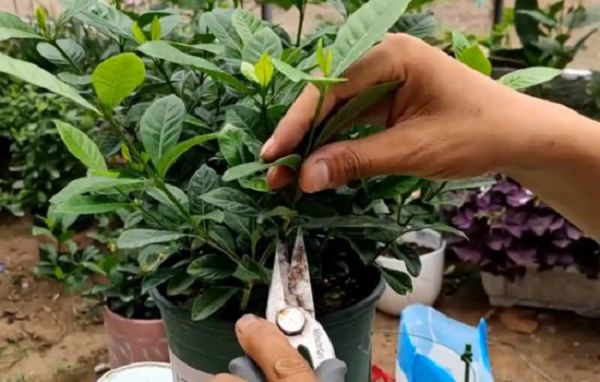
Although the pruning time needs to be chosen correctly, the pruning method also needs to be well mastered. We have already discussed post-bloom pruning: just cut off the thin, weak branches. Pruning during the growing season mainly involves cutting off the longer tender shoots that sprout beneath the flower receptacles that previously bloomed. When pruning, you can select two adjacent and largest leaves, then cut off the branch above the leaves, keeping only a shorter section of branch.
Summer is the peak growing season for gardenias, during which their growth is very rapid. But if its branches grow too long, all the leaves at the bottom of the pot will drop off, leaving only the long branches and leaves at the top. If we do not prune correctly and promptly, once the bottom leaves have all fallen off while the leaves on the upper branches tower high up, the potted plant will naturally look unattractive. So we need to promptly shorten the upper branches, cutting them a bit shorter and keeping just 1-2 nodes.
The general principle is to follow the above method: first select the two largest leaves from the lower part of the branch, then shorten and cut off all the branches and leaves above those leaves. In this way, as the plant grows, new shoots will sprout again from beside the two selected large leaves at the cut point. As the new shoots grow, the overall plant shape will become fuller and more beautiful, and the situation of having no leaves at the bottom and leaves only at the top will no longer occur. Moreover, even if the bottom leaves drop off, it will not affect the overall beauty of the potted plant, and this way it will bloom even more and more beautifully.