How to grow Star Jasmine in pots? A detailed guide to potting methods
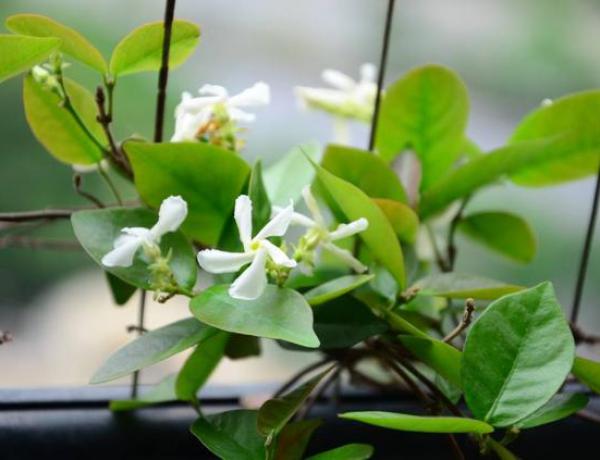
Star Jasmine (Trachelospermum jasminoides) is an evergreen woody vine in the genus Trachelospermum of the Apocynaceae family. Its flowers are as white as jade, with 5 petals forming a rotating pinwheel shape that looks romantic and fresh. Star Jasmine is not closely related to true jasmine, but it produces even more flowers than jasmine, with a flowering period that can exceed 200 days a year. It also grows extremely fast, capable of covering a 20-meter fence in just two years. More importantly, Star Jasmine has a very intense fragrance and is known as "the world's number one fragrance." Today we will discuss the care methods for potted Star Jasmine, with the key point being to keep things simple and low-maintenance.
1. Choose a large pot, with soil rich in organic matter
Star Jasmine has very strong growth ability. It not only grows fast but also has a well-developed root system. So when growing Star Jasmine, we need to leave it enough room to grow, and the soil must be loose, breathable, and highly permeable. The only weakness of Star Jasmine is that it fears water accumulation in the pot.
1. Pot: When planting Star Jasmine, choose as large a pot as possible. That is, the larger the pot, the more growing space Star Jasmine has, and the faster it will grow. But when choosing a pot, don't just focus on size; also pay attention to drainage and breathability. It is best to choose Qingshan pots or gallon pots, with as many drainage holes on the sides and bottom as possible. Here is a reference plan: if using gallon pots, you can directly use a 5-gallon extra-large pot.
2. Soil: Star Jasmine itself does not have high soil requirements, but its strong growth ability means it consumes nutrients very heavily. So when mixing soil for Star Jasmine, it must be nutrient-rich and full of organic matter. It is best to add some slow-release fertilizer or chicken manure and sheep manure as base fertilizer to the potting soil. Also, the only weakness of Star Jasmine is that it fears water accumulation in the pot, so the soil must also have good drainage and breathability, preferably with about 30% granular soil.
After choosing the pot and soil, before potting, we should also place crushed ceramsite or an inverted tile at the bottom of the pot as a drainage layer. This further ensures dryness and breathability in the Star Jasmine pot and minimizes the chance of water accumulation.
3. Provide a support point; a flower trellis or fence will both work
Star Jasmine is a climbing vine with very strong climbing ability. Only when there is a support point can it grow normally and rapidly.
For potted Star Jasmine, we can directly set up a trellis for it. Try to choose a larger trellis and fix the branches of the Star Jasmine onto it. When fixing, make sure the flower buds face outward, so that Star Jasmine grows outward and blooms on the outer side of the trellis, while the center of the trellis becomes a hollow tube. This helps with ventilation and breathability, can reduce the occurrence of pests and diseases, and is also quite helpful for the growth of Star Jasmine.
If there is a wall or fence at home, we can also place the Star Jasmine pot beside the wall or fence, so that Star Jasmine will climb up along the wall on its own. We can fix the branches of Star Jasmine according to our needs and shape it into the form we want.
3. Star Jasmine has strong adaptability to light, and its growth rate can be changed by controlling light
As a general principle, Star Jasmine loves light very much. The more light it gets, the faster it grows, the more it blooms, and the more intense its fragrance becomes. But for potted Star Jasmine, sometimes growing too large becomes a sweet burden, and we have to prune it often. So in actual care, we can change the growth rate of Star Jasmine by controlling light.
If we want Star Jasmine to grow as quickly as possible and bloom abundantly, then give it as much sun as possible, even in the hot summer without shading. Under sufficient light, Star Jasmine will continue blooming and can grow 10 meters in a year.
But if we want to save space and shape it, and want to control the growth rate of Star Jasmine, then we can reduce light. As for how much to reduce, we need to determine that according to our own needs. If you want it to stop growing or grow very slowly, then providing one or two hours of light per day is enough for Star Jasmine to survive healthily, but the amount of blooming will also decrease.
4. Fertilize simply and use multiple fertilizers together
The characteristics of Star Jasmine are fast growth, abundant blooming, and a long flowering period. But these three characteristics combined mean that Star Jasmine's fertilizer consumption and demand far exceed those of ordinary flowers. So to grow Star Jasmine well, we must do a good job with fertilizing. Fertilizing can be somewhat simple and rough, with high frequency and relatively large amounts, and the three types of fertilizer should be used together.
1. Balanced compound fertilizer with three elements: Balanced compound fertilizer with three elements is mainly used during the growing season of Star Jasmine, and can also be used year-round. The frequency is relatively high, once every 10 days. It is best to choose water-soluble fertilizer, dilute it with water at 1000 times, and water Star Jasmine directly with it. To enhance the effect of the fertilizer, you can also use slow-release fertilizer together, sprinkling it on the surface of the potting soil once every two or three months, letting it seep into the Star Jasmine potting soil with watering to nourish its roots.
2. Phosphorus and potassium fertilizer: Phosphorus and potassium fertilizer is quite helpful for Star Jasmine to develop flower buds and for buds to open. So in spring we can apply phosphorus and potassium fertilizer to Star Jasmine. The frequency should be maintained at once every 7 days, but the dilution concentration should be higher, preferably diluted with water at 1500 times, used both as a foliar spray and as a root drench.
3. Organic base fertilizer: Star Jasmine grows fast, its root system bears a heavy load, and it consumes soil nutrients quite heavily. To maintain a healthy growing environment for Star Jasmine, we should try to add base fertilizer to the potting soil. You can use fermented chicken manure and sheep manure, or plant-based fertilizers such as decomposed peanut shells or soybean cake. This helps maintain soil fertility. Even so, we should still repot and change the soil for Star Jasmine at least once every 2 to 3 years to ensure its root system stays healthy.
Tip: To extend the flowering period of Star Jasmine, we can give it a little medium and trace element fertilizer every month, such as calcium-magnesium fertilizer. The amount should not be too large; about 2 grams per month is enough.
5. Do not water too frequently; water thoroughly when the potting soil is almost dry
Star Jasmine rarely suffers from pests and diseases, and it can tolerate low temperatures of minus 10 degrees Celsius. But the only thing it fears is water accumulation in the pot. So when watering, we do not need to be too frequent. Keeping the soil slightly moist, or waiting until the potting soil is almost dry before watering Star Jasmine thoroughly, is enough.
Star Jasmine plants are relatively large and place a heavy burden and consumption on the soil. So when watering Star Jasmine, we can regularly use a little rice-washing water to water it once a month. This can prevent soil compaction and ensure the Star Jasmine root system is not damaged.
6. Pay attention to placement
Star Jasmine belongs to the Apocynaceae family, and it also inherits the toxicity of Apocynaceae plants. That is, Star Jasmine is toxic, but it has no effect when we view or touch it for ornamental purposes. Just be careful not to eat it by mistake. However, if there are children or pets at home, try to grow less Star Jasmine, or place Star Jasmine in a relatively high position so children cannot reach it.
In addition, the fragrance of Star Jasmine is very intense, but it is different from the fresh scent of jasmine. The more you smell jasmine, the more comfortable it feels; but smelling Star Jasmine for a long time can cause symptoms of dizziness and nausea. This is not a sign of poisoning, but is caused by the fragrance being too intense and by the characteristics of the scent itself. So during the flowering period of Star Jasmine, try not to place it indoors. Choose a place with good ventilation and sufficient light to grow Star Jasmine.
Star Jasmine has strong growth ability and excellent adaptability to the environment. Basically, it can be said that Star Jasmine is not afraid of cold or heat, and does not suffer from pests and diseases, but it is especially afraid of water accumulation in the pot. When choosing a pot, choose a large one. When mixing soil, pay attention to nutrition, drainage, and breathability. You can regulate the growth rate of Star Jasmine through light. Fertilize frequently, and for the final placement, pay attention to ventilation and breathability, and try to place it outdoors. If you do these things well, your Star Jasmine can also bloom for more than 200 days a year, with abundant flowers and a strong fragrance.