How to scientifically plant and propagate Clivia miniata by division?
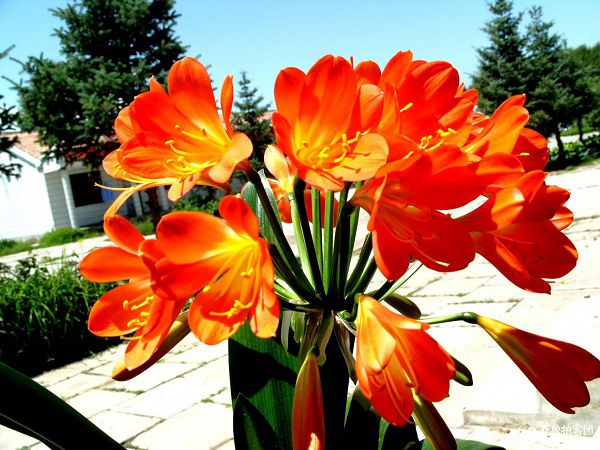
Clivia miniata is mainly propagated by sowing seeds.
The flowering period of Clivia miniata is from after the onset of winter to March-April of the following year, and the seeds take 9-10 months to mature after flowering, so sowing Clivia miniata is best done in November-December. Before sowing, select the seeds and remove the empty, shriveled, poorly developed ones. An ordinary flower pot can be used for sowing; first spread a 2 cm thick drainage layer of coarse sand or gravel at the bottom, then add a layer of growing medium mixed from leaf mold and river sand about 4-5 cm thick, and on top spread 0.5-1 cm of river sand as the sowing layer. For spot sowing, space the seeds 2 cm apart, then cover them with sand. After covering with soil, soak once with water and cover with a glass lid. After sowing, maintaining a temperature of 20°C-25°C is favorable for germination.
From germination to growing the first leaf takes 2 months; after that, lift the glass lid for ventilation and gradually remove it. After sowing, the seedlings can be transplanted after 90 days. When transplanting, first make holes with a bamboo skewer or bamboo chopstick, insert the fleshy roots into the soil, with the depth such that the root crown is buried and the seed is exposed, and at the same time make sure the leaves all face the same direction. After transplanting, water once thoroughly, and after a few days when the seedlings have recovered, let them receive light. During the seedling stage, keep the temperature at 15°C-20°C; in winter and spring they can be exposed to sunlight, in spring and summer they should grow under diffused light, and after autumn begins they can be planted in their permanent position.
To propagate Clivia miniata by division, the following work must be done well:
① For home potting, clay tile pots are preferable, as this kind of pot has good air permeability, which is beneficial to plant growth.
② Prepare sterilized growing medium. If using leaf mold mixed with fine sand, the leaf mold should be disinfected by spraying with a 1000-2000 times water solution of potassium permanganate; the fine river sand should also be scalded and washed with boiling water to disinfect it, so as to prevent the seedlings from being infected by pathogens and rotting.
③ Prepare a small amount of charcoal powder to smear on the wounds, for moisture absorption and anti-rot purposes.
④ When dividing, knock the Clivia miniata out of the pot, loosen the potting soil, straighten out the root system, and find the axillary buds that can be divided: if the offset is growing on the outer edge of the mother plant and is relatively small, you can hold the bulb part with one hand and pinch the base of the offset with the other, and with a gentle twist you can break the offset away from the mother plant; if the offset is thick and sturdy, use a sharp knife to cut it off. Then smear the wounds with charcoal powder to absorb the flowing sap and prevent rotting. Let the offsets and mother plant dry indoors before planting; the planting depth should be such that the base of the offset's pseudobulb is buried, with the part close to the plant positioned slightly higher, and cover with sterilized sandy soil. After planting, wait 2 days before watering once thoroughly, and 2 weeks later when the wounds have healed, add another layer of growing medium. Generally it takes 1-2 months to grow new roots, and after 1-2 years it can bloom.