How do you care for bougainvillea indoors in winter so that it blooms?
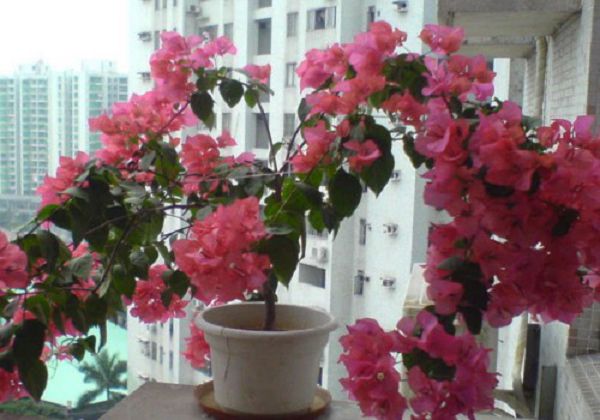
Many gardening friends like to grow bougainvillea as a potted plant at home, mainly because the bougainvillea flowers really are so beautiful. But quite a few people, when growing bougainvillea indoors, find that it only grows branches and leaves and never blooms. In fact, there are reasons for this. The normal flowering period of bougainvillea is at the turn of winter and spring, so what should be done?
If you are also a bougainvillea enthusiast, then when growing bougainvillea as a potted plant at home you need to pay attention to the growing environment, because a poorly chosen placement for the bougainvillea may cause it to grow only branches and leaves without blooming. Since many gardening friends place potted bougainvillea on a balcony or grow and manage it indoors, it is fairly normal for the no-bloom phenomenon to appear. To let bougainvillea bloom on schedule in winter, we must create suitable growing conditions for the plant.
By placing one pot of bougainvillea outdoors and another on a balcony or indoors for care, you can find that bougainvillea grown outdoors generally blooms normally on schedule, and its branches and leaves do not become leggy; whereas bougainvillea placed on a balcony or indoors usually grows only branches and leaves without blooming. It is clear that outdoor and indoor environments are both importantly linked to the growth and flowering of bougainvillea.
The biggest influence among these should be the issue of light, since outdoor light is abundant while light on a balcony or indoors is relatively scarce. Especially when potted bougainvillea is placed indoors for care, even in a spot near a windowsill, light passing through the glass is often weakened to a certain degree, and the indoor space is relatively cramped, so the light duration is often shorter and the light-receiving area is smaller; added to this, ventilation conditions are somewhat poorer, so indoor bougainvillea is very hard to get to bloom.
In fact, bougainvillea very much likes a growing environment with abundant light; even in summer when the light is fairly strong, we should not let it lack light. As long as it is not left exposed to the blazing sun continuously in midsummer, it can generally be given full sun, and there is no need to shade it specially. It is clear that light plays an important role in promoting the growth and flowering of bougainvillea.
If we place potted bougainvillea on a balcony or indoors, its growth will usually be affected to varying degrees because the light is not very abundant, and the effect on flowering in particular is considerable. So, to ensure that indoor bougainvillea can bloom smoothly under winter temperature conditions, it should first be moved outdoors for care starting before flowering, until the flowering period ends. This is because the indoor environment generally cannot meet its light needs.
Not only that, but controlling water before flowering is also crucial for promoting blooming in bougainvillea; even during the growing period, watering should not be too much. This is because sometimes bougainvillea fails to bloom, and to a large extent this is importantly linked to improper water management. To promote blooming in bougainvillea, starting from the growing period we should control water appropriately for it, mainly by reducing the frequency of watering and letting the potting soil stay slightly on the dry side for a few days.
Generally, we wait until the leaves of the bougainvillea begin to show slight wilting, then water it thoroughly. By repeating this water-control treatment several times in succession, the bougainvillea can be prompted to bud and set flower buds smoothly on schedule, and then comes the time for the bougainvillea to bloom to its heart's content.
Another point is that when branches and leaves become leggy, they should be pruned promptly, and heavy pruning is the appropriate method. Heavy pruning is usually only suitable during the growing period, because during that time the plant has strong sprouting ability and can quickly grow new branches and leaves. Heavy pruning can usually be done when buds break in spring and in June-July. After branches are cut short, the plant can be stimulated to sprout more side branches and flowering branches, making it easier for the plant to differentiate flower buds.
Moreover, bougainvillea also needs sufficient nutrients to bloom; generally, during the growing period, apply fertilizer once a month while reducing the proportion of nitrogen fertilizer and increasing the proportion of phosphorus and potassium fertilizer, or use a bit more compound fertilizer. This is mainly to prevent branches and leaves from becoming leggy and growing wildly, and to prompt the plant to grow robustly and bloom more and more brilliantly. Only when nutrients have accumulated to a certain level, and the earlier conditions have been met, will it be very hard for bougainvillea not to bloom.