What are the precautions for growing Aglaia odorata (mock lime)?
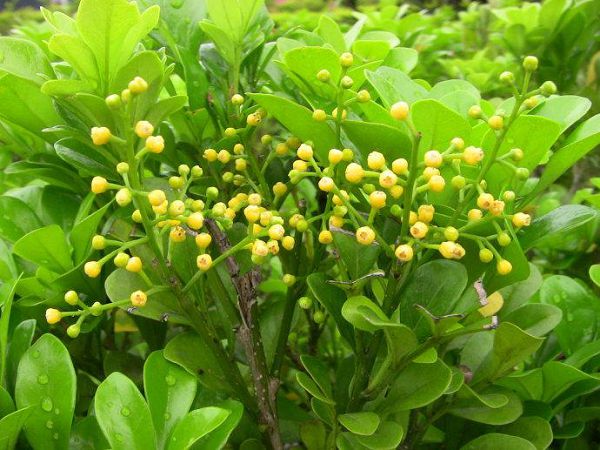
Fertilizer application: Aglaia odorata has luxuriant branches and leaves, and during the growing season it continuously produces new shoots and forms flower spikes, so it needs sufficient fertilizer. Insufficient fertilizer will not only significantly reduce the number of flowers and shorten the flowering period, but also noticeably fade the flower color and fragrance. For this reason, topdressing should be done in a timely manner. The best topdressing is well-rotted cake fertilizer or sesame paste residue water, but Aglaia odorata cannot tolerate concentrated fertilizer, so fertilization should follow the principle of applying thin fertilizer frequently, especially when topdressing begins in spring, when concentrated fertilizer should be avoided. Topdressing should preferably be applied once every 7-10 days, and an appropriate amount of superphosphate should also be added to the fertilizer water to help improve flower quality.
Moderate watering: When Aglaia odorata is first potted, after watering it thoroughly once, it is best to water it sparingly for half a month to encourage new roots to grow. At ordinary times, the potting soil should be kept moist but not overly wet for a long time. Too dry is bad for the growth of Aglaia odorata and causes the leaves to wilt, while maintaining relatively high air humidity is beneficial to its growth. In dry weather and during the vigorous growth period, it is best to spray water on the leaves 1-2 times a day.
Propagation key points: Aglaia odorata is generally propagated by layering and cuttings, which can be done during the plum rain period in early spring.
1. In South China, the air layering method is mostly used: from late April to mid-May, select vigorous plants free of pests and diseases, choose 2-year-old to 3-year-old branches on the sunny side, and perform girdling 20 cm from the branching point to expose the cambium. The cut should be about 2 cm wide. After the cut has dried slightly for a day or two, wrap it with a strip of mud, then bind it with plastic film so that the mud strip always stays moist. Roots can form in about 50 days. After the second set of new roots has emerged, cut it off from the mother plant, first heel it in with the mud strip in a shaded place to recover, and after more than 1 month, pot it for final planting.
2. In North China, use the film-covered moisture-retention method for cuttings: from May to July, take 1-year-old to 2-year-old branches as cuttings, about 10 cm long, with 2 to 3 compound leaves, and insert them for rooting. Use a 50/50 mixture of peat soil and river sand soil as the cutting medium, cover with plastic film, and set up a shade net above. By around the Beginning of Autumn, the rooting rate can reach about 60%. Generally, roots can form after two months. Only after roots have formed may they be transplanted.
Pruning key points: Aglaia odorata should be pruned and shaped starting from the young seedling stage, keeping a section of main trunk 15 cm to 20 cm high. Do not let the main branches grow in a cluster from the soil surface; instead, prune and branch above the 15 cm high trunk so that the plant's form becomes full. The lower branches of perennial old plants often age and die. Therefore, in North China it is advisable to shorten-prune once every other year during the hot season to stimulate adventitious buds on the lower part of the main branches to sprout and grow new side branches, thereby maintaining a well-balanced tree shape, strong tree vigor, and lush leaves and abundant flowers.
Repotting: Aglaia odorata seedlings require a vigorous plant, an intact root system, and soil that does not break apart so they can survive planting. When planting, a root ball 1/3-1/2 of the crown diameter of the Aglaia odorata is acceptable, and the depth is generally 1 times the diameter of the flowerpot mouth or equivalent. When adding new soil, appropriately add some phosphorus fertilizer as a base fertilizer, but not too much. After potting, place it in a cool place for care, and after about one week move it to a sunny place.
Pest and disease control:
1. For aphids, spray the plants with cigarette butt or chili water. Spraying with 800 times diluted Mieyaling is also acceptable. If there are few, they can be removed manually with a small brush.
2. For scale insects, spray with 1500 times diluted Jiesha. If there are few, they can be removed manually with a brush.
3. For red spider mites, spray the plants with 1000 times diluted dichlorvos or 2000 times diluted dimethoate.