A detailed guide to growing Agapanthus, easy for beginners to learn
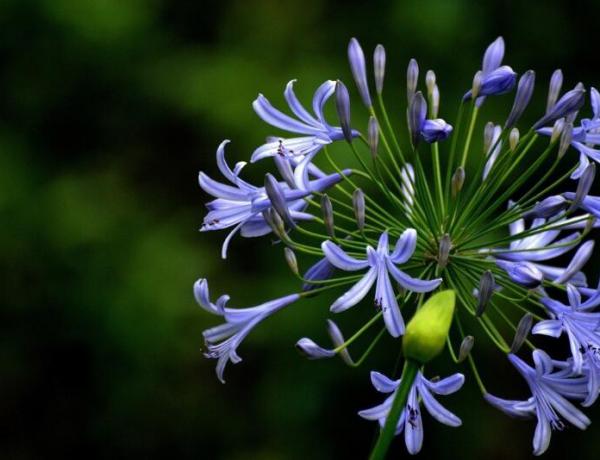
Hello everyone, today we are looking at a summer-flowering plant with elegant flowers and leaves resembling those of the clivia - Agapanthus. Agapanthus is also known as purple clivia and African lily, and some growers cannot tell Agapanthus apart from amaryllis. Note that, apart from the fact that the lily belongs to the genus Lilium in the family Liliaceae and has no taxonomic relationship at all with Agapanthus, clivia and amaryllis both belong with Agapanthus to the family Amaryllidaceae, so they are somewhat similar in plant form, but they can be clearly distinguished by flowering period and leaf shape.
1、
Agapanthus likes a warm environment and is neither tolerant of severe cold nor extreme heat. When summer temperatures rise above 30 degrees, growth is inhibited, and if temperatures remain above 35 degrees during the flowering period, it will affect the opening of the flowers when the July and August flowering period arrives, so growers should pay attention to cooling in summer. In winter the temperature should not be lower than 5 degrees; too low a temperature will cause cold damage to Agapanthus. However, in winter it also must not be kept in an environment above 20 degrees, as this will prevent the flower buds from vernalizing, resulting in failure to flower normally the following year.
Agapanthus has certain requirements for light. It likes sun but avoids direct blazing sun in summer. Lack of light will cause leggy growth, dull leaf color and narrow, elongated leaves, resulting in poor ornamental value. Generally, normal light exposure is fine in spring, autumn and winter, while in summer Agapanthus can be moved under a tree or to a north-facing balcony to avoid sunburn on the leaf surface caused by direct sunlight.
Agapanthus has low requirements for soil and grows well in well-drained sandy soil. When potting, it is recommended to use garden soil, coarse sand or honeycomb coal cinder, and compost mixed together as the potting soil. I personally prefer to use honeycomb coal cinder: first, it is widely available and low in cost; second, it is lighter than coarse sand. Growers who do not have honeycomb coal cinder can also use perlite as a substitute.
Agapanthus likes water and fertilizer, but fertilizer should be applied lightly and frequently to avoid damaging the roots with excessive fertilizer. When fertilizing, attention should also be paid to applying more organic fertilizer with mild fertility and long-lasting effect, and as little inorganic fertilizer as possible, to avoid degradation and compaction of the growing soil that affects plant growth. Fertilization should be done in stages with key points: during the growing period, compound fertilizer is the main choice, while at the bud stage and flowering period, the amount of phosphorus and potassium fertilizer should be increased.
2. Propagation methods of Agapanthus
There are two propagation methods for Agapanthus: division and seed sowing. The seed sowing method has a long flowering cycle, and it is impossible to determine what kind of flowers the new plant will produce before it blooms, so it is generally used by hobbyists for propagation and in new horticultural breeding. With the division method, the divided plant can bloom the following year; it is carried out in early spring together with repotting. After division, the flower characteristics of the young plant are exactly the same as those of the mother plant, so this method is used in large-scale cultivation.
3. Pests and diseases of Agapanthus
Agapanthus is rarely troubled by insect pests. When incompletely decomposed organic fertilizer is used, fungus gnats are likely to appear, and they can be killed with common low-toxicity pesticides. Common diseases include leaf spot, red spot, anthracnose and other fungal diseases, which can be prevented and controlled with common sterilizing agents such as thiophanate-methyl and chlorothalonil.