How to Grow and Care for the Black Aeonium (Aeonium arboreum 'Zwartkop')
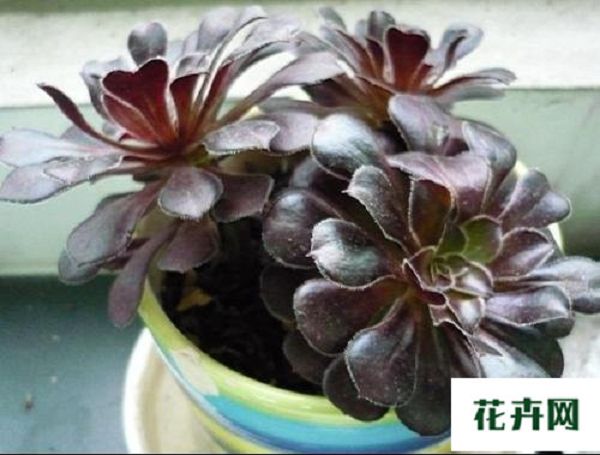
Growing Environment
The black aeonium (Aeonium arboreum 'Zwartkop') likes a warm, dry, sunny environment; it is drought-tolerant, not cold-tolerant, and tolerates partial shade slightly. It can be planted in fertile, well-drained, airy potting soil, and volcanic ash makes it even better. It grows in cool seasons and goes dormant in summer, though not for long. To propagate, cut off the rosette leaf disc in early spring and root it as a cutting; the remaining stem will send out clusters of tiller buds. If cuttings are taken in early summer, not only is the survival rate affected, but the stem also produces fewer buds. Leaf cuttings are difficult to root.
The black aeonium grows better when the weather is cool; it goes dormant in summer (it can be kept in partial shade during dormancy). The soil should be fertile and loose, the light should be sufficient, and watering should not be too frequent. During dormancy, observe the plant's condition according to the temperature, reduce the frequency of watering accordingly, and provide appropriate partial shade. Spring and autumn are its main growing stages, so water and fertilizer management should be appropriately strengthened. In winter, water according to your own conditions and the plant's condition, and pay attention to cold protection. If there is heating indoors, pay attention to strengthening the light and water accordingly based on the growth.
Propagation Methods
During the growing period, cut healthy, plump fleshy stems and insert them in vermiculite or sandy soil for propagation. Plant in fertile, well-drained, airy potting soil, and volcanic ash makes it even better. It grows in cool seasons and goes dormant in summer, though not for long. To propagate, cut off the rosette leaf disc in early spring and root it as a cutting; the remaining stem will send out clusters of tiller buds. If cuttings are taken in early summer, not only is the survival rate affected, but the stem also produces fewer buds. Leaf cuttings are difficult to root.
Management and Care
In summer, when temperatures are high, the plant has a brief dormant period, during which growth slows or stops completely. At this time it can be placed in a well-ventilated spot for care, avoiding prolonged rain, with a little shading, restricted watering, and no fertilizing. Spring, autumn and early summer are the plant's main growing periods, and it should be given plenty of sunlight. Although it can grow in partial shade, the area near the growing point turns dark green, and the dark purple of the leaves in other parts also fades to light brown, affecting its ornamental value. In addition, excessive nitrogen fertilizer in the soil and overly vigorous growth can also cause this phenomenon. Therefore, keeping the potting soil slightly dry and letting the plant grow a little more slowly often gives better results. In winter, if the minimum temperature does not drop below 10°C, you can water normally so the plant keeps growing, but there is no need to fertilize; if you cannot maintain such a high temperature, restrict watering so the plant goes dormant, and it can also withstand low temperatures of 3-5°C. Repot once every 1-2 years; the potting soil should be fertile and have good drainage. A common mix is 2 parts coarse sand or vermiculite, 1 part leaf mold, and 1 part garden soil, mixed evenly. If conditions allow, mixing in an appropriate amount of plant ash or bone meal as a base fertilizer gives even better results.