How to grow potted orchids so they thrive
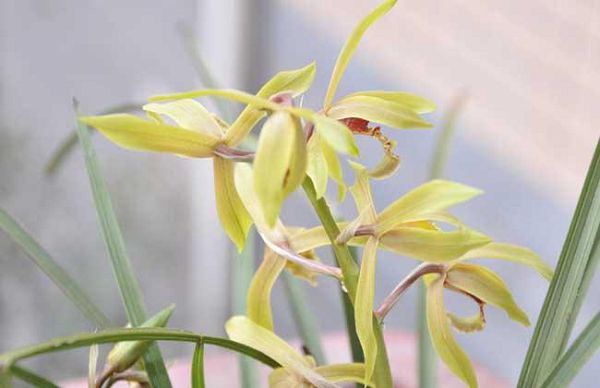
Orchids are also known as spring orchid, orchid grass, secluded orchid, national fragrance, and so on. They are epiphytic or terrestrial herbaceous plants of the genus Cymbidium in the orchid family. Orchid cultivation in China has a history of about two thousand years. Chinese people have always regarded orchids as a symbol of nobility and elegance, and together with "plum, bamboo, and chrysanthemum" they are called the "Four Gentlemen." They have extremely high ornamental and cultivation value. Let us take a look together below.
Orchid growth habits
Orchids originally grew in hilly areas or beside mountain springs and flowing water among towering peaks and continuous mountain ranges. Some grow in deep valleys and ravines on sloping hillsides covered with dense trees, or in crevices with rocks and relatively deep soil layers. Because orchid types differ, their living habits also vary. Spring orchids prefer shade, while summer orchids prefer sun, but both prefer warm and humid climates. Orchid roots are distributed on the surface layer of the soil and require soil rich in humus, with good looseness, water permeability, fertilizer retention, and water retention. The soil is acidic, with a pH value between 5.5 and 6.5. Orchids most avoid coal smoke and dust, and are also afraid of blazing sun and violent wind and rain. Areas with air pollution are not conducive to orchid growth. The roots need orchid fungi to coexist with them, otherwise growth is poor.
Orchid propagation methods
1. Division: This can be done in both spring and autumn, generally once every three years. Any plant with robust growth and densely clustered pseudobulbs can be divided. After division, each cluster should retain at least 5 connected pseudobulbs. Before division, reduce watering to make the potting soil relatively dry. When potting after division, first cover the drainage hole at the bottom of the pot with broken tile pieces, then spread coarse gravel to occupy 1/5 to 1/4 of the pot depth, then place coarse-grained soil and a small amount of fine soil, and finally plant with sandy loam rich in humus.
2. Sowing: Orchid seeds are extremely fine. The seed contains only one incompletely developed embryo, and its germination capacity is very low. In addition, the seed coat does not easily absorb water, so sowing by conventional methods cannot germinate them. Therefore, orchid fungi or artificial culture medium are needed to supply nutrients for germination.
How to grow potted orchids.
1. Soil: Orchid soil should be mainly humus, primarily using leaf mold or mountain forest humus soil. In the south, use humus soil from the place of origin, commonly known as orchid mud. You can also use leaf mold, vermiculite, perlite, and other materials to artificially prepare a loose, airy, and water-permeable growing medium. Generally, use 8 parts leaf mold and 2 parts river sand mixed into growing soil, or 7 parts leaf mold, 2 parts perlite, and 1 part river sand mixed into growing soil, or 6 parts leaf mold (peat soil), 3 parts compost soil, and 1 part river sand mixed evenly into growing soil.
2. Fertilizing: For orchid topdressing, liquid fertilizer or foliar fertilizer is mostly used, and the concentration should be lighter than for other flowers. Generally, during the growing season, apply fully decomposed dilute cake fertilizer water at about 15%, or 0.1% urea fertilizer water plus 0.2% monopotassium phosphate fertilizer water, once every 15 to 20 days. From before flowering to the flowering period, spray the leaves 2 to 3 times with 0.2% monopotassium phosphate or plant ash water to promote the development of roots, stems, and flowers. Orchids have fleshy roots, so do not apply undecomposed fertilizer, to avoid root rot.
3. Watering: Watering orchids should be based on the species, growth condition, and local climate. Achieve moist but not wet, dry but not parched. Do not water too much or too little. Grasp the principle of not dry in autumn and not wet in winter. In winter, when temperatures are low, the plant is in a dormant state, so watering should be controlled, generally once every 5 to 7 days. However, Cymbidium sinense, which blooms in winter, needs more water. In spring and autumn, water once every 2 to 3 days. In summer, water an average of 1 to 2 times per day.
4. Temperature: In the north, potted orchids should be moved indoors around the Frost's Descent solar term when the temperature drops to 5°C. In the early period after being moved indoors, open the windows frequently to maintain air circulation. In winter, the indoor temperature should preferably remain around 10°C. After Grain Rain, move them outdoors for care. The suitable growth temperature for orchids is 16 to 24°C. In winter, the indoor temperature is generally required to be relatively low, preferably 10 to 12°C during the day and 5 to 10°C at night. Temperature and humidity must not be too high. In summer, the temperature should not exceed 30°C.
5. Light: Orchids prefer shade and fear direct strong light, so shading is needed in spring, summer, and autumn. For growing orchids at home, in order to control the amount of light, it is best to place them on a balcony windowsill with bamboo curtain shading or under the eaves. Generally, provide shade from 9 a.m. to before 6 p.m., and pull the curtains open in the morning and after 6 p.m. so they receive scattered sunlight. In winter, move them indoors to a place with visible scattered light, but also avoid direct sunlight. Among orchids, Cymbidium sinense has the strongest shade tolerance, followed by Cymbidium ensifolium, while spring orchids and cymbidium orchids have weaker shade tolerance.
6. Pruning: During orchid cultivation, the plants should be pruned. For example, when old leaves turn yellow and wither, they need to be pruned, which benefits the growth of other leaves and also improves ventilation. Diseased leaves especially need timely pruning to prevent contagion. In addition, scissors also need to be disinfected to prevent infection.
7. Repotting: Orchids grow relatively slowly, so they can be repotted once every 1 to 2 years after the flowers fade. When potting, first place about 3 cm of tile pieces, furnace slag, and the like at the bottom of the pot to facilitate drainage. Then put in a layer of growing soil, place the orchid seedling in the center of the pot, straighten the roots, and let them spread naturally. When the soil is filled to halfway, gently lift the orchid seedling while shaking the flower pot so that the soil and roots combine closely. When the soil is filled to 2 to 3 cm from the pot rim, gently press it firm with your hands.
Precautions for orchids
1. Orchids are mainly distributed in the southeast and southwest regions. They mostly grow wild in moist valleys under sparse forests and in shaded places beside rocks, so they prefer warm and humid climates, prefer shade and moisture, and require a shading degree of 70 to 90%. They avoid high temperatures, dryness, and strong light.
2. During orchid cultivation, withered and yellow old leaves and diseased and pest-damaged leaves should be continuously cut off to facilitate ventilation. After flower buds emerge, each plant should retain one strong flower bud and cut off the rest, so as to avoid consuming too many nutrients and affecting flowering the following year. After the flowers fade, the flower stems should be cut off.
3. Orchids should be protected from cold in winter. Terrestrial orchids have strong cold resistance, while tropical orchid types require higher overwintering temperatures. They should be moved indoors early or protected from cold with a plastic shed to avoid freezing. The room temperature should preferably be kept at 10 to 15°C, and ventilation should be noted during indoor care. As the climate gradually warms in spring, gradually move the orchids to the courtyard or balcony.
4. For home orchid cultivation, natural rainwater, stream water, well water, and river water are best for watering. If tap water is used, it should first be stored in a vat and exposed to the sun to remove bleaching powder before use. If tap water is used to water flowers for a long time, the growing medium will gradually become alkaline.
5. When cultivating orchids, ferrous sulfate can be applied once at intervals to increase soil acidity. In addition, watering orchids with fermented rice washing water can also keep the soil in a slightly acidic state.