Why does a hyacinth fail to sprout long after it has rooted?
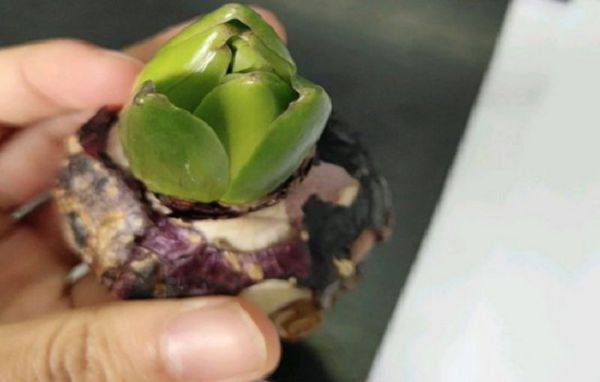
Hyacinth is a plant that blooms beautifully but is also not easy to grow well, especially in the early stages of planting, when it is even more important to master the care methods. Otherwise, it may easily have difficulty rooting and sprouting, and even if it does root and sprout smoothly, it may still easily suffer from "stuck arrows" (flower spikes trapped in the bulb), ultimately leading to difficulty flowering or no flowers to enjoy at all.
During this period, many growers find that not long after planting a hyacinth, it roots, yet it does not sprout for a long time. This is truly puzzling, since logically, once the hyacinth bulb has rooted and can absorb and supply nutrients, it should sprout quickly.
In fact, this is mainly caused by improper care and management in the early stages of planting hyacinths, especially during the rooting and sprouting period. This is mainly the result of not grasping its requirements for light and temperature in the early planting stage; as long as we can solve these two problems, it will both root quickly and sprout smoothly.
Hyacinth is a flowering plant that can be grown both in water and in soil, and especially in a hydroponic environment, temperature control and shading are essential in the first few days of planting. Keeping it in a relatively cool, shaded environment of 2°C-6°C is often the only way to stimulate the bulb to develop roots. After the bulb has grown roots, it generally sprouts promptly and resumes rapid growth, and only then can we appropriately raise the temperature and increase light, while also needing to fertilize in time to supplement the nutrients needed for growth. Soil-grown hyacinths have roughly the same requirements.
When we encounter a situation where a hyacinth has rooted but does not continue to sprout, on the one hand it may be because we raised the temperature too early, or let it bask in the sun too early, or it may be unable to sprout due to a lack of nutrients. Therefore, we need to investigate these three aspects until we find the real cause, and then adjust the care methods to solve the problem.
In the early growth stage, hyacinths have relatively high requirements for light and temperature. Generally, before rooting, the temperature should be kept between 2°C-6°C while providing shade. Only after it has rooted can we gradually raise the temperature to 5°C-10°C, but it still should not be exposed to direct sunlight; instead, place it in an environment with scattered light for care.
In this way its root system will continue to germinate, grow and strengthen, and the roots' ability to absorb and supply nutrients will be greatly improved, so timely fertilization is needed. If it is a hydroponic hyacinth, generally add a little nutrient solution when changing the water, once every 10-15 days. If it is a soil-grown hyacinth, then we need to promptly supplement it with some multi-element fertilizer containing nitrogen, phosphorus and potassium.
Only in this way can the hyacinth both grow a strong root system and sprout and grow leaves quickly and smoothly. And if during the hyacinth's growth period any one of the conditions of light, temperature or nutrients cannot be met, it may fail to sprout after rooting. Of course, it may also show poor rooting or later develop undesirable symptoms such as "stuck arrows."