How should you care for a potted rhododendron (ying shan hong) to improve its survival rate?
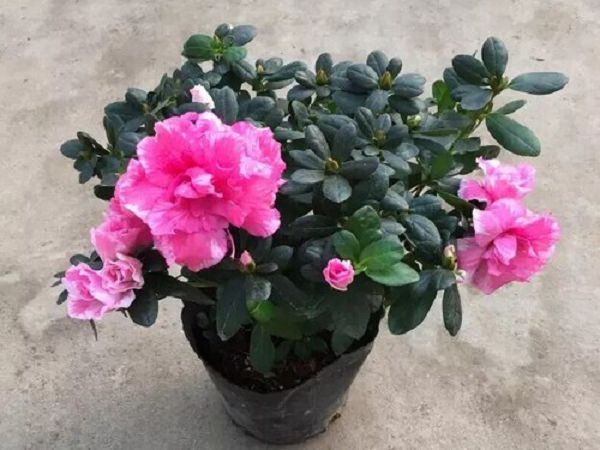
Rhododendron, also known by the aliases ying shan hong, shan shi liu, shan zhi zhu, hong zhi zhu, shan juan and so on. There are many species of rhododendron, and the leaf shapes vary greatly. Its flowers grow in clusters of 2 to 6 at the tips of the branches, the corolla is broadly funnel-shaped, and the capsule is egg-shaped. At present, rhododendron has become one of the most popular and important ornamental flowering trees both at home and abroad.
For growing rhododendrons it is best to have both an indoor and an outdoor environment. The indoor environment is used in winter. The outdoor site is used in summer and autumn, and a mud ground is best; cement ground should be avoided. The site should be spacious, ventilated and shaded, with a shade frame built above it, covered with reed blinds or using the shelter of natural tree shade; a light transmission rate of about 30% is suitable, and exposure to the afternoon sun must be avoided.
For watering rhododendrons it is best to use rainwater, and next river water or pond water. If tap water is used, it is best to store the water for 1-2 days to let the chlorine evaporate before use. When using it, add 0.2% ferrous sulfate, and water once every 7-10 days during the growing season; use it regularly to ensure the soil is acidic.
Rhododendrons like loose, highly permeable, well-drained acidic soil rich in humus, with a pH of 5.0-6.0. If clay or alkaline soil is used, hardly one in a hundred will survive. In particular, summer azaleas and Western azaleas absolutely require mountain soil. The mountain soil must also be improved, and at present three kinds of prepared growing soil are usually used.
For the pots used to grow rhododendrons, generally two kinds are chosen: clay pots and purple clay pots. Clay pots have good air and water permeability, and production units all use this kind of pot for cultivation. Finished rhododendrons, especially those already trained into a shape, are generally planted in beautiful and elegant purple clay pots for indoor and outdoor display; purple clay pots have a fine texture, rich colors and beautiful shapes, and can double their ornamental value.
Rhododendrons like shady and moist conditions and should not be too dry. During the flowering period they need even more water. In winter, rhododendrons have entered the dormant period and do not need much water, so generally water once every 4-5 days, preferably around noon on a clear, warm day;
For the azalea lace bug (also known as the crown net bug), spray 40% dimethoate 1500 times dilution during the period of infestation, once every 7 days, for 3 consecutive times. Control of the terminal bud leaf roller mainly relies on hand-picking to kill it; the larvae or pupae can also be killed by spraying 40% dimethoate emulsifiable concentrate 2000 times dilution or dichlorvos 1500 times dilution.
Rhododendron (ying shan hong) is widely distributed in our country and its resources are very rich. The trunk form of ying shan hong is ancient and peculiar, the trunk is upright, the thick roots are exposed, it grows fast, tolerates pruning, and its branches are full of bright flowers, making it an excellent material for bonsai grown for both flowers and trunks. Especially in the flowering season, the branches full of delicate red flowers are deeply welcomed by viewers. But there are several difficult points in the maintenance and creation of ying shan hong bonsai that are not easy to master. If you want a high survival rate for ying shan hong, the following points are worth noting:
1. Digging time. It is best to dig after the plant has become dormant and before it flowers; at this time the plant has abundant nutrients stored within it and the sap has not yet begun to flow, so it survives easily. After the flowers open in spring, the plant has consumed a large amount of nutrients because of heavy flowering, and the plant body is relatively weak, unable to withstand major damage and attacks by pests and diseases, so stump material dug after flowering does not easily survive.
2. Selection of stump material. First, choose to dig stump material with a thick, large trunk, one that has been cut down by people many times, with a beautiful stump shape, good branching and natural transitions. Stump material with natural transitions survives easily because the branch and trunk cuts are small. Second, choose to dig stump material with many fine roots and fibrous roots. Ying shan hong is a shallow-rooted tree species, and generally has quite a lot of fine roots and fibrous roots; some stump material, however, has only a few relatively long large roots because of being squeezed by rocks or growing in a harsh environment. After such large roots are shortened, the wounds on the large roots are relatively large and do not heal easily, and moreover there are not many fine roots on the large roots, so such stump material does not survive easily and should not be dug. Third, when digging, a soil ball must be kept; stump material with its original soil has mostly undamaged fibrous roots and a high survival rate, while stump material without a soil ball has mostly damaged fibrous roots and does not survive easily.
3. Treatment of the stump material. After the stump material is dug, it should be wrapped in something like a woven bag and tied tightly to prevent the soil ball from being shaken apart during transport; at the same time, care must be taken to prevent the stump material from losing water. After stump material without original soil is brought back, soak it in clean water for a few hours to let the stump material absorb enough water before planting.
4. Choice of soil. The quality of the soil used for growing ying shan hong is very important for survival. Ying shan hong is a plant that likes acidity, so it should be planted in slightly acidic soil with a pH of 5.5-6.5; it is best to plant it in the loose, breathable yellow leaf mold soil of the places where rhododendrons grow. The soil is better in granular form; soil that is too fine is bad for water drainage and also does not breathe, which will make the fibrous roots unable to respire properly and cause the stump material to suffocate and die.
5. Choice of pot. It is best to use an unglazed clay pot to grow the stump material. Ying shan hong has shallow roots and fine, dense fibrous roots, so the pot should not be too deep, and a pot with poor air permeability must not be used for planting. A simple pot such as a wooden box can also be used to grow the stump material; as far as possible do not use a heavily alkaline cement pot to grow the stump material.
6. Planting. When planting, the soil should be a little dry; using dry soil for planting makes the potting soil less likely to become compacted. When planting, it must not be planted too deep; planting too deep will kill the stump because the roots do not get enough oxygen. When planting, a small wooden stick can be used to firm the soil in the pot; do not let the roots of the stump material hang in the air. After watering, do not poke the potting soil again, and do not shake the stump material, so as to avoid compacting the potting soil; this point is also important. After planting, water thoroughly once to settle the roots, then cover the whole stump together with the pot with a transparent plastic film bag to keep in moisture, and check the potting soil at intervals to ensure it stays moist. In spring, after the stump material sprouts, wait until the new shoots have grown to about one cun long and the branch tips that need to grow shoots all have new shoots, then choose a spell of several consecutive rainy days and uncover the plastic bag to harden the seedlings. If dry, clear weather occurs, spray water on the stump head to keep it moist; just keep the potting soil moist, and do not let water accumulate. The stump material can also be planted in river sand, because river sand is clean and breathable, so the survival rate is also high; the drawback is that later, when potting up, the plant is hard to move with its soil, which makes potting up inconvenient, and at the same time, because river sand has few nutrients, after it has fully survived it must be fertilized frequently and acidified. If conditions permit, planting it in the ground in a greenhouse also gives a very high survival rate and is convenient to manage.
7. Choice of maintenance site. Ying shan hong likes a moist environment. After the new stump is planted, place it in a ventilated, moist place for maintenance. When maintaining it in a dry environment, use a shade net for shade, spread an old blanket used for wrapping furniture on the ground, then spray the blanket wet to increase air humidity. Only after the plant has fully survived can the shade net be removed, and only after it has adapted can it be moved to a place with full sun for maintenance. Ying shan hong roots rather slowly; although some plants have put out some new branches, stump material that does not grow vigorously in summer and autumn has in fact not put out many new roots and cannot yet be considered fully survived, so maintenance must still be strengthened, and the plant should not be moved to a dry place for exposure to the sun. In particular, those stump materials whose new branches look all right when it rains in summer and autumn but wilt as soon as the sun shines on them and which do not grow vigorously have basically not sprouted new roots and are relying on the little water drawn in by the stump head itself; such stump material is falsely alive and will basically all die in the following year.
8. Preserving buds. The buds of ying shan hong are densely packed, and a new stump may sprout a great many branch buds. In order to make the plant grow more roots, try not to remove the buds in the first year, because more branches and leaves means more water is transpired, which can prompt the plant to grow more roots; wait until the following spring to thin the buds of plants that are growing relatively well.
9. Watering. Ying shan hong likes a moist environment but does not tolerate wetness. In particular, the mortality rate is quite high for plants grown in soil that does not breathe and is bad for water drainage. If the soil is too wet, the plant sprouts few new roots, and some plants may falsely stay alive until the following spring before dying, so watering ying shan hong should depend on how dry or wet the soil is; just keep the soil moist, and on no account let water accumulate, nor water it with alkaline water.
10. Flower control. Ying shan hong flowers very easily, and flowers abundantly; even some plants that have not survived well will flower. Too much flowering consumes a large amount of nutrients and will accelerate the death of the plant. Therefore, for a new stump in the first year, or a plant that is still growing poorly in the second year, the flower buds should be thinned after they form, so that the plant's nutrients are used for the plant's growth.
11. Fertilizing. Newly planted stock has few new roots, and the new roots that do sprout have poor tolerance for fertilizer, so a new stump should not be fertilized in the first year; this point is very important. After the plant has survived, apply only organic fertilizer, and apply it as a thin fertilizer; acidic organic fertilizer is better. Do not apply strong fertilizer or chemical fertilizer.