When does the purple magnolia usually bloom?
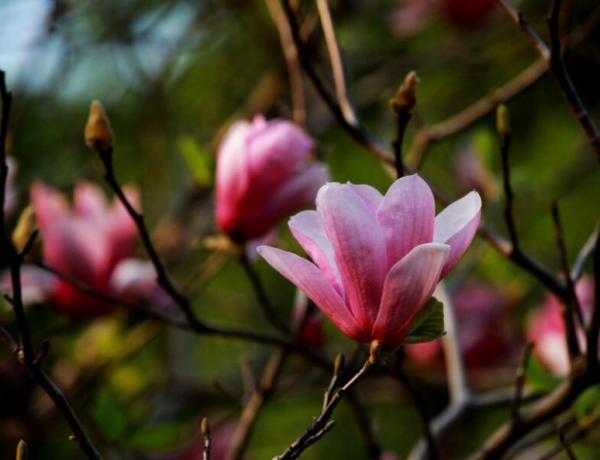
The purple magnolia generally blooms from March to April. Its flowers are gorgeous and delightful, with a delicate fragrance. It looks beautiful whether planted alone or in groups. With its graceful tree shape and abundant branches and flowers, it is an excellent plant for courtyard and street landscaping, and is a traditional ornamental flower and Chinese herbal medicine with more than 2000 years of history in China.
How to cultivate the purple magnolia
1. Potting soil: The purple magnolia prefers loose, fertile acidic to slightly acidic soil. You can use an equal mix of leaf mold and garden soil as the growing medium, and add 50 to 150 grams of bone meal or nitrogen-phosphorus-potassium compound fertilizer to the soil. The pot should be slightly deeper and larger, and place some crushed hard plastic foam blocks at the bottom of the pot to enhance air permeability and drainage and prevent root rot. Repot and change the soil once every year or every other year after flowering, retaining 1/2 to 1/3 of the old soil.
2. Water and fertilizer: The purple magnolia likes moisture but fears waterlogging, so timely and appropriate watering is very important. From the beginning of spring to flowering, keep the potting soil moist but not wet; after flowering, keep the potting soil moist but not waterlogged; after leaf fall, keep the potting soil slightly moist but not dry. At no time should it be drought-stressed or waterlogged, and especially during the rainy season, pay attention to drainage to prevent waterlogging.
The purple magnolia likes fertilizer. Fertilization should seize the two key periods: February before flowering and May after flowering. Apply nitrogen-phosphorus-potassium compound fertilizer about once every ten days. The former makes the buds swell and the flowers bloom, while the latter promotes more bud formation and more flowers the following spring. When leaves fall in early winter, apply a fertilizer mainly based on phosphorus and potassium once to enhance its cold resistance for overwintering, and apply little or no fertilizer at other times. Avoid applying nitrogen fertilizer alone.
3. Light and temperature: The purple magnolia likes light. Place it in a sunny courtyard or rooftop garden, where more sunlight makes it grow robustly and luxuriantly. Under semi-shade conditions it can still grow, but it will be weaker and produce fewer flowers, and in too much shade it will not flower. It is relatively cold-tolerant, and in Beijing and areas to its south it can overwinter outdoors.
4. Pruning: The purple magnolia has strong root sprouting ability. If propagation is not needed, cut the sprouts as they grow, and keep only 3 main stems per pot. For branches that are too tall or too long, they can be shortened just after flowering when leaves have just unfolded. Because its wound healing ability is poor, apply sulfur powder after cutting to prevent rot. If not necessary, do not prune. After flowering, if seeds are not needed for propagation, cut off the spent flowers together with the stalk.
5. Propagation: Commonly used methods are division, layering, and seed sowing. After flowering, while repotting and changing the soil, take the plant out, use sharp scissors or a knife to cut off the rooted suckers from the roots, and plant them separately. Transplanting can be done in autumn or before flowering in early spring. For small seedlings, dip them in mud slurry; for large seedlings, they must be kept with a soil ball.
Apply fertilizer once before and once after the flowering period, mainly phosphorus and potassium fertilizer. In summer high temperatures and autumn dry seasons, maintain soil moisture. After flowering and before new branches sprout, cut off dead branches and dense branches and shorten leggy branches. For sowing, collect seeds in September, store them in sand in winter, and sow in the following spring; they germinate 20-30 days after sowing.