Although the clivia likes fertilizer, too much fertilizer will instead hinder its growth
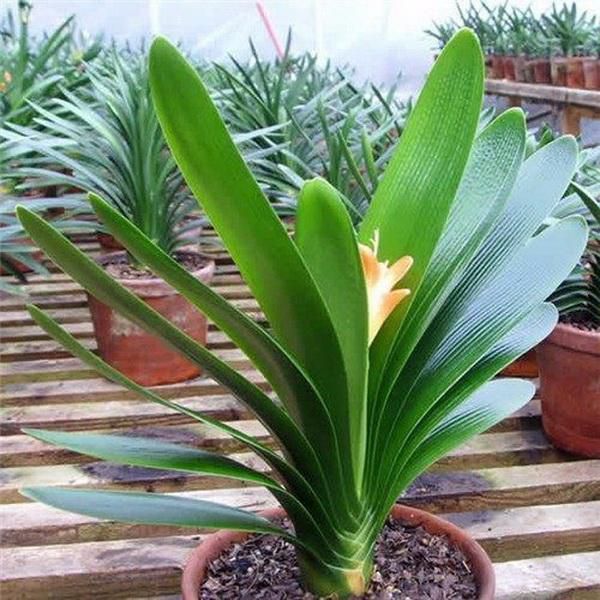
The clivia's roots are fleshy and fibrous, milky white, and very thick and robust. The root system is thick and large, with a very fleshy feel. The persistent leaf bases at the base of the clivia's stem enlarge and clasp each other to form a pseudobulb-like structure. The leaves emerge in two ranks overlapping from the shortened stem at the root, neatly arranged, broad and strap-shaped, with rounded tips, hard and thick in texture, and with luster and veins. The basal leaves are thick in texture, sword-shaped in form, leathery, dark green, glossy, strap-like, 30-50 cm long, up to 85 cm at the longest, 3-5 cm wide, gradually narrowing toward the base, alternately arranged, with entire margins.
The flower scape emerges from the leaf axils; if grown from seed, it generally flowers only when it has reached 15 leaves. The flower stem is about 2 cm wide; the small flowers are stalked, arranged in an umbel at the top of the stem, funnel-shaped, upright, yellow or orange-yellow, or orange-red. The umbel is terminal, the flowers upright, with several imbricate bracts, each inflorescence having 7-30 small flowers, sometimes more than 40. Tepals 6, connate. The nodding clivia has slightly drooping flowers with narrowly funnel-shaped tepals. The pedicel is 2.5-5 cm long; the flower is upright and facing upward, the tepals broadly funnel-shaped, bright red, with a slightly yellowish inner surface; the tepal tube is about 5 mm long, the outer whorl tepals have a slightly protruding tip, the inner whorl tips are slightly concave and slightly longer than the stamens; the style is long, extending slightly beyond the tepals.
The berry is purplish red, broadly ovate. The full bloom period runs from New Year's Day to the Spring Festival, mainly in spring and summer, and it can bloom year-round, sometimes also in winter, and sometimes in summer between June and July. The fruit ripens around October; it is a berry, purplish red. Both flowers and leaves are beautiful.
Fertilization methods for clivia
Applying base fertilizer
Also called basal fertilizer. The main role of base fertilizer is to create conditions for the plant's development and meet its own nutrient needs. Clivia's base fertilizer is applied when repotting, once every 2 years. Commonly used base fertilizers include: animal manure, green manure, compost, soybean cake fertilizer, and so on.
Method
Before planting, mix the base fertilizer with the soil.
Top dressing
Top dressing is carried out during the plant's growing period. Commonly used fertilizers include: cake fertilizer, bone meal, fish meal, and so on. As the plant grows older and its leaves grow larger, its own nutrient needs increase, and timely top dressing benefits the plant's growth.
Method
When fertilizing, scrape the potting soil aside 2~3 cm, apply the fertilizer, and be careful not to place it too close to the roots, so as not to damage them. Usually once a month; during the growing period the interval can be appropriately shortened to once every 20 days.
Applying liquid fertilizer as top dressing
For liquid fertilizer, you actually do not need to buy specialized fertilizer; simply soak decomposed animal and plant manure, take the clear liquid, and dilute it with water 20~40 times, depending on the size of the seedlings.
Water once 1~2 days after fertilizing, in order to let the liquid fertilizer seep down to the roots and better exert its fertilizing effect. Note: do not water before fertilizing.
Foliar top dressing
When nutrients in the soil are insufficient and the plant lacks fertilizer and grows slowly, the foliar fertilization method should be adopted. Commonly used fertilizers include urea, superphosphate, potassium dihydrogen phosphate, and so on
Method
Dilute the fertilizer into a solution and spray it directly onto the plant's leaves; the nutrient elements will seep into the plant through the leaves. When spraying, be sure to spray both the front and back sides of the leaves evenly. Usually spray once every 4~6 days during the growing season, and once every 10~15 days in the semi-dormant state, spraying after sunrise.