Reasons Why Cattleya Orchids Don't Bloom and How to Fix Them
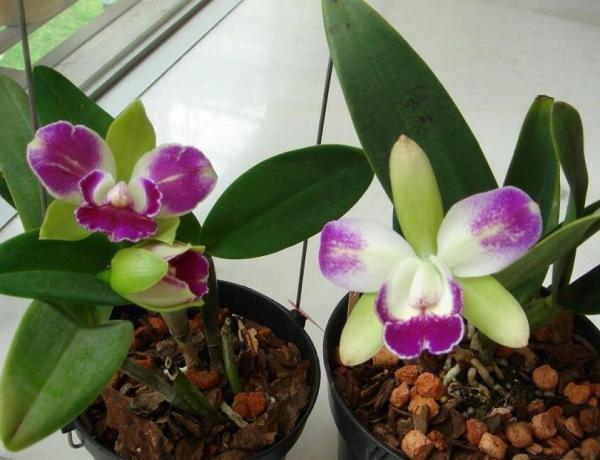
Cattleya orchid flowers come in a myriad of shapes and colors, dazzling and brilliant, and often appear at celebrations and banquets, used for flower arranging displays. If you use Cattleya orchids and Phalaenopsis orchids as the main materials, paired with Oncidium, Solomon's seal, and asparagus fern in a vase, they are bright and elegant with a strong sense of rhythm. If Cattleya orchids are the main flower, paired with Anthurium, baby's breath, Monstera friedrichsthalii, and bear grass, they appear light and lively. Cattleya orchids are the most beloved epiphytic orchids. With large, brightly colored flowers, exotic and beautiful blooms, and an extremely rich variety of flower colors, they are magnificently gorgeous and have earned the title "Queen of Orchids."
Cattleya orchids include species and hybrids. They are one of the most famous orchids internationally, native to Brazil. When first discovered, they were used as binding material, which is why they have particularly strong resilience. The pseudobulbs are club-shaped or cylindrical, with 1 to 3 leaves growing at the top; the leaves are thick and hard, with the midrib sunken; flowers are single or several, borne at the top of the pseudobulbs, large and beautiful, with bright and rich colors. Cattleya orchids are native to tropical America and are the national flowers of countries such as Brazil and Colombia. There are more than several thousand varieties. Colors include white, yellow, green, red, and purple. Propagation is by division, tissue culture, or sterile sowing.
Cattleya orchids prefer a warm and humid environment. In such an environment, the leaves and pseudobulbs are dark green, glossy, and full of vitality. Flower buds can develop smoothly, flowers bloom fully, and flower colors are vivid. New roots and young shoots grow vigorously. If the temperature is around 11°C, the flowering period is delayed, flowers cannot fully open, and the flowering period is shorter.
If the temperature is around 5°C, the leaves turn yellow and appear lifeless, the pseudobulbs develop longitudinal wrinkles, flower buds cannot grow larger or taller, and the flower sheaths turn brown, with growth severely inhibited. If the temperature drops to 1-2°C, the leaves wither and turn yellow or brown and fall off, and the flower buds die. Of course, if the nighttime temperature is above 20°C, it often leads to an excessively short flowering period. In greenhouse cultivation in the north, special attention should be paid to maintaining a large day-night temperature difference, keeping the daytime greenhouse temperature 5-10°C higher than at night. The day and night temperatures must not be equal, and the nighttime temperature must certainly not be higher than the daytime temperature.
During the spring and autumn growing seasons for Cattleya orchids, abundant water and relatively high air humidity are required. They must not be overly dry, otherwise growth will be affected. In winter, Cattleya orchids almost stop growing. In greenhouses with poor ventilation, Cattleya orchids should be moved to an outdoor shade house for a period of time, otherwise growth will be poor and rot is likely to occur.
Too much light can cause severe sunburn or growth stagnation, with leaves turning yellow. In winter inside a greenhouse, light shading can be reduced or omitted. Among orchids, Cattleya orchids are a light-loving species. If light is insufficient, they bloom less, fail to bloom, or produce flowers of poor quality. The leaves become thin and soft, the pseudobulbs become slender, and growth vigor weakens. To produce good flowers, the light can be slightly stronger, and even slightly yellowed leaves will not affect the plant's growth. Growers who cultivate for flower production often adopt this cultivation method, and flower yield increases noticeably.
Cattleya orchids have thick stems and leaves and vigorous aerial roots, and are drought-tolerant; they will not die even without watering for a month. They can be cultivated on rooftops, balconies, under eaves, and beneath large trees, but they require fresh, circulating air and appropriate shading. A shade net can be used to block 50% to 60% of sunlight. Daytime temperatures of 25°C to 30°C and nighttime temperatures of 15°C to 20°C are required, and young seedlings are best overwintered in a greenhouse in winter.
Reducing watering during the flowering period can promote flower bud differentiation; after new shoots or flower buds form, water more, but avoid watering at night, especially when a cold wave strikes, when watering must stop completely; normally, air humidity should be kept at 60% to 65%. Cattleya orchids can be planted in plastic pots or ceramic pots; for mature plants, the growing medium can be 6 parts crushed fern root and 1 part [each of the other components], plus charcoal and gravel, etc.
During the three vigorous growing seasons of spring, summer, and autumn for Cattleya orchids, attention should be paid to placing some fermented solid fertilizer in different parts of the pot surface, applying once every 1-2 months, or applying liquid fertilizer once every 1-2 weeks. Young seedlings should be fertilized even more frequently so they can grow quickly.
When the plant's rhizome has grown beyond the edge of the pot, or the growing medium in the pot has begun to collapse and drainage is no longer smooth, it is time to repot. This usually occurs after two years of cultivation. Repotting is best done in spring after the flowering period, before new roots have grown.
Mature plants generally use larger pieces of growing medium than young seedlings; once a plant has grown at least six mature pseudobulbs, it can be moved together into a larger pot without division. If you want to propagate by division, each pot should contain at least 3-5 pseudobulbs. The pot size should be such that it will not be outgrown within roughly two years.