What are the sowing and planting methods for Impatiens?
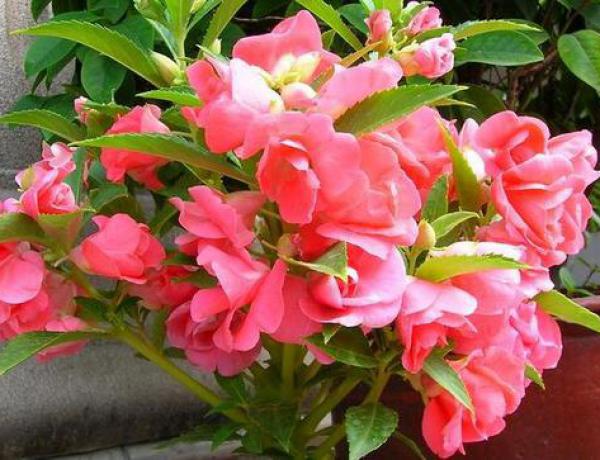
Impatiens (Impatiens balsamina) is an annual herbaceous plant of the genus Impatiens native to China, with a long cultivation history in our country. Its varieties are diverse and its colors are brilliant, with common ones including pink, white, and red. Besides being commonly called "nail flower" (zhijiahua) in childhood, it also has many other names such as "golden phoenix flower" and "bamboo cup flower." Depending on the variety, the mature plant height of Impatiens ranges from 40 to 100 cm. It blooms in June each year and continues blooming until early autumn in September. It has the characteristics of being easy to plant and having strong self-propagation ability.
Growth habits of Impatiens
Impatiens likes a warm growing environment with ample light. It is not very cold-tolerant, but it has strong adaptability, tolerates transplanting, has few pests and diseases, and tolerates poor soil. However, it does not like maintenance environments that are too humid or lack sufficient light, and will develop problems such as leggy growth, weakness, lodging, and few flowers due to lack of light and water accumulation. After gaining a basic understanding of Impatiens, the editor will now explain its planting and care methods for everyone:
Sowing and planting methods for Impatiens
1. Sowing time
Impatiens mainly reproduces by seed. Sow from March to September each year. If flower friends in the south want to plant it, they can start preparing next month. Flower friends in the north are suitable for sowing in April. Generally, it will bloom about 3 months after sowing.
2. Preparing the soil
Impatiens does not like overly moist soil environments, so when growing it in pots, even more emphasis should be placed on the drainage of the potting soil. It is recommended to use loose, well-draining, slightly acidic, fertile soil, such as leaf mold, garden soil, vermiculite, and decomposed chicken manure fertilizer, mixed evenly in a 3:2:1:1 ratio; or leaf mold, peat, river sand, and decomposed sheep manure fertilizer mixed in the same ratio as above.
If you have insecticide, it is best to sprinkle some insecticide when mixing the soil. When the editor first started growing flowers years ago, I did not treat the soil, which led to many insects crawling around the house in summer. Just thinking about it is scary. If you do not have insecticide, you can heat-fry the soil; high temperature can kill insect eggs.
3. Seed treatment
The seeds of Impatiens are brown spherical granules. Before sowing, you can soak the seeds in 40-degree warm water for 6 hours, or directly soak them in cold water for a day, then remove them and drain off the water. Soaking the seeds can increase the germination rate and make sprouting more uniform.
4. Sowing method
Before potting up Impatiens, we need to first lay a drainage layer at the bottom of the flower pot. You can use clay pebbles, or break a broken earthen pot into small pieces and use those. Then fill the prepared soil substrate into the flower pot to about 80 percent full, then gently shake it a few times; at this point the soil will sink slightly. Then water the soil in the pot thoroughly. If you did not heat-fry the soil, it is best to add some fungicide to the water to disinfect the soil.
Then place the seeds on the surface of the potting soil. Generally, placing 4 seeds in a 1-gallon flower pot is enough; too many are not good for growth, and if the seedlings grow too close together, they are also prone to disease and mildew. After the seeds are placed, gently sprinkle a thin layer of fine dry soil on the surface. Use a spray bottle to moisten the surface soil; it is best to choose a spray bottle with fine holes and a soft mist.
After sowing, if the ambient temperature cannot reach 20 degrees, you can cover the mouth of the flower pot with transparent film, only poking many holes in the film for ventilation to prevent excessive moisture and mildew on the seeds and seedlings. After poking the holes, you can move it to a cool, well-ventilated place to wait for germination. If the temperature at sowing time can reach around 20 degrees, then there is no need to cover with film. During this period, keep the soil moist. When you see the covering soil dry, spray a little water. It can germinate in 7-10 days.
5. Transplanting and potting up
After flower friends see the seeds sprout, they should move them to a place with diffused light for care. Note that the light must not be too strong, to prevent drying out the seedlings. When the seedlings grow 4 true leaves, you can dig out the seedlings together with the soil using a seedling lifter, and transplant them into new flower pots.
The steps for preparing soil and potting up in new flower pots are the same as when sowing, except that it is best to plant only one seedling per flower pot. Impatiens is very tolerant of transplanting and can easily survive no matter when it is done, but it is best to bring some of the original soil along when transplanting. After transplanting is complete, place the flower pot in a cool, ventilated place to recover for 3 days, then move it to a place with ample light to let it get more sun and speed up the growth of branches and leaves.
When the fruit of Impatiens matures, it is relatively easy for it to burst and shoot out the seeds. So if flower friends want to keep seeds for sowing the next year, they need to collect the seeds before the flower seeds are fully mature. The usual timing for collecting seeds is when the seed coat is slightly yellowing. Impatiens seeds store very well and will not have a reduced germination rate after being stored for 1 or 2 years, so after flower friends have collected seeds once, the seedlings sown the next year do not necessarily need to have seeds saved.