Detailed Explanation of Key Fertilization Techniques for Potted Phalaenopsis
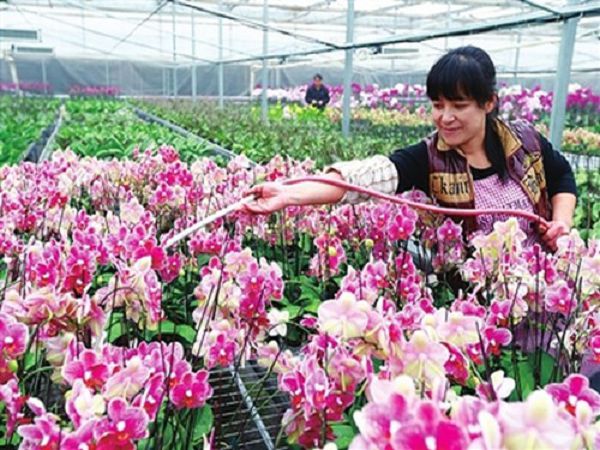
Phalaenopsis mainly relies on foliar feeding to promote plant growth, so during its growing season, spray once a week with a 0.1%-0.3% concentration of complete NPK fertilizer or monopotassium phosphate, as well as pesticides such as lime sulfur mixture, carbendazim, and thiophanate-methyl, to prevent and treat diseases. Phalaenopsis greenhouse cultivation can use soilless substrates, or it can be grown in soil. Soilless substrates can include moss, peat, bark, etc. Several companies in Yunnan use moss as a potting substrate, applying nutrient solution as both water and fertilizer, with good results.
Phalaenopsis fertilization is basically carried out in conjunction with watering. Generally, macronutrients and micronutrients are dissolved in water in proportion, with the pH adjusted to slightly acidic, and then sprayed over the whole plant, 1-2 times per week, at a concentration of 0.1%-0.2%. It is best to use fertilizers that the plant can absorb directly.
For home-grown Phalaenopsis, it is essential to master the correct fertilization methods to achieve strong roots, plump leaves, and vibrant flowers while avoiding fertilizer damage.
1. It is better to use dilute fertilizer than concentrated fertilizer. The fertilization principle for Phalaenopsis is to apply thin fertilizer frequently, in small amounts and multiple times. Concentrated fertilizer easily causes root rot. This is especially important when applying water-soluble quick-acting fertilizers. The dilution concentration must follow the multiplier specified in the instructions. Never increase the concentration on your own. Beginners should dilute it at least one more time beyond the recommended ratio to be safe.
2. During the growing season, fertilize once a week or once every 10 days. The fertilization concentration should gradually increase from small seedlings to large plants. In addition, root fertilizer (referring to fertilizer applied to the substrate at the root zone) and leaf fertilizer (referring to foliar feeding applied to the leaf surface) are best applied alternately.
3. The types and methods of fertilization differ at different growth stages. When new shoots have just formed, the demand for nitrogen fertilizer is relatively high, but potassium fertilizer should also be applied in combination. When flower buds are forming, phosphorus fertilizer should be increased to promote bud development.
4. Fertilization during the bud stage or flowering stage should be appropriate. Fertilization should not be excessive or too frequent, especially nitrogen fertilizer, otherwise it will cause nutrient excess in the plant, stimulate vegetative growth, thereby shortening or offsetting the ongoing reproductive growth, causing early bud drop (bud blast) or flower bud withering.
5. Fertilization is most easily absorbed by Phalaenopsis when the temperature is 22-28°C. Therefore, in spring and autumn, fertilizing in the morning is best; in summer, fertilizing in the evening is best; in winter when temperatures are low or when a cold wave hits, fertilize less or avoid fertilizing. During cold or extreme heat, when temperatures are too low or too high, Phalaenopsis will enter dormancy or semi-dormancy, and fertilization should also be avoided at this time. Because when the plant is in a dormant or semi-dormant state, its internal activity is greatly reduced, and with stomata closed, water evaporation is almost zero, leaving no ability to absorb fertilizer. Fertilizing at this time is undoubtedly wasteful, and the fertilizer will accumulate in the growing medium, causing the substrate to acidify prematurely. If not handled carefully, it can also impede root crown growth and even cause root rot.
6. Fertilization should be uniform and the method should be appropriate. When applying water-soluble quick-acting fertilizer, drench the entire pot until fertilizer water flows out from the bottom of the pot. The leaves should also be moistened, because Phalaenopsis leaves, like roots, can absorb fertilizer. When applying solid fertilizer, spread it evenly so the roots can absorb it uniformly; never pile it up at the root zone, otherwise the excessive fertilizer concentration at that spot will burn the aerial roots.
7. For orchids that have just been planted or just repotted, do not fertilize temporarily. Because during planting or repotting, the plant's root system is damaged or broken. Fertilizing at this time can easily cause the root wounds of Phalaenopsis to become infected with pathogens, leading to root rot.
8. When the plant is affected by pests or diseases, or when the plant's growth is weak, it is best to also suspend fertilization. Because at this time the absorption capacity of Phalaenopsis is weak, fertilizing is undoubtedly wasteful and may even worsen the condition, making weak plants even weaker.
9. When the plant develops root rot or the growing substrate decomposes, fertilization should be suspended. First remove the orchid plant from the pot, discard the decomposed substrate, then trim off the rotten roots, replace with new growing substrate and replant. Resume fertilization only after normal growth resumes and new roots have grown.
Fertilization precautions:
The principle of fertilization should be to apply less fertilizer and use dilute fertilizer. Because it grows relatively fast and its growth period is also relatively long.
Fertilization month precautions: Phalaenopsis grown for one year or many years will be repotted in late spring and early summer (May) each year. Newly repotted Phalaenopsis is in a recovery period, and no fertilization should be given to the orchid plant. After one month of recovery, the orchid plant begins normal growth. That is, from June to September, the orchid plant enters its growing season and needs to be fertilized once a week.
Fertilizers suitable for Phalaenopsis: foliar fertilizer, monopotassium phosphate, fermented farmyard manure diluted with water, orchid-specific fertilizer, etc. During the growing season, foliar fertilizer and monopotassium phosphate can be applied alternately to fertilize Phalaenopsis. If neither of these two fertilizers is available, fermented farmyard manure diluted with water can be chosen for watering with fertilizer solution. If you have orchid-specific fertilizer at home, simply apply the orchid-specific fertilizer directly.
Spring and summer fertilization precautions: Summer temperatures are relatively high, so fertilization of the orchid plant should be stopped. In autumn, the growth rate of Phalaenopsis begins to slow down, so the frequency of fertilization should also be reduced. At this time, if the orchid plant is fertilized frequently, it will affect flower bud formation, making it difficult to bloom.