What are the cutting techniques for winter jasmine? A detailed guide in one article
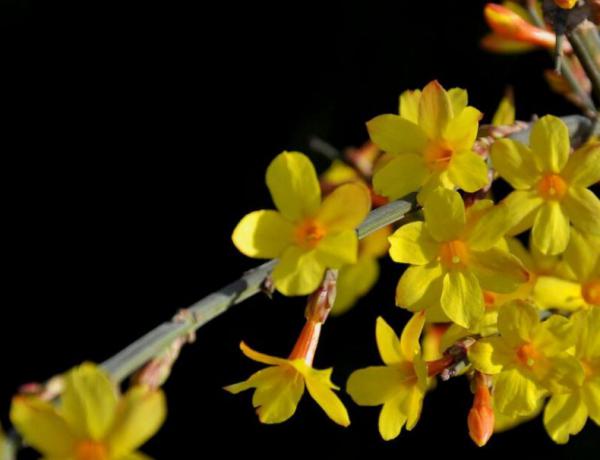
Winter jasmine (Jasminum nudiflorum) is a common flowering plant with a beautiful appearance that is easy to grow. However, the number of winter jasmine flowers is a very important factor affecting the normal growth of winter jasmine. On one hand, winter jasmine is a clump-forming herbaceous plant; if individuals are planted separately and there are too few winter jasmine plants, it is very likely that winter jasmine will struggle to bloom or will not bloom at all. Moreover, when fewer winter jasmine plants grow together, their overall disease resistance is poorer, and the plants are easily infected by pathogens, leading to disease outbreaks.
On the other hand, if there are too many winter jasmine plants, the number of flowers will increase, and the nutrients required will increase accordingly. If sufficient nutrients are not supplied, winter jasmine will grow slowly, its vigor will weaken, and the flowers will gradually wither. Under such circumstances, external intervention to keep the number of winter jasmine flowers within a range that allows healthy growth is very important.
The main propagation methods for winter jasmine are seed propagation, division propagation, and tissue culture. All three methods can change the number of winter jasmine flowers. Today we focus on one of the division propagation methods - the cutting method. The cutting method is easy to perform and can reasonably adjust the number of winter jasmine flowers, effectively promoting the growth of winter jasmine.
I. What points need attention when cutting winter jasmine?
Before cutting winter jasmine, the winter jasmine must first be divided.
① Determine whether division is needed.
The number range in which winter jasmine can grow healthily is 5-6 mature plants or 1-2 seedlings. Within this range, the nutrients supplied to winter jasmine can ensure its normal growth is not disrupted by nutrient deficiency, while also promoting the growth of seedlings. In most cases, however, the number of winter jasmine plants is not within this range, so the winter jasmine must be divided. In addition, when the market demand for winter jasmine flowers reaches its peak, winter jasmine can also be divided to promote the propagation of winter jasmine flowers, obtain more winter jasmine flowers, and bring more economic benefits to the grower.
② Division cycle:
Dividing winter jasmine must be done with caution. If division is performed too many times, it will harm the roots of the winter jasmine and seriously affect its growth. Therefore, there should usually be an interval of about 2-3 years between two divisions, so as to protect winter jasmine from harm. If the interval is shorter, it may cause irreversible damage to the winter jasmine. For example, if winter jasmine is divided once a year, the plant has not yet recovered from the effects of the previous division before the next division must be carried out, which disrupts the normal growth state of the winter jasmine plant and increases the chance of infection by pathogens.
③ Division time:
In theory, winter jasmine can be divided at any time of the year. But in order to avoid harming the plant as much as possible and not affect the growth of winter jasmine, the division time should also be chosen at the most suitable moment. From the perspective of optimization, however, the period after the flowering season (the period from the Spring Equinox to Grain Rain each year, or from the Autumn Equinox to the Start of Winter) is the most suitable compared with other times. But because environmental differences between regions are relatively large, it cannot be stated in an oversimplified way that the division time must be at a certain moment. To determine the specific time, growers still need to consult information, understand local temperature, humidity and other conditions, and then make a decision.
A large amount of statistical data shows that the period after the winter jasmine flowering season is relatively suitable compared with other times. But this is not absolute; the specific time still needs to be determined according to the description in the previous paragraph.
II. What steps can the winter jasmine cutting process be divided into?
1. Preparatory work:
① Choose the flower pot well:
When choosing a flower pot, pay attention to the height and type of the pot. The height of the pot should be determined according to the length of the winter jasmine branches after cutting, and it is best that it is not longer than the winter jasmine branch, nor shorter than half of the branch. As for the type of flower pot, common choices include plastic pots and purple clay pots. Plastic pots are widely used because of their affordable price. But in fact, the effect of purple clay pots is far greater than that of plastic pots, and they are more suitable for the growth of winter jasmine branches after cutting. Therefore, we suggest choosing purple clay pots if conditions permit.
② Flower pot treatment:
New flower pots and old flower pots will be treated in two different ways. New flower pots often contain what we commonly call "vital energy," which is unfavorable to plant growth, let alone the fragile winter jasmine branches that have just been transplanted. But soaking in clean water can quickly remove this "vital energy," so the pot can be used with confidence. Usually, soaking a new flower pot in clean water for 3-4 days is enough.
But if it is a flower pot that has already been used, a large number of unknown bacteria may be attached inside the pot. In order to prevent the transplanted winter jasmine branches from being infected by pathogens, the old flower pot should first be disinfected and then exposed to the sun for about 2-3 days, which can effectively kill bacteria in the pot.
③ Fill the flower pot with growing medium:
Filling the flower pot with growing medium is very important. These media serve to promptly supply water and nutrients to the winter jasmine branches after they are transplanted, ensuring their growth. The specific composition of the growing medium should be prepared according to different varieties of winter jasmine. Usually, mixing Kanuma soil, Sento soil and tree fern in a ratio of 3:4:1 evenly, with auxiliary mixing of granular soil and fibrous materials, is a common method for preparing growing medium.
Of course, the composition of the growing medium is not absolute, and this is not the only reasonably suitable growing medium composition. Growers can consult information and freely experiment to prepare a better growing medium to promote the growth of winter jasmine branches.
In addition, if conditions permit, the growing medium can also be soaked in a carbendazim solution for about 3-4 hours, then taken out, placed in the flower pot and dried for later use. The purpose of doing this is to disinfect the growing medium and avoid infection of the winter jasmine branches by pathogens as much as possible.
2. Specific operation:
① Stop watering the winter jasmine plant about 2-3 days before division. In order to improve the survival rate of winter jasmine after cutting, branches that grew well on the original plant and had strong disease resistance are generally selected for cutting. If the plant is still watered normally a few days before cutting, the cells of these branches cannot gather closely together, which affects the success rate of cutting to a certain extent. Therefore, in order to avoid excessive water in winter jasmine flowers after division, we suggest that growers stop watering the winter jasmine plant 2-3 days before division.
② Prune the branches and treat the wounds. Before cutting, the branches to be used for cutting need to be selected in advance and cut at the time of cutting. Growers usually choose branches about 7-9 cm long that are growing well. When pruning, in order to prevent the cut area of the branch from being infected by pathogens, scissors that have been disinfected in advance must be used to prune the branches, cutting until each branch retains 3-4 leaves and 1-2 young buds. In addition, when pruning, care should be taken as much as possible to prevent causing wounds on the surface of the branches. If a wound is accidentally caused to the branch, pathogens will invade through the wound, causing the cutting to fail. Therefore, when a wound is found on a branch, the wound should be disinfected promptly.
③ Soak in medicinal solution. The branches cut from the winter jasmine plant for transplanting are very fragile. In order to enhance their resistance, the branches can be soaked in a medicinal solution. Doing so can both improve the disease resistance of the branches and effectively prevent infection by miscellaneous bacteria, thereby greatly increasing the success rate of cutting. When soaking, the branches are generally placed in a carbendazim solution for about 1 hour, then taken out and dried.
④ Transplant the branches. The operation during transplanting must be very careful and cautious. The branches that have already been soaked and dried should be carefully inserted into the flower pot, and the insertion depth of the branches must be controlled within the range of 4-5 cm. The position of the branches should also be adjusted appropriately. When adjusting, the grower needs to support and protect the branch with one hand while holding a trowel with the other, using both hands together to move the branch position. If only a slight movement is needed, lightly tapping the flower pot can achieve the purpose. But the entire transplanting operation requires the grower to be highly focused, so as to avoid errors during transplanting that lead to cutting failure.
⑤ Ensure the branches receive sunlight and have smooth air circulation. The branches just transplanted into the flower pot are very fragile, so the first week after transplanting is a critical period for cutting. During this time, it must be ensured that the branches have sufficient water and nutrients and can receive timely light and air. This requires the grower to place the flower pot with the transplanted branches in a place with sufficient light and good ventilation. The ambient temperature in this place should also be maintained at about 13-18°C, neither too low nor too high. Only in this way can the branches grow healthily after transplanting, rather than dying midway and causing the cutting to fail.
⑥ Ensure sufficient water in the flower pot. "Water is the source of life," and sufficient water must be supplied to the branches after transplanting. There are usually two methods of replenishing water: one is the soak-pot method, and the other is spraying on the soil. Both methods can fill the soil with water and continuously supply it to the branches after transplanting. But when using these two methods for one-time watering, attention should be paid to controlling the amount of water; it can be stopped as soon as water first appears at the bottom of the flower pot. Watering can also be done at intervals, but each watering amount should be smaller than the one-time watering amount, and the interval can be decided by the grower.
Generally speaking, watering can be done immediately after transplanting. But some people believe that water itself contains pathogens, and that immediate watering will increase the soil moisture in the flower pot, causing the branches to be infected by pathogens, so they often choose to water only on the second day. In fact, watering immediately after cutting has almost no effect on the plant.
Even if the water carries bacteria, the branches, growing medium, and flower pot have all been disinfected, and the flower pot has already been placed in a place with relatively good ventilation and light transmission. Immediate watering will not cause the soil moisture in the flower pot to remain high for a long time. Therefore, even with immediate watering, the chance of the branches being infected by pathogens is not great, and growers can water with confidence and without worry.
⑦ Rest and wait. After completing the above series of steps, there are basically no important steps left. Next, the grower only needs to ensure that the ambient temperature and humidity where the flower pot is located are maintained within a certain range. Watering and supplementing nutrients can be done once a week, but the grower needs to regularly observe and record the growth of the branches after transplanting. In this way, timely responses can be made when the branches weaken or show any adverse condition, ensuring the success of the cutting.
That is all for the winter jasmine cutting method we are introducing today. By introducing the precautions during cutting, the work to be done before cutting, and the specific steps of cutting, we believe growers have generally grasped how to carry out winter jasmine cutting and can proceed with practical operation.
Of course, the above content is a summary accumulated from our growing experience and may not yet be very comprehensive. Although it can bring everyone some inspiration, more additions are still needed. We hope here that growers can, based on this article and combined with practice, derive better cutting methods, greatly improve the success rate of winter jasmine cutting, and then come back to supplement our article. This can both bring more economic benefits to oneself and make more contributions in the area of winter jasmine cutting.