Chinese juniper bonsai care and management methods and key technical points
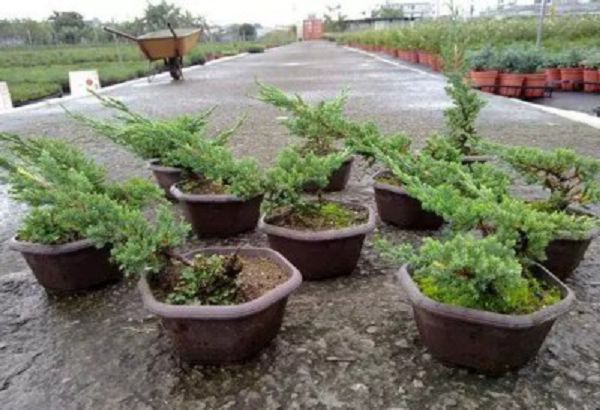
Chinese juniper (Juniperus chinensis), an evergreen tree, up to 20 m tall, 3.5 m in diameter at breast height, with a spire-shaped or conical crown, and a broad ovate form in old trees. Leaves are of 2 types: on young trees or on vigorous basal shoots they are mostly triangular-subulate, in whorls of 3, with a jointed base extending downward; on old trees they are mostly scale-like, opposite, closely appressed to the branchlets; there are also plants that remain entirely subulate-leaved from youth. Flowers are dioecious; male cones form in autumn and open the following year, yellow; female cones are small; the cone matures the following year, berry-like and indehiscent, covered with a white bloom.
Chinese juniper is widely distributed, from Inner Mongolia and Liaoning in the north, south to northern Guangxi and Guangdong, west to Sichuan and Tibet, and east to East China, and is cultivated throughout. Chinese juniper is light-demanding, slightly shade-tolerant, drought- and barren-tolerant, and can grow in acidic, neutral and calcareous soils; it is a common greening tree species on limestone mountains.
Watering: Chinese juniper is drought-tolerant, so watering should not be on the wet side; do not water unless dry, and follow the principle of watering when dry and letting it dry between waterings. During the plum rain season, take care that water does not accumulate in the pot; in high summer, water in the morning and evening, keeping the potting soil merely moist, and mist the foliage frequently to keep the leaves emerald green.
Fertilizing: Chinese juniper stump bonsai should not be fertilized heavily, lest excessive growth spoil the beauty of the tree shape. Each spring, from March to May, apply thin, well-rotted cake fertilizer water or organic fertilizer 2 to 3 times, and in autumn apply it 1 to 2 times, to keep the branches and leaves fresh green and dense and the growth robust.
Pruning: For a finished Chinese juniper bonsai, pinching is the main method; for vigorous shoots, pinch the tips and cut off the growing point to encourage side branches. During the period of vigorous growth, pay special attention to timely pinching and tip removal to keep the crown dense and the form attractive.
Repotting: Chinese juniper stump bonsai grows slowly, so it can be repotted once every 3 to 4 years, preferably in March to April in spring. When repotting, part of the old roots may be pruned away as appropriate, half of the old soil replaced, and fertile, loose potting soil added, to promote the growth and development of new roots. For tall, deep pots, take care to place a layer of coarse sand and broken tile pieces at the bottom to aid drainage.
Control of Chinese juniper rust disease:
1. Symptoms: Chinese juniper rust disease harms the needles and young twigs of Chinese juniper; at first there are yellow spots, which later swell and break through the epidermis to expose red-brown conical or cockscomb-like bodies, single or several joined together, which are the telial horns. After spring rain, they gelatinize on contact with water into orange-yellow flower-like gelatinous masses, and the teliospores are on the surface layer of these gelatinous masses.
2. Occurrence characteristics: The mycelium overwinters on Chinese juniper; the following spring it produces telial horns, which germinate on contact with rain and produce basidiospores that are spread by wind. In warm, rainy springs, the disease is severe.
3. Control methods: In winter, cut off the heavily diseased branches on Chinese juniper. In October to November, spray Chinese juniper with a mixture of 0.3% sodium pentachlorophenate and 1 degree Baume lime sulfur, which can prevent infection by rust spores. In mid-to-late March, before the teliospores germinate, spray 1 to 2 degrees Baume lime sulfur or an equal-amount formula 160 to 200 times Bordeaux mixture 2 to 3 times, once every 7 to 10 days.