What to Do About Rotten Leaves on Clivia? The Correct Way to Handle It
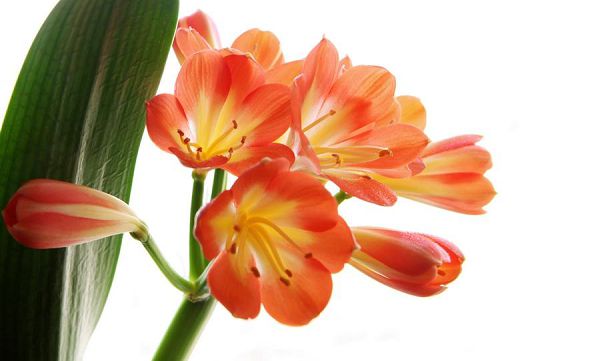
Morphological Characteristics of Clivia
The roots of Clivia are fleshy and fibrous, milky white, and very thick and sturdy. The root system is large and thick, with a distinctly fleshy feel. The persistent leaf bases at the base of the stem of Clivia expand and clasp each other to form a pseudobulb-like structure. The leaves emerge in two ranks from the shortened stem at the base, overlapping neatly, broad and strap-shaped, with rounded tips, firm and thick in texture, and glossy with visible veins. The basal leaves are thick, sword-shaped, leathery, dark green, glossy, strap-like, 30-50 cm long, up to 85 cm at the longest, 3-5 cm wide, tapering toward the base, arranged alternately, with entire margins.
The flower scape emerges from the leaf axil; if grown from seed, it generally blooms only after reaching 15 leaves. The flower stem is about 2 cm wide; the florets are stalked, arranged in an umbel at the top of the stem, funnel-shaped, upright, yellow or orange-yellow, or orange-red. The umbel is terminal, with upright flowers and several imbricate bracts; each inflorescence has 7-30 florets, sometimes more than 40. The perianth has 6 lobes, connate. Clivia nobilis has slightly nodding flowers with a narrowly funnel-shaped perianth. [2] The pedicel is 2.5-5 cm long; the flower is upright and upward-facing, with a broadly funnel-shaped perianth, bright red, slightly yellow on the inside; the perianth tube is about 5 mm long, the outer perianth lobes have a slightly raised tip, and the inner lobes are slightly concave at the tip and slightly longer than the stamens; the style is long and extends slightly beyond the perianth.
The berry is purplish red and broadly ovate. The full bloom period runs from New Year's Day to the Spring Festival, mainly in spring and summer; it can bloom year-round, sometimes also in winter, and sometimes in summer between June and July. The fruit ripens around October; it is a berry, purplish red. Both flowers and leaves are beautiful.
Causes of Rotten Leaves in Clivia
When Clivia develops rotten leaves, the plant may have become infected, which can easily lead to leaf rot. At this point, the leaves of the Clivia will show signs of disease, rotting from the base and gradually spreading; in severe cases, the entire leaf will rot away.
Second, a fairly likely cause is overwatering. When growing Clivia, we should know that it has fleshy roots with a relatively poor ability to absorb water; if watered too much, the potting soil becomes too wet, and leaf rot easily occurs. Note that if water accidentally gets into the leaf heart, or if the plant is exposed to rain for a long time, leaf rot is also very likely to occur.
When growing Clivia, we should prevent the occurrence of rotten leaves.
Watering should be moderate; generally, water along the edge of the pot, not onto the leaves, and do not use too much water when watering; control it appropriately so the soil does not become overly moist. In addition, during frequently rainy periods, take care to protect the plant from rain, so that the leaves of the Clivia are not soaked for a long time and do not rot.
In addition, if you find that a Clivia has rotten leaves, promptly cut off the rotten parts, sprinkle a disinfectant agent around the leaves to disinfect them, and then place it in a cool, well-ventilated spot for care.