Postpartum care for sows like this: low infection risk, fast recovery
A single case of "ASF" (African swine fever) upends the pig-farming landscape, and for the pig industry it is nothing if not turbulent; a saying from the father of modern management, Peter Drucker - "The greatest danger in times of turbulence is not the turbulence itself, but to act with yesterday's logic" - is worth savoring and pondering.
I. The harms of inadequate postpartum uterine care under the ASF backdrop
1. Incomplete expulsion of lochia (retention of amniotic fluid / afterbirth / blood clots / meconium, etc.), inducing endometritis,damaging the uterine mucosa (pathogen invasion risk ↑).
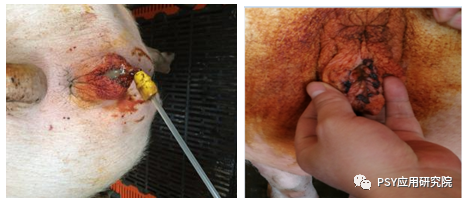
Pus discharge 5 days postpartum Dark pus discharge 8 days postpartum
2. Postpartum inflammation entering the bloodstream, inducing enteritis, pneumonia, etc.,damaging the intestinal mucosa and respiratory mucosa (pathogen invasion risk ↑).
Postpartum anorexia Body temperature 41°C Very poor body condition (poor disease resistance)
3. Postpartum inflammation entering the bloodstream, inducing mastitis,low milk yield and poor milk quality.
Hidden and unnoticed Diarrhea Weak (poor disease resistance)
4. Latent infection, massive after weaning/matingpus discharge。
Massive pus discharge in weaned/mated sows (inflammation - an accomplice of pathogens)
5. Unexplainedreturn to estrus。
Example: 100 sows ♀, wasting one estrous cycle
Feed cost loss: 13 X 21 X 100 =27300(¥)
Market opportunity loss: ((3000 X 20)/365) X 21 X 100 = 34.5ten thousand (¥)
6. A typical accomplice of rampant ASF.
• The two most favorable breeding grounds for ASF virus survival - meat products and blood!
• The first two barriers ASF must breach to invade - skin and mucosa!
• The biggest accomplice of ASF virus in killing pigs - the inflammatory storm!
II. The current state of inadequate postpartum uterine care under the ASF backdrop
1. Governing by doing nothing (impossible to prevent, so better not to prevent), the three-no policy (no cleaning, no disinfection, no care).
The only review: fanning the flames and aiding the villain, letting pathogen transmission proceed unimpeded!
2. Simple postpartum infusion.
Advantages: helpful for assisted farrowing, and incidentally anti-inflammatory
Drawbacks: antibacterial and anti-inflammatory effect is short-lived and incomplete, lochia is hard to clear, no effect on uterine damage, the danger alarm is not removed!
3. Oxytocin to expel foreign matter.
Advantages: helpful for assisted farrowing in older sows with weak uterine contractions, expels part of the foreign matter
Drawbacks: tetanic contraction, loss of colostrum, the sow becomes weaker, lochia is hard to clear, uterine damage worsens, the danger alarm is not removed!
4. Intrauterine pills / antibiotic uterine flushing.
Advantages: prevents infection
Drawbacks: of no benefit for incomplete lochia expulsion or uterine damage, drug residues form a drug film that affects conception, the danger alarm is not removed!
III. The overall approach to postpartum uterine care under the ASF backdrop
Grip the three dimensions of incomplete lochia expulsion, uterine damage, and pathogen infection, avoid impacts on the production performance of sows and piglets, and refuse to feed the arrogance of ASF!
1. Strengthen rhythmic uterine contractions, promote lochia expulsion, and avoid the development of inflammation.
2. Promote uterine repair, accelerate sow recovery, and restore disease resistance.
3. Select the most suitable antibiotics, for efficient antibacterial action and reduced inflammation.
1) As shown in the figure below, both G+ bacteria and G- bacteria are present, so the antibiotic must be broad-spectrum, highly effective, and preferably with low toxicity and side effects.
2) As shown in the table below, ceftiofur and cefquinome have broad antibacterial spectra, high efficacy, and minimal toxicity and side effects.
3) Under the ASF backdrop, following the comprehensive principles of less contact, fewer injections, less bleeding, and rapid control, ceftiofur hydrochloride is the first choice.
4) As shown in the figure below, even for the same ceftiofur hydrochloride, there are obvious differences in long-acting performance; under the ASF backdrop, the longer-acting the better.
4. Select the most suitable anti-inflammatory drug, clear inflammation, and restore the pig's safety.
After farrowing, sows inevitably have residual heat, pain, residual endotoxins, redness and swelling, inflammation, physical weakness and other symptoms; Houttuynia cordata (heartleaf houttuynia) has in recent years drawn widespread attention in the industry for its effects of clearing heat and detoxifying, and reducing inflammation and swelling, and is also very likely used on pig farms, with a fairly good reputation.
Summary: Overall approach to postpartum uterine care under the ASF backdrop
IV. Under the ASF backdrop, which sows need more care and attention?
In the following situations, give a share of care, and add a share of pure land:
★ Sows with a farrowing process ≥4 hours;
★ Sows that have been manually extracted;
★ Sows with ↓appetite and an upturned tail;
★ First-litter / three-way cross / original breeding stock;
★ Sows discharging large amounts of dark-colored pus postpartum;
★ Sows with malignant vulvar edema;
★ Sows whose piglets have a birth weight ≥1.8kg;
★ Sows with a litter size ≥15 piglets;
★ Sows whose piglets have diarrhea / poor coat / emaciation;
★ Sows that have aborted.
V. On-the-ground prevention and control plan for postpartum uterine care under the ASF backdrop
1. Local environmental disinfection (basic guarantee)
1) Entering the farrowing crate:
2) The day of farrowing -- 3 days postpartum:
3) Reduce unnecessary contact + disinfection, and strictly prevent cross-infection (pay special attention to blood and mucosa).
2. Dual two-in-one: (thorough uterine clearing + uterine repair) + (antibacterial + anti-inflammatory)
Step 1:Clean both hands with 0.1% potassium permanganate, wipe and wash the sow's rear quarters with a towel, and wipe the vulva clean with a paper towel;
Step 2:Make the sow stand, and by the artificial insemination method infuse into the uterus the expulsion-promoting and uterine-repair infusion liquid (Gongyanjing) 100ml/bottle + 20ml lincomycin, slowly over 3-5 minutes; after infusion, let the sow remain standing for 3 minutes;
Step 3:Intramuscular injection of long-acting ceftiofur hydrochloride and Houttuynia cordata (Yizhenkang) 10ml;
Step 4:After infusion, a large amount of lochia will flow out within 6-24 hours; if individual sows still discharge a relatively large amount of lochia or pus after two days, infuse another 50ml of Gongyanjing.
3. Pus discharge in late lactation + after weaning + after matingPrevention and treatment
Two types of sows to cull: gilts with pus discharge (the uterine wall is very thin), and those with severe pus discharge.
If the pus discharge is not severe, there is a certain cure rate:
Step 1:Intramuscular injection of 2 vials (4mg) of estradiol or 2 vials of PG600, clean the sow's rear quarters with 0.1% potassium permanganate, wipe the vulva clean with a paper towel, make the sow stand, and by the artificial insemination method infuse 1000ml of normal saline into the uterus, then wait 30 minutes;
Step 2:Intramuscular injection of 2 vials of oxytocin, wait 1 hour, and let basically all of the normal saline flow out;
Step 3:By the artificial insemination method infuse 200ml of Gongyanjing + 30ml lincomycin into the uterus, slowly over 3-5 minutes; after infusion, let the sow remain standing for 3 minutes;
Step 4:Intramuscular injection of long-acting ceftiofur hydrochloride and Houttuynia cordata (Yizhenkang) 10ml;
Step 5:Record and observe the follow-up situation; if pus discharge persists, cull directly.
(Note: if the pus discharge is in late lactation, first inject 2 vials of cloprostenol intramuscularly at the Houhai point, with a 24h interval, then proceed to Step 1)