Overall Planning and Design Scheme for a 200-Sow Breeding Pig Farm
Preface: During a period of high market prices, many pig-farming friends wrote in to ask how to build a large-scale pig farm. How should a farm with 200 sows be built? Is there a reasonable design scheme, and what is the breeding cycle? To address all these questions, we have put together this 200-sow planning scheme for everyone's reference and study. Next, let's take a look at how the planning is done!
I. Target Scale
To build a ten-thousand-head pig farm with an annual output (sales) of 4000 lean-type commercial pigs. At an average of 18 commercial pigs provided per producing sow per year, the whole farm requires a total ofbreeding pigsas follows:
1. Producing sows:
Annual stock of 220 producing sows, of which 10 are used for producing replacement gilts, and an annual stock of 50 replacement gilts (kept in two batches, with the sow herd renewed at a 25% culling rate); actual producing sows = 220 × 92% (about 8% of sows cannot produce) = 202.
2. Breeding boars:
Annual stock of 9 breeding boars (calculated at a boar-to-sow ratio of 1:25), and 2 replacement boars raised (or introduced from outside) each year.
3. Production cycle:
A total of 42 weeks from mating to market.
16 weeks gestation + 4 weeks lactation + 6 weeks nursery + 16 weeks fattening = 42 weeks
4. Reproductive cycle:
16 weeks gestation + 4 weeks lactation + 1 week mating + 2 weeks non-productive period = 23 weeks
52 weeks per year / 23 weeks = 2.27 litters/sow/year
5. Production standards:
202 × 2.27 litters/year = 458 litters/year, 9 litters/week
9 litters/week × 9 weaned pigs/litter × 97% = 79 weaned pigs/week
79 × 97% (3% nursery mortality) = 76 pigs leaving the nursery/week
76 × 98% (2% fattening mortality) = 75 pigs marketed/week
6. Herd maintenance standards:
The productive life of a sow is 5.5-5.75 litters, averaging 5.67 litters.
Average useful life = 5.67 litters / 2.27 litters/year = 2.5 years
Annual sow replacement number = 202 × 40% (annual replacement rate) = 80
Average useful life of a boar = 2 years
Annual boar replacement number = 9 × 50% (annual replacement rate) = 5
7. Feed utilization:
Based on an annual production of 4000 commercial pigs:
4000 × 100 kg × 3.5:1 feed-to-weight ratio = 1400 tons of feed/year
Of which sow feed:
202 × 365 days × 2.75 kg/day = 203 tons/year, about 1 ton/sow/year
Nursery pig feed: 79 nursery pigs/week × 52 weeks/year = 4108 pigs
4108 × 17 kg (25 kg-8 kg) × 2.0:1 feed-to-weight ratio = 140 tons/year
Feed for growing-fattening pigs:
4000 pigs/year × 75 kg (100-25 kg) × 3.5:1 feed-to-weight ratio = 1050 tons/year
Total feed consumption = 203 + 140 + 1050 = 1393 tons, equivalent to 6.6 tons/sow/year
8. Water consumption estimate:
Based on 20 liters of water per pig on hand per day (of which 50% for drinking, 50% for washing, etc.),
Equivalent to 200 liters of water per sow per day (counting 10 piglets), then:
202 sows × 200 liters/day = 40400 liters of water/day = 40 tons of water/day
The herd of 202 sows adopts a year-round balanced production model from farrowing to fattening, with 9 litters farrowed/week.
The pens and equipment for each pig group below are estimated on this basis.
II. Estimation of Pens and Equipment for Each Pig Group
1. Sow gestation stalls: 179, of which:
Gestating sow stalls: 108 (12 weeks × 9 litters/week, from 4-week pregnancy confirmation to 1 week before farrowing, totaling
12 weeks).
Culled sow stalls: 3 (1 sow/week × 3-week retention period)
Mating sow stalls: 68 (2 weeks from weaning to re-mating + 4 weeks pregnancy confirmation, 6 weeks / 80% farrowing rate × 9 litters/week).
2. Replacement gilt pens: 6 pens (12 weeks × 1.5 replacement gilts/week / 3 pigs/pen).
3. Sow mating pens: 2 (9 pigs/week / 80% farrowing rate = 11 sows mated/week, 2-3 matings per
sow, each pen used 2-3 times).
4. Boar stalls: 9 (9 boars).
5. Farrowing sow pens: 45 (4 weeks lactation + 1 week turnover = 5 weeks, 5 × 9 litters/week).
6. Nursery pig pens: 24 (6 weeks × 9 litters/week × 9 weaned pigs/litter = 486 pigs, 486 pigs / 20 pigs/pen).
7. Growing-fattening pig pens: 72 (16 weeks + 2 weeks turnover = 18 weeks, 18 weeks × 79 pigs/week = 1420 pigs, 20 pigs/pen).
8. Sick pig isolation pens and management rooms, etc.: several.
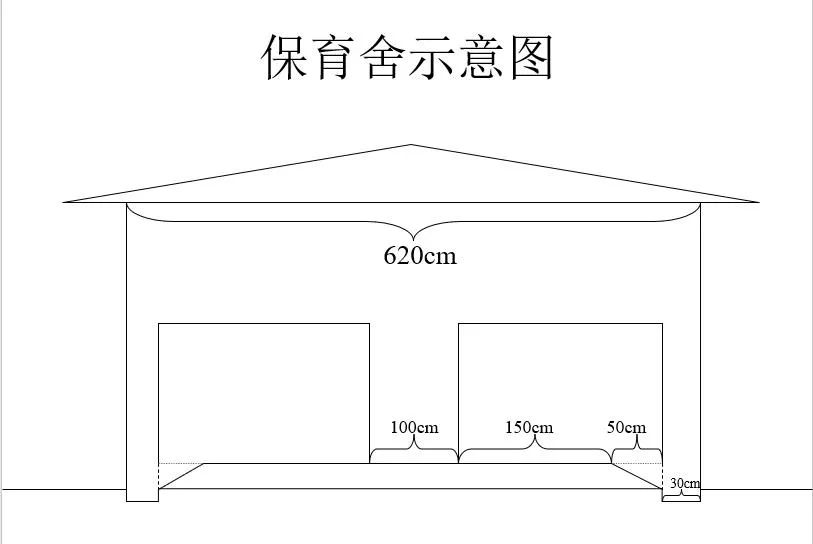
Schematic diagram of the nursery house
Floor plan of the nursery house
Floor plan of the fattening house
Floor plan of the open and gestating sow house
III. Pig Farm Building Area
1.Breeding pigherd area:
179 + 8 + 9 = 196Breeding pigherd pens
196 × 2.5 sq m/pen = 490 sq m
2. Farrowing pen area: 45 farrowing pens × 8 sq m = 360 sq m
3. Nursery pen area: 486 pigs × 0.35 sq m/pig = 170 sq m
4. Growing-fattening pig pen area: 1420 pigs × 1.0 sq m/pig = 1420 sq m
5. Management rooms, etc.: 4 rooms × 15 sq m = 60 sq m
Total building area of the pig farm: 2500 sq m.
Floor plan of the farrowing house
Schematic diagram of nursery pigs
Schematic diagram of the fattening house
IV. Civil Construction
1.Breeding pighouse: 2 buildings (of which: 1 for mating, 1 for gestation)
13 m × 19 m/building × 2 buildings = 494 sq m
2. Farrowing house: 1 building (2 rooms), each room 24 m × 8 m × 2 rooms = 384 sq m
3. Nursery house: 1 building (6 rooms), each room 14.25 m × 4 m × 3 rooms = 171 sq m
4. Growing-fattening pig house: 9 buildings, each building 71 m × 5 m × 4 buildings = 1420 sq m
5. Management rooms, etc.: 4 rooms × 15 sq m = 60 sq m
The above five items total a pig house area of 2530 sq m
V. Three Connections and One Leveling plus Infrastructure
1. Roads (cement roads): passages between the pig houses within the farm and connecting passages to the main roads outside the farm.
2. Water, electricity and telephone, etc.: laying water pipes, equipping transformers, distribution rooms, power and lighting lines, telephones, etc.
3. Perimeter walls: except where the farm borders a river and no enclosure is needed, all other sides require enclosure.
4. Landscaping: landscaping within the pig farm.
5. Other basic facilities: disinfection pools (3), gatehouse (including disinfection pool, changing room) and sewage treatment (ditches, etc.).
VI. Manure and Sewage Treatment
Build biogas digesters to solve the pollution problem.
VII. Land Acquisition
The land required for the pig farm is about 2.5-3 times the building area; considering part of the land for office facilities, a total of about 10-12 mu.
VIII. Investment Budget
(1) Civil construction
1. Pig houses: total area of 2530 sq m, calculated at 400 yuan/sq m, totaling 1.01 million yuan.
2. Equipment purchase and installation costs: 500,000 yuan
3. Three connections and one leveling plus basic facility costs:
Costs for roads, water, electricity, perimeter walls, landscaping within the pig farm and sewage treatment (ditches, etc.).
(2)Breeding pigIntroduction costs
1. Sows: (calculated as replacement pig introduction) 220 × 2800 yuan/pig = 616,000 yuan
2. Boars: 9 × 4000 yuan/pig = 36,000 yuan
(3) Other supporting investments
The supporting investments for the pig farm also include the purchase of transport vehicles, feed mill equipment, heating facilities, construction of biogas digesters and working capital, etc., none of which are budgeted here. Counting only the above two items, the total investment is 2.152 million yuan.
This plan should be implemented according to the actual on-site conditions and is for reference only!