What are the harms of raising pigs on concrete floors? Farmers need to be careful
The harms of raising pigs on concrete floors have been exposed!
First, let's look at the harms:
1. Easily causes diarrhea in pigs
Because during the construction of the pig farm, the ground was not very level, so a large amount of cement was used for leveling. The average thickness of the cement layer is 6--8 cm. Especially in winter, the concrete floor easily absorbs heat, and its heat dissipation is also very poor.
When cold weather comes, the concrete floor is very cold. Pigs themselves do not have much hair, and there are even fewer hairs on their bellies, so how can they keep warm?
Without underfloor heating, pigs are very likely to develop diarrhea because their bellies get cold, and the pigs will only huddle together and pile up on top of one another.
I remember when I raised pigs thirteen years ago, in winter we had to put a lot of fine soil, plant ash, crushed wheat straw and so on where the pigs slept to keep them warm,Prevention and treatmentof piglet diarrhea. At that time, there was no such thing as underfloor heating, and even people's living conditions were not that good.
Fortunately, with the progress of the times and the improvement of the economy, there is nothing you cannot imagine that no one can do. This kind of concrete floor mostly causes diarrhea in nursery pigs at the stage, while older pigs are somewhat better.
2. Easily leads to rough skin and hair in pigs, affecting their market appearance
Because the concrete floor is made of fine sand and cement, but the surface of the floor has a lot of fine sand. When pigs lie down, it easily bruises their skin and hair, and over and over again, the skin and hair become rough and messy.
3. Easily leads to limb and hoof disease in sows
Especially for sows in gestation crates, when the concrete floor is smooth, it easily causes sows to split and strain, and when the concrete floor is rough, it causes bruising of the joint skin, forming large scabs. It can also cause laminitis in the hind limbs of sows and lengthening of the nails, as well as bruising and hyperplasia of the digital pads, affecting sows' estrus and mating.
4. Easily causes Streptococcus and Haemophilus parasuis disease in finishing pigs and nursery pigs
Everyone can notice that on the front and hind limb joints of finishing pigs and nursery pigs in their own pig farms there will be swollen lumps of varying sizes. What are those? They are either Streptococcus or Haemophilus parasuis. Some people always say that I have already vaccinated against Streptococcus and Haemophilus parasuis.
The editor wants to say that these two diseases are both conditional and stress-related diseases, and the condition is caused by the concrete floor. Both piglets and finishing pigs are not very quiet, and it is very easy for them to wear down their foot pads when playing and fighting and become infected with pathogens, and the disease forms just like that.
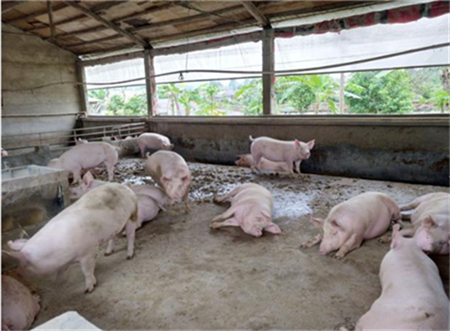
5. Easily leads to mineral deficiency in pigs and affects the absorption of nutrients
Since ancient times, pigs have liked soft ground and soil ground; this is innate. Now that the ground has become hard concrete floor, it will cause a disorder in the pigs' hormone regulation function and affect the metabolic absorption of nutrients.
Pigs also like to gnaw and lick the ground, and some trace elements and minerals are obtained from the ground. If it is a concrete floor, when pigs gnaw it they can only damage the gastrointestinal tract, whereas if it is a brick floor this will not happen.
What measures should be taken when raising pigs on concrete floors?
1. Measures for warmth and cooling
Because concrete has poor thermal conductivity, pig pens with concrete floors are often cold in winter and hot in summer! But pigs are warm-blooded animals. Letting pigs lie on concrete floors that are too hot or too cold may be bearable for large pigs, but not for newborn piglets! What is the best way to handle this?
When building concrete floors, try to make the pens for large pigs and sows slightly sloped, and make the floor of piglet pens flatter, so that the pig pens can stay dry!
In hot summer, keep sufficient drinking water and frequently sprinkle the floor! In cold winter, pig farmers in the north can use heated kang and underfloor heating as warmth methods. Friends in the south can just put a piece of wood in the pig pen for the pigs to sleep on!
In addition, build some small individual pens and hang heat lamps so that piglets can sleep inside them, reducing contact with the concrete floor! In fact, pig farmers can also properly use dry grass, straw, or worn clothes that they collect at ordinary times!
2. Anti-slip and anti-injury measures
Pig farmers all know that concrete floors are hard and slippery. Pigs walking on them will injure their limbs and hooves, or even slip and hurt their bodies!
What should be done?
When building large pig pens, try to apply as little cement as possible to prevent fattening pigs from slipping and injuring themselves because they are too heavy! When building sow pens, it is recommended that half be concrete floor and half be rammed earth or earthen bricks, which will greatly reduce hoof wear. If you are not afraid of trouble, using wooden boards is also fine! Of course, the best method is to let the pigs walk on the land outside the pens!
3. Pay attention to methods in feed formulation
In nature, animals all like to gnaw soil. Do pig farmers know why animals do this?
In fact, when animals gnaw soil, their purpose is to absorb minerals! On concrete floors, pigs often root against the pen or the concrete floor, and the reason is a lack of minerals, especially iron. If pigs cannot absorb it, it often causes anemia, and even emaciation and death!
Many pig farmers inject iron dextran intramuscularly in the first three days before piglets are born to supplement iron and prevent piglet anemia! For pig farmers who mix their own feed, it is recommended to use premix or multiple minerals and multiple vitamins, so that the pigs' nutrition will be comprehensive, and they will not fight or root against the concrete floor! Of course, if conditions permit, pig farmers had best use full-stage feed!