How Do Pigs Mate? Breeding Management Guide (Part 11)
How to Breed Pigs: Breeding Management Guide (Part 11)
Danish-bred pigs are world-famous for their high productivity, but due to challenges in pig farm construction, feeding management and many other aspects, the production performance of Danish-bred pigs in China has failed to reach expectations, yet Danish-bredbreeding pigsare still becoming increasingly favored in China's pig industry. Pig Translation House has specially compiled a series of Danish breeding-related materials, and is currently reposting the Danish "Breeding Management Manual" produced by the Danish Pig Research Centre, jointly launched by Xirou Technology together with Yinglian Feed and Huayangbreeding pigs. Please stay tuned.
Editor's Note
Breeding is the start of a new round of production, and breeding quality directly affects a series of key KPIs such as conception rate, farrowing rate, litter size and weaning number. Therefore, proper management of the breeding house helps improve and maintain high and stable productivity of sows. This manual explains in detail various techniques for heat detection and breeding under different production models, and many chapters are richly illustrated and can be used directly as SOPs.
20. Handling of Return-to-Estrus Sows
HANDLING OF RETURNERS
20.1
Return-to-estrus sows are unavoidable, but proper handling can minimize non-productive days
Returners Can Not Be Avoided, But With Correct Handling Non-productive Days Can Be Minimized
Estrus detection should begin on day 18 after breeding.
Heat control should be performed from 18 days after mating.
Use an ultrasound scanner to perform pregnancy diagnosis on day 24 after breeding.
Pregnancy control can be performed from day 24 with a 2-dimensional scanner.
Place empty sows next to gilts.
Empty sows are placed near the gilts.
Sows that have returned to estrus should be transferred in time to the group expected to farrow in the same week.
Sows that has returned, move on to the week group they should farrow with.
Sows that return to estrus more than once are usually culled.
Sows that return more than once should generally beculled.
Cull return-to-estrus sows that have produced more than 5 litters.
Sows older than 5 litters that returns should be culled.
Those irregular return-to-estrus sows usually do not follow the 3-week estrous cycle.
Irregular returners are returners that do not fifit with the normal 3-week cycle.
Return-to-estrus sows are unavoidable.
Returners can not be avoided.
Return to estrus in sows increases working hours and causes restlessness in the pens.
Returners is time consuming and provide turbulence in the pen.
20.2
Too many return-to-estrus sows reduces the number of piglets produced per sow per year
Many Returners Costs Pig Per Sow Per Year
Lack of estrus and pregnancy diagnosis leads to an increase in non-productive days caused by return-to-estrus sows.
Lack of oestrus- and pregnancy control leads to many non-production days because of returners.
6-7 non-productive days will reduce the number of piglets produced per sow per year by 1.
6-7 non-production days extra “costs” 1 pig per sow per year.
Return to estrus in sows increases working hours due to multiple pen transfers and extra observation of empty sows.
Returners are time consuming due to multiple displacements and increased observation of empty sows.
Too many return-to-estrus sows makes management of group size (weekly) difficult.
Many returners make it diffiffifficult to manage the group size.
20.3
Supplementary Notes: Handling of Return-to-Estrus Sows
Additional Comments: Handling Of Returners
If a sow is not conceived at first breeding and is in a normal estrous cycle, she will come into estrus again 18-24 days later. By actively performing estrus detection on bred sows, potential return-to-estrus sows can be identified at the earliest opportunity.
If the fifirst mating has not resulted in a pregnancy and the sow is in normal cycle, she will be in heat again 18-24 days later. By active heat control among the mated sows you will be able to catch potential returners the fifirst time they come in heat.
If scanning shows a sow is empty, transfer her to the breeding house, where short-term flushing, more attention to estrus detection and better contact with the boar can be carried out better than in the gestation house.
If you fifind the sow empty by scanning, it is moved to the mating unit where there will be a better chance of flflushing, more focus on heat control and better boar contact than in the gestation unit.
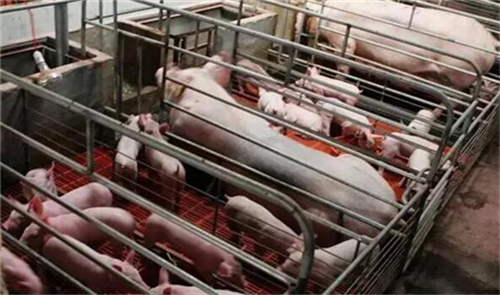
Place empty sows next to gilts and ensure estrus detection is performed twice a day. This makes it easier to notice whether the sow is in estrus.
By collecting the empty sows near gilts you ensure that they are where you will be making heat control twice a day. This ensures that you are more aware of when the sows come into heat.
Transfer return-to-estrus sows to the group that will farrow in the same week; this makes subsequent pregnancy diagnosis, vaccination and other work easier.
It gives the best view in the unit if you always move the returners so they are housed with the week group they will farrow with. This will ease all future work with pregnancy control, vaccination, etc.
Experience shows that the farrowing rate of return-to-estrus sows is lower than that of other sows in the group. If a sow returns to estrus repeatedly, the probability of pregnancy drops greatly with the number of returns. If the group's farrowing rate is below 82% and the number of sows in a certain week drops, this is very likely because there are sows that have returned to estrus twice or more.
Experiences shows that the farrowing rate of returners is lower than other sows in the herd. If asow returns repeatedly, the propability of pregnancy will be strongly decreasing with the numbers ofreturnings. If the farrowing rate in the herd is under 82 % and if there is a lack of sows in the weekly group, it may be appropriate to let a sow return two or more times.
Experience shows that sows that have produced more than 5 litters have a very low farrowing rate if they return to estrus.
Experience shows that sows with more than 5 litters have a very low farrowing rate on returning.
Irregular return to estrus means that, compared with the first recorded estrus/breeding time, the estrous cycle does not follow 3 weeks.
Irregular returners, which are returners that do not have a 3-week cycle, in relation to the fifirst recorded oestrus/ mating will occur.
Irregular return to estrus may be because:
Irregular returners may be because:
The sow was not yet in estrus at the first breeding. ⟦37 The registered breeding time was incorrect.
The sow was not in heat at the fifirst mating.
The recorded mating time is incorrect.
The date of mating is not registered properly.
The sow had a period of silent estrus (due to stress, too little feed, shorter days, too weak light in the house, bad climate and toxins in the feed).
The sow has been a cyclical (“stalled”) for a period (stress, too little feed, decreasing day length, tooweak light strength in the unit, bad climate, and toxins in the feed).
The sow has or had cysts (possibly caused by toxins, but this is not the only cause).
The sows have or have had cysts. (Can occur as a result of toxins, but it is not always a reason isfound).
The sow was pregnant but then aborted (lost or poorly developed). ⟦41 21. Observation and Registration of Gilts' First Estrus
The sow was pregnant but lost the pregnancy (dropped or back formed fetuses).
21. Observation and recording of the first estrus in replacement gilts
HEAT OBSERVATION AND REGISTRATION OF FIRST HEAT IN GILTS
21.1
Optimal Estrus Observation
Optimal Heat Observation
Gilts usually show their first estrus at 6-7 months of age.
Gilts normally get their fifirst heat in 6-7 months of age.
After gilts reach 6 months of age, daily contact with a boar can begin.
From the gilts are 6 months old, they can be introduced to the boar daily.
Perform estrus detection once a day using the "5 key points" of estrus detection.
Heat control is performed after the 5-point plan once a day.
When a gilt's first estrus is detected, mark her.
The gilts are marked when the fifirst heat is observed.
After a sow's first estrus, she will develop a stable estrous cycle of 18-24 days.
Gilts that have had their fifirst heat will be cyclic with an 18-24 day interval.
Gilts that fail to come into estrus together with the other sows in the group need new estrus stimulation.
Gilts that are not coming to heat with the rest of the group are exposed to new stimuli.
Gilts should have comfortable space, sufficient light and contact with a boar in the breeding house.
The mating unit must have good space, plenty of light and boar contact to the gilts.
Pens that are too crowded make estrus observation and registration difficult.
Cramped conditions make it diffiffifficult to observe and record heat.
21.2
Gilts not coming into estrus may be because
Lack Of Heat In Gilts May Be Due To
Estrus was suppressed by stress, such as pens being too crowded, hierarchy competition or competition for feed.
The heat is suppressed due to negative stress eg lack of space, rank matches or fifight over feed.
Poor body condition and stunted development.
Poor body condition and failure to thrive.
Lack of contact with a boar.
Lack of boar contact.
The smell of ammonia in the house suppresses the gilt's sense of smell.
Ammonia smell in the unit inhibits the gilts smell.
The gilt's signs of estrus are not obvious and were not noticed by the staff because estrus detection was not done properly.
The gilt shows weak heat signs and the heat is not detected by the staffff because the heat control isinadequate.
Insufficient light.
Lack of light.
The following can make estrus detection in gilts difficult
Heat control in gilts can be diffiffifficult if
Gilts are scattered in different locations in the house.
The gilts are in difffferent places in the housing system.
Gilts are kept in very large groups.
The gilts go in large incalculable groups.
21.3 Supplementary Notes: Observation and Registration of Gilts' First Estrus
Additional Comments: Heat Observation And Registration Of First Heat In Gilts
Besides age, the timing of first estrus also depends on breed, body condition, contact with a boar and changes in the gilt's surrounding environment. ⟦63 Contact with a boar requires the gilt and the boar to be in the same pen. To achieve the best effect of contact with a boar, contact should be twice a day for 10-15 minutes each time.
Besides age the time of fifirst heat depends of race, body condition, boar contact and changes in the gilts surroundings.
Contact with the boar requires the replacement gilt and the boar to be in the same pen. To achieve the best effect of contact with the boar, contact twice a day is needed, lasting 10-15 minutes each time.
Boar contact should be done by gilts and boar being in the same pen. For optimal effffect of boar contact it is recommended twice a day of 10-15 minutes duration.
The boar must be sexually mature and preferably over 10 months of age.
The boar must be sexually mature, preferably over 10 months old.
Estrus detection should first be carried out by observing externally visible signs of estrus, such as swelling and reddening of the vulva, increased curiosity, and possibly mounting other sows.
Heat control is performed by fifirst and foremost to look after the visible exterior heat signs which are
swollen and red labia, increased curiosity from the gilt and possible mount on other animals.
Not all sows show obvious signs of estrus (the older the gilt, the less obvious the signs of estrus), so it is important for the inseminator to actively perform estrus detection. When the inseminator performs estrus detection, they should imitate the key stimulation points of a boar's contact with the gilt.
Not all animals show visible heat signs (the older the gilts get, the weaker the heat signs are) so it isimportant that the inseminator performs an active heat control. When the inseminator performs heatcontrol it is done by imitating the boars touch of the gilts stimulation points.
The gilt must show the standing reflex to confirm first estrus. The standing reflex can be achieved by the inseminator performing the "5 key points" of estrus detection or by using a boar.
The gilt must show standing heat to detect the fifirst heat. The standing heat is triggered either via the 5 point plan executed by the inseminator or by using the boar.
Overall, during estrus, a lot of work is usually required to make the gilt show the standing reflex.
First and last during the heat, you usually work more with the gilt to get it to show standing heat.
When a gilt's first estrus is observed, it is important to mark her. Use 3 different colors and change the color each week; this helps to observe which gilts need attention each week. When first estrus is observed, you may also choose to give the gilt a sow number. Marking gilts is for the convenience of short-term flushing (short-term flushing must be carried out 7-14 days before the planned breeding date).
It is a great advantage to mark the gilt when the fifirst heat is observed. Use 3 difffferent colors and change the color of each week. It helps to visualize the gilts you should be focusing on each week. You can also choose to give the gilt a sow number when fifirst heat is observed. Marking of gilts is a tool to fifind out when to flflush them. (Flushing must be done 7-14 days before expected mating).
Record the gilt number and week number on a board or card, so that even if the color mark on the sow disappears, it can still be judged from the records.
Write down the gilt number and week number on a board or card, so you have something to relate to if the color marks disappear.
Breeding at the second estrus or later results in a higher litter size than breeding at the first estrus.
Mating of the gilt in the second heat or later increases the litter size in relation to mating in the fifirst heat.
When a gilt's estrus becomes regular, the timing of estrus is fixed, and the estrus interval is 18-24 days.
When the gilts are cyclical, the time of heat cannot be moved. Cyclic gilts come into heat within an interval of 18-24 days.
If you try to induce estrus by injecting gilts with hormones, there is a risk of cyst formation, and the timing of estrus will not change.
If you try to provoke a heat by injecting the gilt with hormones, you risk the formation of cysts and it does not move the time of heat.
Using hormones on gilts is not recommended.
Use of hormones for gilts is not recommended.
Gilts that fail to come into estrus together with the other gilts in the pen or that have not come into estrus by 7.5 months of age need new stimulation, such as mixing with other sows, pen transfer, and contact with different boars.
Gilts that do not come into heat together with the other pen mates or later than 7.5 months is exposed to new stimuli/ positive stress. It can be done by mixing with other animals, moving between the units and/or boar contact with difffferent boars.
Gilts over 10-11 months of age that are in comfortable pens but have still not shown obvious estrus should be culled. There will always be some sows that do not come into estrus. If the proportion of non-estrus sows exceeds 5%, more thought needs to be given to the feeding conditions.
Gilts that have had optimal conditions in the mating unit, but have not shown a clear heat latest at 10-11 months of age are culled. There will always be a certain number of animals that never comes into heat. If this number exceeds 5 % you should explore the conditions more.