What medicine for swollen legs in piglets? Ceftiofur combined with this doubles the effect
Swollen joints in nursery piglets is currently one of the most common clinical symptoms on pig farms. At present, the main infectious diseases causing swollen joints in piglets are Haemophilus parasuis disease (hereafter referred to as HPS), Streptococcus suis disease (hereafter referred to as strep) and swine erysipelas, among which Haemophilus parasuis disease and Streptococcus suis disease are the more common.
Although both can cause swollen joints in the herd, Haemophilus parasuis is a Gram-negative bacillus, while Streptococcus is a Gram-positive coccus, and their sensitive antibiotics are very different. Therefore, how to differentially diagnose these two diseases and select specific drugs is the key to diagnosing and treating the disease:
Judging from the symptoms of joint swelling
Although both Streptococcus and Haemophilus parasuis can cause swollen joints in piglets, a simple distinction can also be made from the appearance of the swelling.
1. HPS may cause swelling of the entire limb and hoof, while strep is mainly reflected in swelling of the joints.
2. The fluid in HPS swelling is a serous protein exudate; on palpation the body temperature does not rise, and pinching with the hand causes severe pain. The fluid in strep swelling is pus, and shows a change from hard in the early stage to soft later, with a rise in temperature.
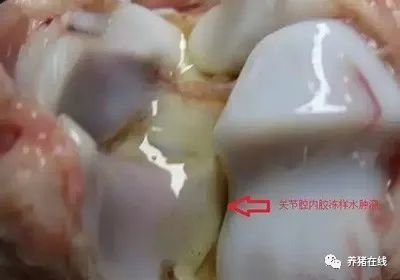
3. On dissection of the swollen joint, HPS is mostly found to have a jelly-like secretion, while strep has a purulent secretion, and sometimes yellowish-white cheese-like lumps can be found.
Post-mortem body surface symptoms
In deaths caused by HPS, there is generally no color change on the pig's body surface. In deaths caused by strep, the body surface is blue-purple, especially severe on the neck, lower jaw, abdomen and extremities of the limbs.
HPS has a typical shaggy heart, that is, the surface of the heart is covered with a large amount of fibrinous exudate, and the pleural and abdominal effusions increase; in severe cases the entire abdominal cavity is wrapped in yellowish-white fibrinous exudate.
Strep causes splenic enlargement and congestion, with less fibrinous exudate in the abdominal cavity; generally, with careful searching, yellowish-white cheese-like lumps can be found. Yellowish-white cheese-like lumps are present in the joint cavity.
Haemophilus parasuis disease:
1. Use sensitive antibiotics, such as: ceftiofur sodium, enrofloxacin, amikacin, gentamicin and other sensitive drugs, combined with Houttuynia cordata injection;
2. Use furosemide to reduce fibrinous exudation and relieve symptoms.
1. Use sensitive antibiotics such as amoxicillin, ceftiofur sodium, lincomycin, sulfonamides, etc. Combined with Houttuynia cordata injection;
2. Combined with anti-inflammatory drugs: flunixin meglumine, aspirin, etc.
Likewise, if the incidence of arthritis in piglets is relatively high, the corresponding powder can be selected and mixed into the feed at weaning; generally, using it continuously for 7-10 days after weaning can achieve a good preventive effect.
Houttuynia cordata injection:
When used as medicine, Houttuynia cordata has the effects of clearing heat and detoxifying, dispersing abscesses and expelling pus, and promoting diuresis to treat strangury. When used in diseases of swollen joints in piglets, the effect of dispersing abscesses and expelling pus can promote the reabsorption of fibrinous or purulent exudate in the joint cavity, and the effect of promoting diuresis to treat strangury is similar to furosemide and anti-inflammatory drugs, reducing the exudation of fibrinous and purulent secretions, thereby effectively relieving symptoms. Together with the important effect of clearing heat and detoxifying, in clinical practice, using ceftiofur combined with Houttuynia cordata for piglets with swollen joints can produce a goodtreatmenteffect.