When does Vanilla planifolia bloom? Introduction to the blooming months of Vanilla planifolia
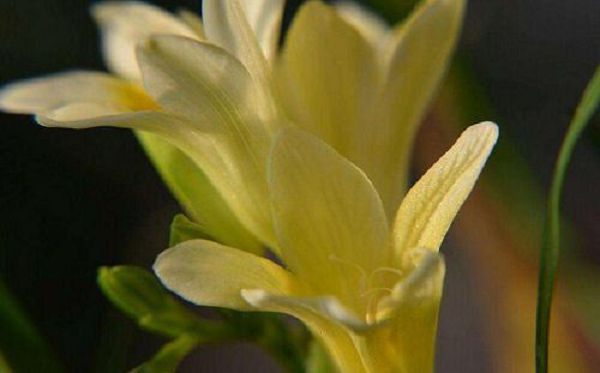
The stem of Vanilla planifolia is about 1 cm long. The leaves are alternate in two rows, sickle-shaped, leathery, with an obtuse or acute apex and a slightly twisted base. The raceme is 2-4 cm long and bears 1-4 flowers; the flowers are yellowish-white, spreading, and thick in texture; the sepals are similar, more or less obovate. The petals are obliquely elliptic, equal in length to the sepals but narrower, with an obtuse apex and a narrowed base; the lip is 1.2-1.4 cm long and 8.5-10 mm wide, with no spur and no sac at the base, constricted in the middle with the lateral edges of the rear half slightly raised; the front half is larger, nearly circular. So when does Vanilla planifolia bloom? In which month is the blooming period of Vanilla planifolia?
According to experienced Vanilla planifolia growers, the blooming period of Vanilla planifolia is from July to November.
Origin and habitat
Found only in Taiwan, China (Taitung and other places). It grows in broad-leaved forests at an altitude of 500-1500 m.
Growth habits
Orchids generally grow on mountain slopes and valley walls in deep mountains and secluded valleys, on sloping hillsides or in rock crevices with good water permeability and water retention, beside sparse mountain grasses, and in the shade of secondary mixed woods. Or in places with shade, short sunshine duration, or only scattered light filtering through. In places with high air humidity and good air circulation, they sometimes also grow on cliffs beside mountain streams. Orchids are best planted in an environment with air circulation. They are shade-loving and averse to direct sunlight, fond of moisture and averse to dryness, and grow best at 15°C to 30°C. Growth is poor above 35°C. Severe cold below 5°C will affect their growth vigor, and at this time the orchids are often in a dormant state. If the temperature is too high and combined with exposure to the sun, leaf scorch or withering will appear within one or two days. If the temperature is too low and they are not moved indoors in time, frost damage will occur. Orchids have fleshy roots and are suitable for sandy loam rich in humus, and the drainage performance must be good. Leaf mold or mountain soil with more humus should be selected. Slightly acidic loose soil or iron-containing soil is suitable, with a pH value of 5.5-6.5.
Propagation method
It can be done in both spring and autumn, generally dividing the clump once every three years. Any plant that grows robustly and has dense pseudobulbs can be divided, and after division each clump must retain at least 5 pseudobulbs connected together. Before division, watering should be reduced so that the potting soil is somewhat dry. When potting after division, first cover the drainage hole at the bottom of the pot with broken tiles, then spread coarse gravel to occupy 1/5 to 1/4 of the pot depth, then add coarse-grained soil and a small amount of fine soil, and then plant with sandy loam rich in humus. The planting depth should be such that the pseudobulbs are just buried in the soil, leaving a 2 cm rim at the edge of the pot, spread Selaginella uncinata or fine gravel on top, and finally water thoroughly, place in a shady place for 10-15 days, keep the soil moist, gradually reduce watering, and carry out normal care.