Several issues that must be noted during artificial insemination of sows!
Artificial insemination on pig farmstechnologyis now quite mature in application, and whether on large-scale farms or among small and medium-sized backyard producers, some are using it, but doing artificial insemination well still requires a certain amount oftechnical skill, especially when it comes to the details of estrus detection in sows and the understanding of artificial insemination. Now let's talk about these precautions and misconceptions, hoping they will be helpful to pig-farming friends.
I. Issues to note when checking sows for estrus
1. Checking sows for estrus is generally done half an hour after feeding and before dark (for ease of observation).
2. When checking for estrus, make sure the boar and sow have nose-to-nose contact. When checking by pressing on the back, a sow in estrus will respond within 5 minutes; those that do not respond need to be rechecked for estrus after 12-24 hours.
3. Use an old boar with strong libido for estrus checking. If checking for estrus inside the pen, be sure to use a wooden board or similar aid, and let the boar move in front of several sows. Contact time needs to be 5-10 minutes.
4. When the boar contacts the sow, the inspector should observe the sow's behavior and performance from behind the sow's pen and record it on the spot.
5. When using the back-pressing method to determine standing estrus, limit it to 3-4 sows per group. If the sows are moved, it is best to give them 5 minutes to settle down.
6. One third of the inseminator's total working time should be devoted to estrus detection in sows.
7. Carry out estrus detection twice a day, once in the morning and once in the afternoon, using a combination of manual estrus checking and boar teasing.
II. Several misconceptions about artificial insemination in sows
1. Natural mating gives a higher conception rate and larger litter size than artificial insemination
If semen quality is good and the insemination time and volume are appropriate, the conception rate and litter size per farrowing will not be low, but try to avoid mistakes in the management and operational details of artificial insemination.
2. Artificial insemination easily causes sows to produce weak piglets and develop uterine inflammation
Before both artificial insemination and natural mating, the sow's vulva and other areas should be disinfected, first wiping with clean gauze dipped in 0.1% potassium permanganate solution, then wiping clean with disinfectant wipes. Never wipe inside the vagina unless the inside of the vagina has been contaminated.
The insemination catheter should also be cleaned and disinfected. If disinfection is strict, in fact the incidence of uterine inflammation in sows under artificial insemination is lower than under natural mating.
3. Temperature misconception
Semen taken from a 17°C semen storage box does not need to be warmed to 37°C; after shaking evenly it can be used directly for insemination; but when checking semen motility, the slide should be preheated to 37°C, so that the check is accurate.
In addition, during storage of semen in an incubator, to prevent sperm from settling and clumping and dying, it should be inverted or gently shaken once at regular intervals (about every 12 hours). After taking the semen out of the incubator, it should be inseminated into the sow in good time, no longer than 2 hours.
4. The more inseminations the better, and the larger the artificial insemination volume the better
In fact, too many inseminations increase the chance of reproductive tract infection in sows, and a large artificial insemination volume not only wastes semen but also increases costs.
The number of inseminations should be appropriate; after an interval of 8-12 hours, insemination can be done once more; each insemination volume is about 40 milliliters, and both the number of inseminations and the insemination volume depend on the sow breed.
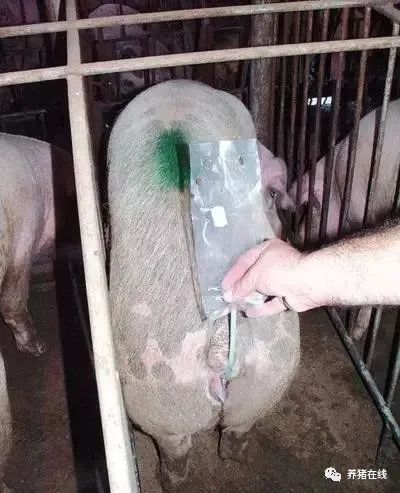
5. Pull out the insemination catheter immediately after the semen is fully delivered
After the semen is fully delivered, prevent the sow from lying down immediately, which would cause the semen to flow back; continue stimulating the sow for about 5 minutes by massaging the sow's udder or pressing the sow's back or stroking the sow's vulva;
After the semen is fully delivered, the insemination catheter should remain in the reproductive tract; it is better to fold the rear part of the catheter, tie it with string, and let the catheter slowly slip out naturally. Do not disturb the sow's rest within a few hours after insemination, to avoid stress.
6. Performing artificial insemination immediately after the sow is fed
After the sow is fed, she is unwilling to move and her libido is reduced, making it harder to conceive, which can lead to return to estrus. Also, after artificial insemination, it is best not to feed or water the sow immediately.