Why do orchids bought online need to have their hollow roots and dried-out roots cut off?
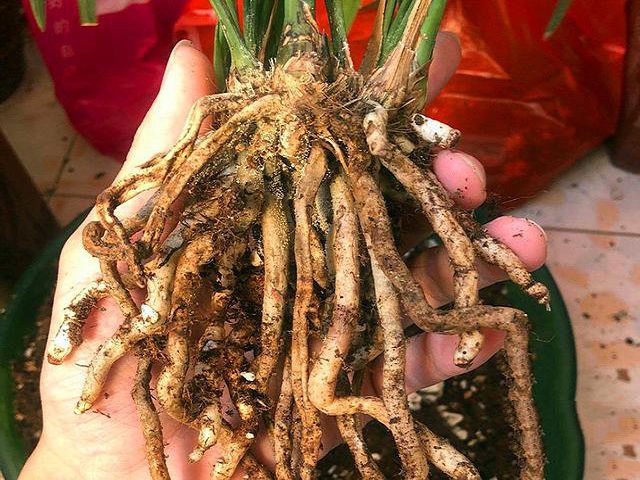
Not only do the hollow roots need to be cut off, but dried-out roots and roots showing signs of rot also need to be cut off. These useless roots will plant hidden dangers for the orchid's future care. In serious cases, they may cause the orchid to die.
Why do orchids bought online need to have their hollow roots, as well as dried-out roots and roots showing signs of rot, cut off?
1. Hollow roots are a fairly common phenomenon in orchids, mostly caused by improper care, with a portion dying from natural aging. Orchid hollow roots generally retain their epidermis and root core, and these epidermis and root core have already lost their basic absorption function. Keeping them on the base of the plant is basically meaningless. The only tiny bit of use is that they can help anchor the plant when planting the orchid, but this tiny bit of anchoring effect is far outweighed by the harm it brings to the planting medium and the orchid plant, which is the second point to be discussed below;
2. Hollow roots, as well as dried-out roots and roots showing signs of rot, in the medium not only fail to absorb any water or nutrients, but will instead continue to rot in the medium. During the rotting process of these roots, large amounts of bacteria and microorganisms are produced, and these bacteria and microorganisms may also invade the orchid's healthy roots, pseudobulbs, leaves and other parts. During the continued rotting of these roots, they may also continue to spread, even spreading to the entire orchid plant, ultimately causing the whole orchid plant to die;
The previous section explained why orchids bought online need to have their hollow roots, as well as dried-out roots and roots showing signs of rot, cut off. So what other treatments do orchids bought online need?
1. Disinfect the plant. For orchids bought online, in addition to pruning hollow roots, as well as dried-out roots and roots showing signs of rot, the whole orchid plant should also undergo some simple disinfection treatment, to kill the various harmful pathogens carried by the orchid plant. The method is also simple and easy to carry out: you can choose to use a plant disinfectant to soak the whole plant. Generally, fungicides such as carbendazim or chlorothalonil can be chosen, mixed into a solution according to the ratio on the instructions, usually at a concentration of 0.1%, and a soaking time of about half an hour is sufficient.
2. Stimulate with rooting solution. Plant rooting agents from reputable manufacturers mostly have fairly obvious effects. Orchids bought online can have their roots soaked in some rooting agent to stimulate the orchid's cell tissues, so that after planting they can root and adapt to the pot as quickly as possible. The soaking time of the orchid roots in the rooting agent should not be too long, usually not exceeding half an hour. This needs to be strictly carried out according to the instructions for the rooting agent. If the soaking time is too short, it will not be effective; if too long, it may damage the orchid's cell tissues;
3. After the orchid bought online has had its roots pruned, been disinfected, and been soaked in rooting agent, the plant should be left to dry its roots for a short time. The purpose is to dry the wounds on the roots and avoid bacterial infection. The treated orchid plant can be placed in a cool, ventilated place and left to dry for about a day. The wounds caused by pruning the roots will basically air-dry, and then the orchid can be planted.
Issues to note when planting orchids bought online and after planting
1. Choice of planting medium. The planting medium for orchids is quite important. Orchids have fleshy root systems and have relatively high requirements for the drainage and air permeability of the medium, while also having relatively high requirements for the medium's water retention. Therefore, the planting medium for orchids must achieve a balance among four qualities: water retention, drainage, air permeability, and nutrition. The medium for planting orchids needs to be mixed from multiple media to achieve a better effect. For example, leaf mold, pine bark, and river sand can be mixed at a ratio of 4:4:2 (for reference only); flower enthusiasts can choose and adjust appropriately according to actual conditions;
2. Watering thoroughly after planting. After the orchid has been planted, the initial rooting water must be poured thoroughly several times, to make the medium fit tightly against the orchid's roots as much as possible. When the orchid's roots fit tightly against the medium, the absorption area increases, speeding up the orchid's adaptation to the pot as much as possible;
3. Requirements for the orchid's care environment. Orchids prefer bright, diffused light and a growing environment with relatively high air humidity. In winter and early spring, orchids can receive direct sunlight; at other times, direct sunlight should be avoided. When growing orchids at home, a relatively humid growing environment needs to be created for them. The plant and its surroundings can be misted frequently to increase air humidity, especially in summer and in indoor spaces with heating in winter, where misting to increase humidity is an indispensable operation;
4. Water and fertilizer management for orchids. Orchids like moisture but fear waterlogging, and the choice of planting medium plays a key role. A medium with good drainage will not produce waterlogging after watering. In daily care of orchids, the medium should be kept moist but not waterlogged, and watered when dry and allowed to dry between waterings. In all four seasons, the medium can be kept until it dries out and then watered thoroughly in time; each watering can be repeated several times to ensure the medium is thoroughly watered. Orchids do not like heavy fertilizer. When fertilizing orchids, it is best to apply an organic fertilizer solution. Once a month, a mixed fertilizer solution of multiple organic fertilizers can be applied, such as fermented and fully rotted chicken manure, sheep manure, cake fertilizer, bone meal, etc., mixed into a low-concentration fertilizer solution for watering; both the concentration and frequency need to be on the low side. Stop fertilizing in winter and summer.
Summary: Orchids bought online need their hollow roots cut off, mainly because these hollow roots are meaningless and will continue to rot in the medium, causing adverse effects on the orchid medium and the orchid plant. After pruning the orchid's roots, the whole orchid should undergo a simple disinfection treatment before it can be planted and cared for.