How to Breed Pigs, Breeding Management Guide (Serial 9)
Foreword
Foreword
Danish-bred pigs are renowned worldwide for their high productivity, but due to challenges in pig farm construction, feeding management and many other aspects, the production performance of Danish-bred pigs in China has not reached expectations. However, Danish-bredbreeding pigsare still becoming increasingly favored in China's pig industry. Pig Translation Hub has specially collected and compiled a series of Danish breeding-related materials, and is currently reprinting the Danish "Breeding Management Manual" produced by the Danish Pig Research Centre, jointly launched by Xirou Technology together with Yinglian Feed and Huayangbreeding pigs. Please stay tuned.
Editor's Note
Breeding is the start of a new round of production. Breeding quality directly affects a series of key KPIs such as conception rate, farrowing rate, litter size and weaning numbers. Therefore, proper management of the breeding barn helps improve and maintain high and stable productivity of sows. This manual explains in detail various techniques for heat detection and breeding under different production models, and many chapters are richly illustrated and can be used directly as SOPs.
16. Body Condition
Body Condition
16.1
16.1 Pregnant sows are mainly fed according to body condition
Pregnant Sows Should Be Fed Primarily By Body Condition
Sows transferred to the gestation barn 4 weeks after breeding are fed according to the normal feeding curve.
By inserting in the gestation unit 4 weeks after mating, the group is placed on the normal feed curve.
If a weaker group of pigs is grouped with intermediate body condition as the standard, sows should be fed according to curves A and B respectively.
If the weakly group is split down the middle the sows are fed after curve A and B.
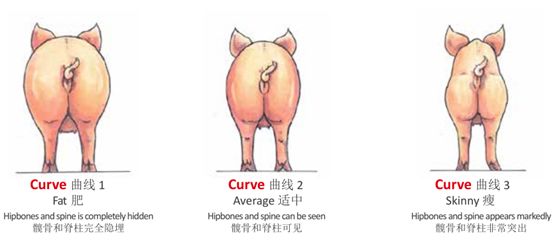
Sows that are too fat or too thin should be fed individually according to curve 1 or 3.
Different sows should be fed individually according to curve 1 or 3.
Curve 1: Fat sows
Curve 1: Fat sows
Curve A: Large-framed sows
Curve A: Big sows
Curve 2: Sows of moderate body condition
Curve 2: Average sows
Curve B: Small-framed sows
Curve B: Small sows
Curve 3: Thin sows
Curve 3: Skinny sows
Curve 4: Gilts
Curve 4: Gilts
Sows in poor body condition should be moved to spare pens.
Sows that come in poor body condition are moved to the spare unit.
Fat sows are more likely to have problems during farrowing and therefore require more assistance at farrowing. They also have more leg problems, resulting in a higher culling rate.
Fat sows are more likely to get farrowing problems and thus greater need for farrowing assistance.Furthermore, they have more leg fractures and thus higher mortality.
In winter, due to lower temperatures, the feeding curve should generally be raised.
In winter season the curves are regulated upwards due to the lower temperature.
1. Fat sows in the farrowing house eat less than sows of normal body condition, resulting in lower weaned piglet weights.
Fat sows eat less in the farrowing unit than sows in normal body condition. This gives small pigs at weaning.
2. Sows that are too fat or too thin consume more total feed than sows with stable body condition. (about 100 feed units per litter)
Sows which vary in body condition, have greater total feed consumption than sows with stable body condition (approx. 100 FU/litter)
3. Thin sows have a higher probability of shoulder injuries, leg problems and return to estrus.
Skinny sows have greater risk of shoulder wounds, leg problems and returning.
16.2
16.2 Supplementary Notes: Body Condition
Additional Comments: Body Condition
If parous sows and gilts are transferred to the gestation barn immediately after breeding, these pens should be locked during the first 4 weeks (except in the UK). This allows sows to be fed individually, ensuring that sows reach a consistent body condition before group housing 4 weeks after breeding. Experiments show that feeding 3.8 feed units per day during the first 4 weeks after breeding has a positive effect on the litter size of thinner sows, but a negative effect on gilts. The energy imbalance in sows caused by weight loss during lactation can lead to abortion. Sows only finish growing after their 4th litter, so young sows need to be given extra feed.
If the sows and gilts are placed in the gestation unit just after mating, the boxes are locked in the first 4 weeks (except UK). This makes it possible to feed the animals individually, thus ensuring a uniform body condition when the animals are loosened 4 weeks after mating. Experiments have shown a positive effect on the litter size with skinny sows at a high feed strength 3,8 FU per day in the first 4 weeks after mating. In gilts, there is a negative impact of high feed strength in these 4 weeks. A possible weight loss from the farrowing unit should urgently be obtained since sows in negative energy balance may abort. The sows are only fully grown after 4th litter, so therefore young sows should receive extra feed.
Not all sows have the same feed conversion rate. Especially very thin sows in the farrowing house, even if given extra feed, find it difficult to recover to the same body condition. Therefore, the body condition of sows should be checked, and the feed amount for thin and fat sows adjusted. Feeding curve A applies to sows slightly above moderate body condition. Feeding curve B applies to young and thin sows. Good body condition management is key to feed intake, because for every 1 kg increase in sow body weight, more feed needs to be consumed.
Not all sows have the same feed conversion. Especially sows that are very emaciated from the farrowing unit, can be difficult to obtain in the same body condition again, even if they are given extra feed. Therefore should the sows’ body condition be checked and skinny and fat sows feed quantity should be regulated. Feed curve A meets sows, which is slightly above average. Feed curve B meets young and skinny sows. Good body condition management is critical for the feed consumption, since sows have a high feed consumption per kg weight gain.
Sows that are too fat or too thin should be fed individually according to curve 1 or 3.
Different sows should be fed individually according to curve 1 or 3.
Most of the fetus's weight is gained in the last few weeks of gestation. Therefore, the feeding amount should be increased to 3.5-4.0 feed units per day during this period, but this does not apply to fat sows.
Fetus have by far the largest growth in the last weeks of gestation. Therefore, the feed strength should be increased in this period from 3,5 to 4,0 FU per day, however not for fat sows.
When feeding liquid feed to the herd, it is best to feed twice a day, because the ratio of dry to wet feed in the feed is at least 1:4, and sows cannot adapt to such a large feeding amount. Most importantly, all feed valves should preferably be able to open and drop feed in sequence immediately. If this cannot be done, sows will compete to eat in the pens that drop feed first, which causes unnecessary restlessness in the barn. When feeding dry feed to the herd, it is recommended to feed once a day and provide some straw daily.
In herds with liquid feeding, it is advantageous to feed the sows twice a day as sows physically can not accommodate the large feed quantities when the ratio between dry:wet is 1:4 or more. It is important for the pens function that all valves in the pen feed immediately after each other. Failing this, the sows will compete to get into the boxes that are fed first, which creates unnecessary anxiety in the pen. In herds with dry feed one daily feed is recommended, when there is assigned straw daily.
Temperature has a great influence on sow feed intake. Thin sows have a thinner fat layer than fat sows and therefore need more feed to produce heat.
Temperature has great influence on the sows feeding needs. Furthermore, skinny sows have a thinner layer of fat than fat sows and therefore has a bigger need for feed to produce heat.
Temperature drop requires additional feed to supplement pig feed units:
Extra feed by decreasing temperature Fuso:
17. Pregnancy Diagnosis
Pregnancy Test
17.1
17.1 Daily Estrus Detection
Daily Heat Control
1. Check all pens daily for sows in estrus.
Every day, you check for sows in heat in all units.
2. When the sows are quiet, workers put their hands in their pockets and walk around the pens (disturbing the sows as little as possible) to observe the sows.
Go for a round in the units with your hands in your pockets and observe the animals, when they have calmed down.
3. Restless sows may be in estrus.
Sows that are restless could be in heat.
4. If one sow mounts another sow, she may be in proestrus. Mark that sow, then perform estrus detection over the next 3 days.
If a sow mounts another sow, it could be in pre heat. Mark the sow and check her for heat the next 3 days.
5. The sow being mounted may be in estrus.
A sow being mounted could be in heat.
6. Carry out the "5 key points" of estrus detection and complete the back-pressure test. If she remains still, she is in estrus and can be inseminated.
Complete the 5-point-plan and finish with the riding test. If the sow stands still when you sit on her, she is in heat and can be inseminated.
7. Move sows in estrus to the breeding barn so that the gestation barn can remain quiet.
Move sows in heat to the mating unit, so there will be peace in the gestation unit.
In addition to daily estrus detection, there are 3 key points in estrus detection and pregnancy diagnosis, and each is reflected in daily work.
In addition to daily heat control, there are three elements in the control of oestrus and pregnancy. Everyone should be a part of the routines.
Using boar exposure for estrus stimulation can detect sows in estrus earlier. (See 18 - ScanningTechnique)
Control with the boar may reveal sows in early oestrus. (See 18 – Scanning technique )
Pregnancy diagnosis (scanning) can be performed on day 24, and suspect sows can be scanned again within a week.
Pregnancy control (scanning) can be performed from day 24 and doubtable sows are scanned again within a week.
Vaccination about 3 weeks before farrowing allows visual assessment of whether a sow is pregnant.
At vaccination approx. 3 weeks before farrowing, it is assessed visually if the sows are pregnant.
Back-pressure test
Riding test
A sow with swollen vulva, next to a sow with a normal vulva
Sow with swollen labia next to a sow with normal labia。
17.2
17.2 Improper or absent estrus and pregnancy diagnosis leads to
Inadequate Or No Oestrus- And Pregnancy Control Leads To
1. Return-to-estrus sows and empty sows are not identified. This causes the group size to fluctuate continuously.
Returners and empty sows are not being identified. They create turbulence in the group with slipping and returning to come.
2. The number of litters per sow per year and the number of weaned piglets per year decrease. Empty sows cause an increase in non-productive days.
Fewer litters and thus fewer weaners per sow per year.
3. The cost of each non-productive day is 20 Danish kroner.
Empty sows give non-productive days. One non-productive day costs 20 Danish krones.
Mounting
Mounting
17.3
17.3 Supplementary Notes: Pregnancy Diagnosis
Additional Comments: Pregnancy Test
Daily estrus detection allows timely identification of return-to-estrus sows. 30-50% of return-to-estrus sows are detected within 3 weeks after breeding, and the rest (50-70%) are detected at other times. Therefore, daily estrus detection is important.
By implementing a daily heat check you detect RETURNERS in time. 30-50 % of the returners are detected 3 weeks after their mating day, the rest (50-70 %) are found in the interim period. Therefore, heat check is necessary every day.
Signs of estrus:
Oestrus signs are:
1. The sow allows other sows or a boar to mount her.
The sow let other sows and the boar mount her.
2. The sow follows the workers.
The sow follows the manager around the pen.
3. The sow is unusually active.
The sow is hyperactive.
4. The sow seeks out the boar.
The sow seeks the boar.
5. The sow appears on the list of sows that have not eaten at the electronic sow feeder.
The sow may act on the remnant list of ESF.
6. The sow's vulva is swollen.
The sow has swollen labia.
7. The sow makes "grunting" sounds.
The sow “buzz”
Boars can help detect sows in estrus, but boars cannot detect all sows in estrus.
The boar can be a help to find the oestrus sows, but the boar doesn’t discover all the oestrus sows.
1. There is a phenomenon of "love at first sight" between boars and sows.
Both the sow and boar have preferences (“love at first sight”).
2. Young and low-ranking sows show less obvious signs of estrus.
Young and low ranking sows do not dare to show oestrus.
Boars can serve as a quick tool for detecting empty sows, but with uncertainty.
The boar should be regarded as a tool to find empty sows quickly. The boar is not a certainty.
Many empty sows are not cyclic, so they cannot be detected through heat checking and can only be found by scanning.
Many empty sows are not in cycle. Therefore, one can not find them by heat check. They can only be found by scanning.
Scanning does not necessarily have to be performed after day 24 of breeding, but if scanned too early, the result is uncertain because it is difficult to observe embryos on the screen at that time. If scanning confirms a sow is empty, she should be moved to the breeding barn immediately.
Scanning can not with certainty be made from day 24 after mating. If the scan is done too early, the results is uncertain since the embryos are difficult to see on the scanner screen. If the sow scanned empty she is immediately moved to the mating unit.
If there is doubt about the scanning result, make a clear mark on the sow and record the sow's pen and number. An accurate result should be obtained at the next scan.
If you have doubt about the outcome the sow is clearly marked and number and section is noted. At the next scan there should be achieved a safe outcome.
If a sow is found to be empty or still uncertain at the second scan, transfer her to the breeding barn.
If the sow empty at the second scan, or you are unsure, the sow is moved to the mating unit.
For all sows whose pregnancy cannot be confirmed, scan again within a week. Empty sows should be moved to the breeding barn immediately, which makes the sow's estrus more pronounced.
All sows where there is doubt about pregnancy, is scanned again within a week. Empty sows are immediately moved to the mating unit, which often triggers a more pronounced heat.
See 18 - ScanningTechnique
See 18 – Scanning technique
While scanning sows, assess their body condition at the same time, and adjust the feeding curve in time if needed.
While scanning the sows are assessed on body condition and the feed curve is adjusted if necessary.
When vaccinating (day 90 of gestation), it is possible to assess whether a sow is pregnant. If in doubt, scan immediately.
By vaccination (day 90), it is estimated if the sows are pregnant. By doubt they are scanned.