How many times is it most appropriate to inseminate a three-way cross sow when breeding?
Due to the influence of breed characteristics, three-way cross sows used for breeding face the problem of relatively low litter size. Some farmers are very concerned about whether increasing the number of breeding inseminations can improve the reproductive performance of three-way cross sows?
Below, the author analyzes the effects of the number of breeding inseminations on sow conception rate and farrowing rate, and subsequently on the average total piglets born per litter and average healthy piglets born per litter, combined with production practice, in order to give farmers some insight.
1. Effects of the number of breeding inseminations on sow conception rate and farrowing rate
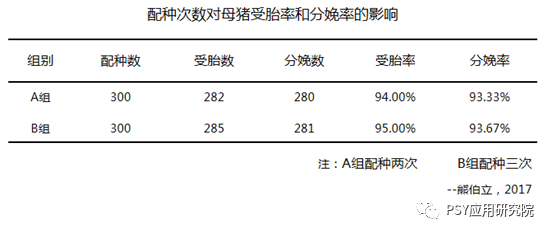
Xiong Boli (2017), in a study on the effects of the number of breeding times on sow reproductive performance, found that the conception rate differed by 1.00% and the farrowing rate by 0.34% between breeding twice and breeding three times, with neither difference being significant. This suggests that breeding twice or three times will not have a major effect on sow conception rate and farrowing rate.
In addition, Lin Zhaojing et al. (2017), in a study on the effects of the number of inseminations on sow pregnancy, found that the difference between inseminating once and inseminating twice was significant, and the difference between inseminating once and inseminating three times was likewise significant, while the difference between inseminating twice and inseminating three times was not significant. This suggests that inseminating once will significantly reduce sow conception rate.Combined with production practice, there are many factors affecting sow conception rate and farrowing rate, but as far as the number of breeding inseminations is concerned, inseminating twice is more appropriate.
2. Effects of the number of breeding inseminations on average total piglets born per litter and average healthy piglets born per litter
Xiong Boli (2017), in a study on the effects of the number of breeding times on sow reproductive performance, found that the average total piglets born per litter for breeding twice was slightly lower than for breeding three times, while the average healthy piglets born per litter for breeding twice was slightly higher than for breeding three times, and the differences in average total piglets born per litter and average healthy piglets born per litter between the two groups were both not significant. This suggests that breeding twice or three times will not have a major effect on the average total piglets born per litter and average healthy piglets born per litter of sows.
In addition, Liu Wenmin et al. (2017), in a study on the effects of twice-inseminationtechnologyon sow reproductive efficiency, found that the effects of inseminating twice and inseminating three times on sow farrowing performance were also not significant.Combined with production practice, there are also many factors affecting the average total piglets born per litter and average healthy piglets born per litter, but as far as the number of breeding inseminations is concerned, its effect on them is not great.
Summary
The same is true for three-way cross sows. It can be seen that the effects of the number of breeding inseminations on sow reproductive performance are all not significantly different, but in the post-African swine fever era, using twice-inseminationtechnologycan effectively reduce the frequency of contact between personnel and sows, which is of great significance for the prevention and control of African swine fever.