How to Mate Pigs: A Breeding Management Guide (Part 10)
Foreword
Foreword
Danish pigs are renowned worldwide for their high productivity, but due to challenges in pig farm construction, feeding management and many other aspects, the production performance of Danish pigs in China has not reached expectations. However, Danishbreeding pigsare still increasingly favored in China's pig industry. Pig Translation House has specially collected and compiled a series of Danish-related materials, and is currently reprinting the Danish "Breeding Management Manual" produced by the Danish Pig Research Centre, jointly launched by Xi Rou Technology together with Yinglian Feed and Huayangbreeding pigs. Please stay tuned.
Editor's Note
Mating is the start of a new round of production. The quality of mating directly affects a series of key KPIs such as conception rate, farrowing rate, litter size and weaning number. Therefore, proper management of the breeding barn helps improve and maintain high and stable productivity in sows. This manual explains in detail various techniques for heat detection and mating under different production models, and many of its chapters are richly illustrated and can be used directly as SOPs.
18. Scanning Pregnancy CheckTechnique
SCANNING TECHNIQUE
18.1
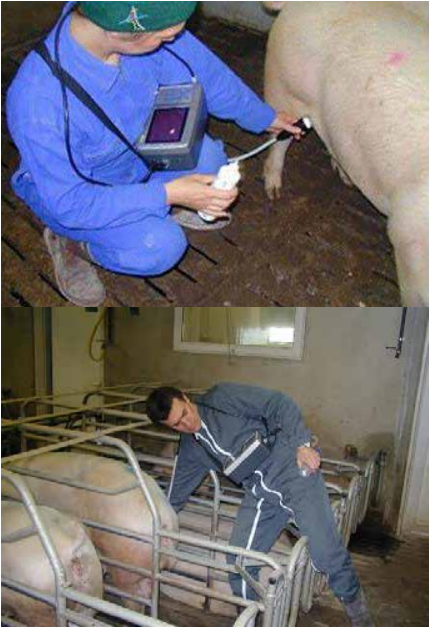
18.1 Good, regular pregnancy testing is a scanning
Good And Systematic Pregnancy Control Is Done By Scanning
All sows are scanned on day 24.All sows are scanned at day 24.
Remember to scan the sows in the sick pen.
Remember to scanne sows in the hospital pen.
Workers should be careful not to let their arms, hands, knees and toes be crushed by the sows in the pen.
Be aware that your arms, hands, knees and toes don’t get squeezed in the inventory if the sows are in boxes.
Apply coupling gel to the scanner's probe and place it on the groin area.
The scanner head is applied gel and is placed in the groin.
Move the probe slowly until a clear image of the embryos appears.
lowly move the scanner head around until there is a clear picture of the fetus.
If the image is unclear, apply more coupling gel.
If the image is blurred, apply more gel.
At least 3 distinct embryonic sacs must be found before pregnancy can be determined.
Only the discovery of at least 3 distinct fetal bladders is a sure sign of pregnancy.
If unsure about the scan result, mark the sow and scan again within one week.
If you are unsure of the diagnosis, then mark the sow, and scan again within a week.
Mark a "minus sign" on the back of empty sows and move them back to the breeding barn.
Empty sows are marked with a minus sign on the back and are moved back to the mating unit.
If the farrowing rate is below 85%, another scan is needed at week 6 of gestation.
If the farrowing rate is below 85 % it is recommended to scan a second time in 6th week of gestation.
18.2
Errors
Errors
The most common errors during scanning:
The most common error when scanning is:
An empty sow is scanned as a pregnant sow
An empty sow is being scanned pregnant.
Dark spots are mistaken for embryos because of rushing.
Hurry, where a dark smudge is assessed as a fetus.
If one side of the sow is obscured by a bladder full of urine, scan the other side.
A fifilled urine bladder covers the embryos – try the other side.
Confusing cysts with embryos.
Cysts can be confused with embryoss.
A pregnant sow is scanned as an empty sow
A pregnant sow is scanned empty.
There are few embryos, and only one side of the sow was scanned once.
A sow with few embryos with only one scanning on one side.
The sow was scanned less than 24 days after mating.
A sow, which is mated less than 24 days before the scan.
18.3
Supplementary notes: ScanningTechnique
Additional Comments: Scanning Technique
An empty sow with cysts. This sow will never become pregnant.
Scan of empty sow with cysts. This sow will never be pregnant.
A sow with a cyst on an accessory ovary. This sow can become pregnant.
Scanning of sow with one paraovarian cyst. This sow could get pregnant.
Scanning a sow on day 24 after mating, the large embryonic sacs can be seen easily.
Scans day 24. Large embryos bladders which are easy to see.
Ultrasound image at position 1.
Ultrasound image position 1.
Ultrasound image at position 2.
Ultrasound image position 2.
Ultrasound image at position 3.
ltrasound image position 3.
Ultrasound image at position 4.
Ultrasound image position 4
Ultrasound image at position 5.
Ultrasound image position 5
19. Using a Boar for Pregnancy Testing
USING THE BOAR FOR PREGNANCY CONTROL
19.1
19.1 In the gestation barn, the boar's task is to perform heat detection
In The Gestation Unit The Boars Job Is To Make Heat Control
Heat detection can be carried out through the following points:
Heat control can be achieved by:
Let the boar walk along the observation aisle in the gestation barn. Sows in heat will approach the boar.
The boar walks around on the inspection path in the gestation unit. The sows that are in heat, will seek out for the boar.
When putting the boar into the sow group, pay attention and observe.
The boar is in the group under observation.
Install a monitor in the boar pen; this can detect whether sows come into contact with the boar and how often.
The boar is housed in an enclosure with a boar detector which detects if the sow visits the boar andhow often.
The boar must be moved to a different pen once a week so that it stays fresh.
Boars must change pen every week to maintain their novelty value.
The boar must be fed correctly.
The boar must be fed properly.
A good boar has the following requirements:
For a good boar there are following requirements:
The boar must be active and have a strong libido.
He must be active and virile.
The boar must be sociable and friendly.
He must be sociable.
The boar must have a good physique.
He must have a good constitution.
The boar must not be too large, otherwise it will scare the smaller sows.
He must not be too big, so he scares the small sows.
The boar must be vaccinated correctly.
He must be vaccinated proberly.
Remember, no matter what method is used, the boar can only find those sows that show obvious signs of heat.
Remember, whatever methods, the boar can only fifind the sows that show oestrus.
The boar's effect will be poor if
The boar has little effffect if.
the boar is always kept together with the sows.
The boar always goes together with the sows.
the boar is too aggressive and keeps chasing certain specific sows in the barn.
The boar is too violent and chases certain sows in the pen.
the boar's temperament is unpredictable.
The boar is unpredictable.
the boar is listless.
The boar is lethargic.
A good boar in a pen with good conditions.
Nice boar with good housing conditions.
The boar shows interest in the sows.
Boar seeks sow.
An active boar.
An active boar.
A lazy boar.
An indolent boar.
19.2
Supplementary notes: Using a boar for pregnancy testing
Additional Comments: Using The Boar For Pregnancy Control
When the boar walks in the gestation barn, carefully observe the sows' behavior. Sows that show interest in the boar and show signs of heat should be marked and moved to the breeding barn.
When the boar is taken around the gestation unit, the sows’ behavior should be observed carefully. Sows showing interest in the boar and shows signs of oestru, is marked and moved to the mating unit.
It is not recommended to keep the boar and pregnant sows in the same pen. The boar is unlikely to complete mating with all the sows returning to heat, nor can it make all the sows returning to heat show obvious signs of heat. Identification therefore becomes difficult.
It is not recommended to house the boar in the pen with the pregnant sows. The boar will not necessarily mate all the returners and inspection will not detect all the returners. The control will therefore become diffiffifficult.
If the boar is placed in a pen with a monitor, that pen has specific requirements. The boar must be able to see other sows. Make sure the boar does not get cold, so the pen must have bedding, or even a heat-insulating cover installed. Sows going to contact the boar will be automatically recorded by electronic equipment, but there is no guarantee that all sows in heat will contact that boar.
If the boar is housed in a boar detector pen there are certain requirements for the pen layout. The boar should be able to see other animals. It should be ensured that the boar does not freeze. Therefore, the pen must be properly bedded maybe with a cover. Sows that seek out the boar are recorded electronically. There is no guarantee that all oestrus sows will contact the boar.
The boar must be moved to a different place once a week so that it stays fresh. The boar must mate with a sow every 14 days; this ensures it will not lose its libido.
The boar must change place weekly, so he preserves =novelty effffect. The boar should every 14 day be allowed to mate a sow so he does not loose interest.
The boar is fed according to the table below:A boar is fed according to the following instructions:
Before the boar comes into contact with sows, it needs to be vaccinated with the same basic vaccines as gilts (porcine parvovirus, swine erysipelas virus, etc.). Then it must be vaccinated about 2-2.5 times a year, the same as parity sows.
Before the boar comes in contact with the sows, he should have received the basic vaccines like the gilts. (PPV, erysipelas, etc.) Then he should be vaccinated as sows – approx. 2-2,5 times annualy.