When does the Southern magnolia bloom? Introduction to its flowering months
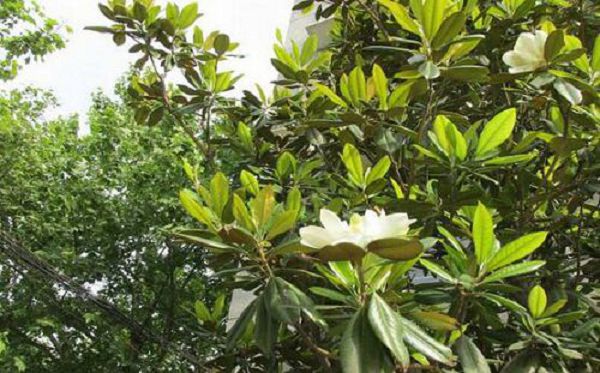
The Southern magnolia, also known as the bull bay and the lotus magnolia, is a plant of the Magnoliaceae family and the Magnolia genus. It is native to the Americas, North America, and the Yangtze River basin and areas south of it in mainland China. In the north, such as Beijing and Lanzhou, it has been introduced and cultivated. It is used for ornamental purposes, and its flowers contain aromatic oil. So when does the Southern magnolia bloom? What month is the flowering season of the Southern magnolia?
According to experienced Southern magnolia growers, the flowering season of the Southern magnolia is from May to July, the seed coat is red, and the fruit ripens from September to October.
Growing environment
The Southern magnolia likes light when growing, but is slightly shade-tolerant when young. It likes a warm and humid climate and has a certain degree of cold resistance. It is suitable for growing in dry, fertile, moist, well-drained slightly acidic or neutral soil. When planted in alkaline soil, it is prone to yellowing, and it dislikes waterlogging and poor drainage. It has relatively strong resistance to smoke, dust, and sulfur dioxide gas, and has few pests and diseases. Its root system is deep and extensive, and its wind resistance is strong. In particular, seed-grown saplings have straight trunks, a majestic tree form, and strong adaptability.
Growth characteristics: The Southern magnolia belongs to the Magnoliaceae family and the Magnolia genus. It is an evergreen tree with leathery leaves, rusty-colored tomentum on the underside, a glossy surface, and slightly recurved margins. The leaves are 10-20 cm long. Another variety is called the narrow-leaved Southern magnolia, whose leaves are narrower and longer, with less hair on the underside and slightly stronger cold resistance. The flowers are large, white or pale yellow, with a delicate fragrance, 20-30 cm in diameter, usually with 6 petals, as large as lotus flowers. The flowering season is from May to July, the seed coat is red, and the fruit ripens from September to October. Usually the Southern magnolia can grow to 30 m, but the common magnolia can only grow to 16-23 m. The crown is ovate-conical, and the twigs and buds all have rusty-colored tomentum. The branches are majestic and magnificent. The Southern magnolia has a beautiful tree form and large, fragrant flowers. It is an excellent environmentally friendly courtyard tree and is suitable for greening factories and mines, and it is closely related to human survival.
Distribution range
The Southern magnolia is native to the southeastern United States. It is distributed in North America and in the Yangtze River basin and areas south of it in mainland China. In the north, such as Beijing and Lanzhou, it has been introduced and cultivated by humans. It is the city tree of Changzhou, Nantong, Zhenjiang, and Lianyungang in Jiangsu Province, Hefei and Lu'an in Anhui Province, and Yuyao in Zhejiang Province. It is also relatively common in Shanghai, Nanjing, Zhenjiang, and Hangzhou in the Yangtze River basin.
Ornamental value
The leaves are thick and glossy, the flowers are large and fragrant, and the tree form is majestic and magnificent, making it one of the precious tree species. After its aggregate fruit matures, the follicles split open to reveal bright red seeds, which is also quite beautiful. It is best planted singly on a broad, open lawn or arranged into ornamental groves. Because its crown is huge and the flowers bloom at the top of the branches, it should not be planted in a narrow courtyard when arranging, otherwise its ornamental effect cannot be fully brought into play. The flowers are large and fragrant, and it can be planted as a solitary specimen, in opposite pairs, in clumps, or in groups, and can also be used as a street tree.
Road greening: The Southern magnolia is evergreen all year round and has few pests and diseases, so it is an excellent street tree species. It can not only provide necessary shade for pedestrians in summer, but also beautify the street scene very well. However, when planting, larger seedlings should be selected as much as possible, with a trunk diameter of 3-6 cm and a height of about 2.8 m being more suitable. If too small, they are easily damaged; if too large, the transplant survival rate is low. In road greening, planting the Southern magnolia together with colorful-leaf tree species can produce a striking color contrast, thereby making the street scene's colors more vivid and rich. In green belt applications, interplanting the Southern magnolia with purple-leaf plum and pairing it with osmanthus, Pittosporum tobira balls, and so on not only creates a sense of layering in space, but also brings great variation in color, breaking the monotony of the sequential space, producing a harmonious sense of rhythm, and achieving very good results.
The Southern magnolia can be used in courtyards, parks, amusement parks, and cemeteries. Large trees can be planted singly in lawns or in rows on both sides of pathways; medium and small ones can be planted in groups on flower terraces. At places such as Beijing Dajue Temple, the Summer Palace, and Biyun Temple, it is planted among ancient buildings. It is especially harmonious with Western-style architecture, so it is more suitable for Western-style courtyards.