How much land and how much investment are needed to build a pig farm producing 5000 pigs per year?
Because of rising prices, pork has become a meat that people say they cannot afford to eat. Many friends report that the meat tastes better in their mouths too. Many friends have also seen the opportunity in the pig farming industry and have asked me what conditions and equipment are needed to build a pig farm, and how to go about it. Today, using 5000 pigs as the baseline, I will explain in detail all the specific issues involved in building a pig farm.
Basis and principles for the pig farm
(1) It is characterized by modern intensive pig production, and production is designed and organized according to factory-style assembly-line processes.
(2)Breeding pigsThe selection must be lean-type improvedbreeding pigsor the optimal combination of cultivated lean-type maternal-linebreeding pigs, to give full play to the production potential of thebreeding pigs.
(3) When intensive pig farming implements the process flow, corresponding scientific management procedures and feeding systems must also be drawn up.
(4) The nutrition of the feed used on the pig farm must be standardized, and according to the pigs' physiological stages, full-price feeds such as gestation feed, lactating sow feed,suckling piglet feed, growing pig feed and finishing pig feed must be formulated.
(5) The pig farm must establish and formulate strict epidemic prevention and health care systems and measures to ensure the safe production of the pig herd.
(6) The pig farm must be equipped with managerial personnel who understand the business and skilledtechnicalworkers.
(7) Pig farm production should adhere to the ecological industry policy of taking one industry as the main focus while operating in diversified ways.
(8) The manure and urine excreted by the pig farm must be treated by biological fermentation, protecting the environment as much as possible and preventing pollution.
Maintechnicalindicators and parameters
Technical parameters for the pig farm's pen and building constructiontechnicalparameters: producing 5000 commercial pigs per year requires 20 mu of land, with a pig building construction area of 2548 square meters, an office, dormitory, disinfection andtreatmentroom area of 240 square meters in total, and a small feed processing room and warehouse of about 300 square meters, for a total construction area of 3088 square meters.
Pig pen design parameters:
- The number of pig pens (cages) and the area of a single cage for a 5000-head commercial pig farm are shown in (Table 1).
- Breeding pigproduction indicators and production performance requirements are shown in (Table 2).
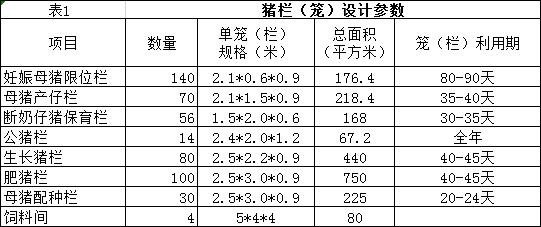
Table 1, Pig pen (cage) design parameters
Table 2, Production indicators and production performance for 5000 commercial pigs
Requirements for cage and housing facilities
(1) Sow gestation crates, boar pens and sow farrowing crates are made of stainless steel pipe material, nursery cages are made of No. 8 steel, and other pens for growing pigs, finishing pigs and sow mating can be built with brick, wood and cement structures. All kinds of cages and housing are best custom-made at a machinery manufacturing plant to ensure quality.
(2) The floor of the pens and housing should be level and compacted, built with cement, and the slope from inside to outside should preferably be maintained at 4%; the pen surface should be smooth to an appropriate degree and not too slippery, so as to preventpig farm workersfrom falling.
Other supporting facilities for the pens and housing
(1) Feed troughs: 70 feed troughs are installed in the sow farrowing beds, and 28 feed troughs are installed in the nursery pens, with feed troughs on both sides for feeding; the feed troughs in other pig houses are all built with brick and cement.
(2) Water drinkers: choose 52 Model 94SX-3 water drinkers and 270 Model 94SZY-3 water drinkers.
(3) Purchase 5 small manure carts, 5 feed carts, as well as pig weighing cages and platform scales, etc.
(4) 1 feed unit (Model 2000-3000) (set), and 1 high-pressure washing and disinfection machine.
(5) Others such as ventilation fans, electric fans and piglet insulation equipment for sow farrowing rooms, etc.
Overall layout of the pig houses
(1) The farrowing house and nursery house should be placed in one building, because these two types of pig housing both need insulation in winter and spring, and the building standard can be higher, with a total construction area of 491.5 square meters. The other boar, gestating sow and mating houses are built together in one building, and the standard can be slightly lower, with a total construction area of 610.7 square meters. Growing pigs and finishing pigs can be housed in two buildings, totaling 1446 square meters. In addition, each pig house should have a 20-square-meter feed storage room, totaling 80 square meters; the above construction area is 2548.2 square meters. In addition, the office, dormitory and feed processing room, etc. total 540 square meters, and the whole farm's construction area is 3088 square meters.
(2) Other ancillary facilities of the pig farm, such as water and electrical circuit facilities.
Production organization and process flow of the pig farm
(1) The pig farm's organizational form is the farm director responsibility system, with a productiontechnicaldepartment, office, accounting room and supply and marketing department under it, as well as an affiliated feed processing plant, etc.
(2) Process flow: a five-stage process flow is adopted,breeding pigreproduction -> suckling piglet stage -> nursery stage -> growing pig stage -> finishing stage (see Figure 1).
(3) Apart from the farm director and management personnel, the pig farm has 10-11 direct production workers, plus 2 feed processing personnel. At the same time, workers are encouraged to also take on part of the management work.
Breeding pigreproduction -> suckling piglet stage -> nursery stage -> growing pig stage -> finishing stage (Figure 1)
Pig farmtechnicalmanagement
(1) Breed selection: lean-type improved breeds or combinations should be selected, and domestic cultivated lean-type maternal-line pigs can also be selected, such as currently using Landrace x Large White crossbred offspring as sows, then using Duroc boars as terminal sires for three-breed crossbred commercial pigs, or using Xiangbai sows and Duroc in a two-way crossbred commercial pig combination. This is because these commercial pig matching methods are simple and convenient, the commercial quality is high, and they meet the needs of domestic and international markets.
(2)Breeding pigreplacement: two years after the pig farm is put into production, replacement is needed for various reasons, and generally an annual replacement of 20%-25% is sufficient. It is best for the new sows needed to be retained from this farm's ownbreeding pigsand solved through mating and reproduction.
(3) For the pig farm's feed supply, apart from the feed forbreeding pigsand finishing pigs being mixed on site, other feeds such assuckling piglet feedand growing pig feed should preferably use well-known brand full-price feed.
(4) The organized production of an intensive pig farm is a continuous assembly-line operation, so production arrangements are best made on a weekly basis; for example, each week 12-13 sows must be mated, and each week 11-12 sows must farrow, so that the task of annually marketing 5000 commercial pigs can be completed.
(5) The pig farm must implement early supplementary feedingtechnologyand early weaningtechnology, so as to give full play to the sow's production potential, enabling each sow to produce 2.2-2.3 litters per year, and enabling 1 sow to rear more than 18 finishing pigs, so as to ensure good economic benefits.
(6) Epidemic prevention and health care work on the pig farm is the key to success or failure. Therefore, strict and scientific epidemic prevention systems must be formulated and conscientiously implemented to ensure safe production and prevent any mistakes.
(7) The pig farm establishes a production statistics system, such as sow mating, farrowing and litter production, piglet rearing and weaning, and the feed consumption of eachtype of pigas well as pig sales, all having unified table statistical records and monthly analysis, summaries and accounting.
Pig farm investment budget
(1) Construction budget (Table 3)
Construction budget (Table 3)
(2) Internal facilities of the pig houses are shown in (Table 4)
Internal facilities of the pig houses are shown in (Table 4)
(3) Breeding stock introduction cost: introducing 350 Landrace x Large White crossbred sows (1800 yuan/head), requiring 630,000 yuan. Introducing 20 Duroc boars (2500 yuan/head), requiring 50,000 yuan. The total breeding stock introduction cost is 680,000 yuan.
Apart from land, which has not been converted into a price, the above infrastructure, internal facilities of the pig houses, feed unit and breeding stock introduction cost total an investment of 2.129 million yuan.
Feeding costs
(1) Feed consumption and costs for various types of pigs (Table 5)
Feed consumption and costs for various types of pigs (Table 5).
(2) Other expenses (Table 6)
(2) Other expenses (Table 6)
(3) Annual income and expenditure balance sheet for the whole farm (Table 7)
(3) Annual income and expenditure balance sheet for the whole farm (Table 7)
Under normal production conditions, this 5000-head commercial pig farm can make a profit of 8.67 million yuan per year. But the infrastructure investment is 1.04386 million yuan, the pen (cage) equipment investment is 456,220 yuan,breeding piginvestment is 680,000 yuan, totaling 6.48 million yuan; according to current pork prices, raising pigs can basically recover the cost and become profitable in one year. Feng shui turns in cycles, and pork prices rise and fall, so building a pig farm still requires careful consideration!