When is the blooming season of Tillandsia? A detailed explanation of Tillandsia flowering time
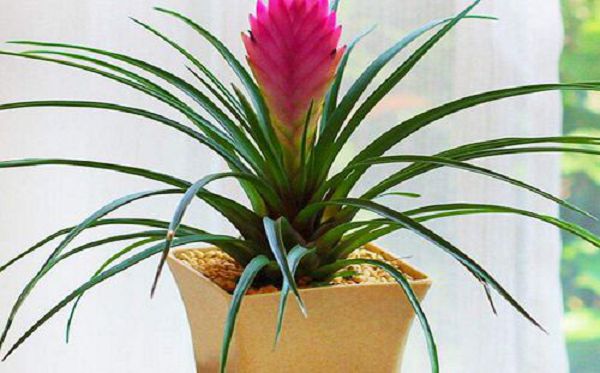
Tillandsia, also known as the purple-flowered pineapple or purple-flowered wooden-handled pineapple, is an ornamental plant of the genus Tillandsia in the Bromeliaceae family. It is small in size, with a plant height of less than 30 cm. The leaves are narrow and linear, 20 cm-30 cm long and 1-1.5 cm wide, clustered, dark green, hard in texture with a concave arc-shaped surface, with purple-brown mottled halos in the middle and a green-brown back. So which month does Tillandsia bloom? When is the blooming season of Tillandsia?
The blooming season of Tillandsia is January to March, with an ornamental period of up to 70-80 days.
Growth habits
Ornamental bromeliads like warm, humid environments with sufficient sunlight. Only under bright light conditions can they bloom normally and produce the most beautiful leaves, but direct midday sunlight still needs to be prevented in summer. The suitable growth temperature is 20-30 °C in summer and 15-18 °C in winter; below 10 °C it is difficult for them to grow, and the nighttime minimum should be kept at 5 °C. The soil should be neutral or slightly acidic sandy loam mixed with leaf mold or peat soil.
Propagation methods
Sowing
Under natural conditions, it is very difficult to obtain seeds from ornamental bromeliads. Even when seeds are obtained through methods such as artificial pollination, the traits of the offspring will segregate and cannot maintain the excellent traits of the mother plant. Therefore, sowing propagation is only used for germplasm preservation of native species and for breeding new varieties. The seeds of most ornamental bromeliads quickly lose viability after leaving the mother plant, so they should be sown immediately after collection. Bromeliads generally need 3-4 months from flowering to seed maturity. Bromeliad seeds are very small; one fruit can produce dozens of seeds, and one plant can produce thousands of seeds. Bromeliads can be sown indoors in pots or in seedling trays. The sowing substrate can be a mixture of river sand, perlite and peat soil, and must be sterilized at high temperature before sowing. Scatter the seeds on the surface of the substrate and press lightly; no soil covering is needed, just cover with plastic film or glass to retain moisture. At the optimum germination temperature of 24 °C-26 °C, they germinate in about 7-14 days. When the seedlings have 3-4 true leaves, they can be transplanted into 4-5 cm pots. Bromeliad seedlings need 3-4 years of cultivation before the central leaves can change color and bloom for ornamental display.
Division
After ornamental bromeliads finish flowering, multiple offsets are produced at the leaf axils at the base. April to June is usually the suitable period for division. Wait until the offsets grow to about 10 cm and have 3-5 leaves, then first remove the whole plant from the pot, remove some of the potting soil, hold the mother plant with one hand, and with the thumb and index finger of the other hand tightly pinch the base of the offset and pull downward at an angle to break off the offset. Disinfect the wound with a fungicide and let it dry slightly, then insert it into perlite or coarse sand. Keep the substrate and air moist and provide appropriate shade. After 1-2 months, when new roots have grown, normal management can begin.
Cuttings
For small-scale production and home cultivation of ornamental bromeliads, offset cuttings are generally used. Before and after the original ornamental bromeliad blooms, multiple offsets are produced at the leaf axils at the base. When the offsets have grown to about 10 cm and have 3-5 leaves, use a sharp knife to cut them off close to the mother plant together with a short section of the compressed stem. Disinfect the wound with a fungicide and let it dry slightly, dip it in naphthaleneacetic acid at a concentration of 300-500 mg/kg, and insert it into perlite, coarse sand or potting soil. Keep the substrate and air moist and provide appropriate shading. After 1-2 months, new roots will grow and normal management can begin. Note that if the offsets are too small, they are not easy to root when cuttings are taken and are very prone to rot; if they are too large when divided, they consume too much nutrition and reduce the propagation coefficient.