What are the patterns in the humidity requirements of potted orchids?
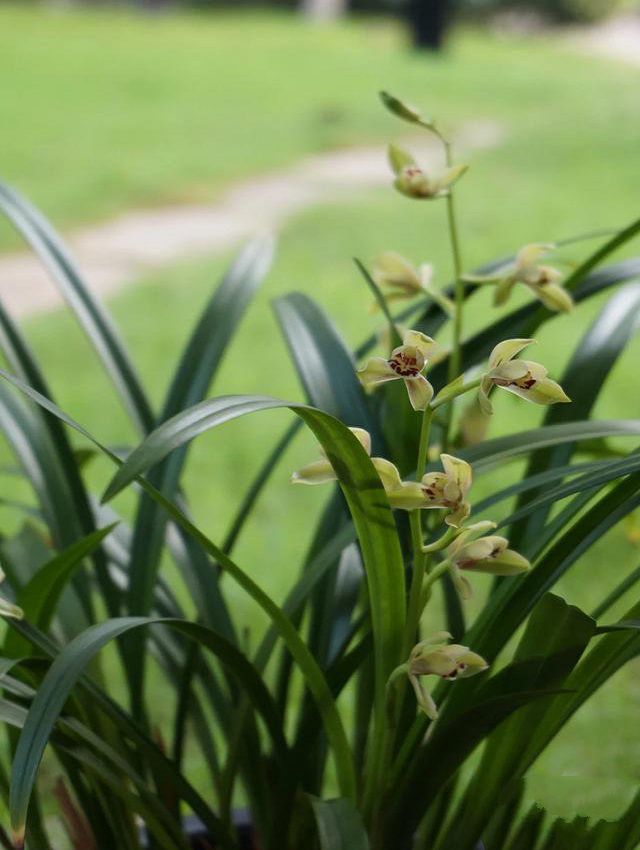
With their unique elegant temperament and graceful bearing, orchids are loved by more and more flower enthusiasts. So, during the process of growing orchids, through which characteristics of orchids can the humidity of the growing environment be adjusted and controlled? And what patterns do potted orchids follow in their humidity requirements?
As everyone knows, various orchids have relatively high humidity requirements, usually around 60% to 70%. However, in actual cultivation we have concluded that the demand for humidity can also be judged by the leaf texture and leaf shape. First, leaf texture. The leaf texture of orchids is not the same. Usually, the fewer fibers in the leaves and the thicker and more abundant the leaf flesh, the higher the orchid variety's requirement for environmental humidity. For example, the leaves of Cymbidium sinense (Chinese cymbidium) and Cymbidium ensifolium are often thicker in texture than those of Cymbidium goeringii and Cymbidium faberi, and have much more leaf flesh.
Therefore, the growing environment humidity for Cymbidium sinense and Cymbidium ensifolium should be much higher than that for Cymbidium goeringii and Cymbidium faberi. The environmental humidity for Cymbidium goeringii and Cymbidium faberi can be adjusted to around 50% to 60%, and they will grow well. The growing environment humidity for Cymbidium ensifolium needs to be slightly higher. The growing environment humidity for Cymbidium sinense needs to be around 80% for the plant to grow vigorously, with glossy green, thick and large leaves.
As for some epiphytic orchid varieties such as Phalaenopsis, Cattleya and Oncidium, their leaf texture is much more fleshy than that of Cymbidium sinense, and the fibers in the leaf texture are also much fewer than those of Chinese orchids. Their humidity requirements for the growing environment are higher, generally above 85%. From this it can also be seen that the growth of Chinese orchids requires a certain amount of environmental humidity, while some epiphytic orchids and exotic orchids require much higher growing environment humidity than Chinese orchids.
Second, leaf shape. Orchid varieties with relatively thin and narrow leaf shapes have lower requirements for growing environment humidity. Orchid varieties with relatively wide, short and thick leaf shapes have much higher requirements for growing environment humidity. In short, the growth of Chinese orchids requires a certain amount of humidity, but far less than the growing environment humidity required by some epiphytic orchids and exotic orchids.
Therefore, flower enthusiasts can reasonably adjust and configure the humidity of the orchid growing environment according to the orchid varieties they are cultivating.