When is the blooming season of Mesembryanthemum cordifolium?
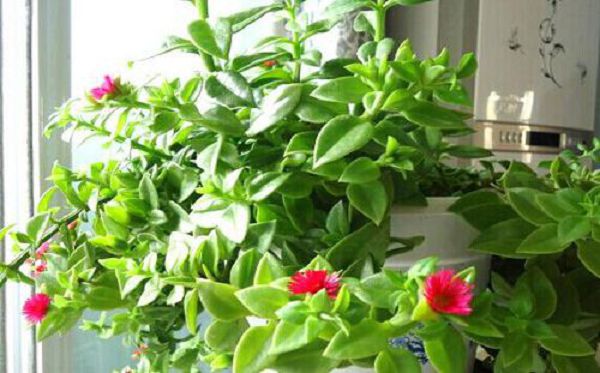
Mesembryanthemum cordifolium generally refers to heartleaf ice plant, a perennial evergreen herb in the family Aizoaceae, genus Mesembryanthemum. Its stems are prostrate and spreading, 30-60 cm long, branched, slightly fleshy, hairless, with small granular bumps. The leaves are opposite, heart-shaped ovate, flat, with an acute or rounded tip bearing a small pointed head, and a rounded base. So when does Mesembryanthemum cordifolium bloom? Which months are its flowering season?
Mesembryanthemum cordifolium generally blooms in July-August, and the flowering period is long. The flowering period of Mesembryanthemum cordifolium has two aspects: the blooming period of a single flower and the blooming period of the whole pot. Generally speaking, a single flower of Mesembryanthemum cordifolium can bloom for two or three days, opening during the day and closing at night, while the whole pot can continue blooming for 3-4 months, that is, from spring to autumn, blooming intermittently during this period, with July-August being the most vigorous.
Growing environment
Heartleaf ice plant prefers warm, dry, soft and sufficient light, tolerates partial shade and drought, is not tolerant of waterlogging, and has a certain degree of cold resistance. Sunlight of about 50%-70%, avoiding direct strong light, high temperature, and excessive humidity, and it cannot be exposed to rain for a long time. April-September is its peak growing season, and sufficient light should be given, but in the high temperature of midsummer it still needs proper shading to avoid yellowing of branches and leaves caused by scorching sunlight. However, it should not be too shaded either, otherwise the plant shape will become loose and flowering will be sparse. Therefore, it is best to hang it in a shade shed, under tree shade, on the inner side of a balcony, or in another place without direct sunlight for care, and pay attention to good ventilation to avoid a stuffy and hot environment. The growing temperature is 15-25°C, and it is afraid of freezing below 5°C.
Distribution range
It is naturally distributed in the eastern Cape Province, KwaZulu-Natal Province, and the Limpopo River basin of South Africa. It has been introduced and cultivated in China.
Propagation methods
Cuttings
Cuttings can be taken in spring, summer, and autumn, with summer and autumn being better. Generally, it is best to do this during the rainy season or on cloudy days, and the survival rate of cuttings is relatively high. For cuttings, choose healthy plants free of pests and diseases, cut vigorous and full branches, take the middle and upper stem sections, and cut them into small sections of about 12 cm. The upper cut should be about 1 cm above a bud, and the lower cut should be 1-3 mm below a basal bud. After cutting, the cuttings should be dried for about 1 day, and after the cut surface is dry, dip them in rooting powder and insert them into the prepared substrate. The cutting medium uses garden soil, humus soil, and perlite mixed at a ratio of 6:3:1. When cutting, insert the cuttings obliquely into the seedbed or nutrient bag, with the insertion depth being 1/2-2/3 of the total length, and the insertion density is preferably a plant and row spacing of 3-4 cm. After insertion, press firmly and water thoroughly, then manage and protect them according to conventional requirements. Generally after 3 weeks the wounds heal and roots gradually form.
Sowing
Cover the drainage hole at the bottom of the seedling pot with a tile, and place a 2 cm thick layer of coarse river sand and fine gravel below to facilitate drainage. Put the prepared sowing soil in the upper layer, tamp it firm, and scrape it level for later use. When selecting seeds, first observe and record whether the name matches the actual item, so as to determine the purity of the seed type or variety. Then select seeds that are full, fresh in color, pure, and free of pests and diseases, soak them in warm water at 52°C for 20 minutes while stirring constantly, take them out, and then soak them in clean water for 4-5 hours, with the water amount being at least 5 times that of the seeds. Then wrap the seeds in a wet cloth and place them under conditions of 28-30°C for germination. They can also be mixed with 2-3 times their amount of fine sand, placed in a clay pot, and covered with a wet cloth for germination. Turn them over once a day from top to bottom. If the sand is not dry, there is no need to rinse it. Keeping them at 25°C, they can sprout smoothly within 2-3 days.
Before sowing, first water the flowerpot thoroughly by the bottom-soaking method, sow after the water seeps down, cover with 1 cm of nutrient soil, and cover the pot mouth with newspaper or glass to prevent water evaporation and sunlight exposure. Remove the covering at night for ventilation and air exchange. Always keep the surface of the pot soil moist without becoming compacted.