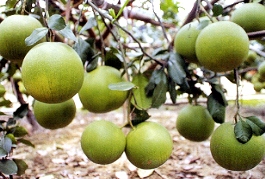
Growth Habits, Planting Methods and Fertilization Management of Taiwan Madou White Pomelo
Madou White Pomelo is a pomelo variety from Taiwan, China, and it is a very popular pomelo variety locally in Taiwan, China. So would you like to learn how this pomelo is cultivated?
Like other citrus, mature Madou White Pomelo plants sprout new shoots in three periods: spring, summer and autumn; in warm regions they also produce winter shoots. Among these, spring shoots sprout the most, followed by summer shoots and autumn shoots. Spring shoots are the important fruiting shoots and vegetative shoots of the year, and vegetative shoots also develop into the main fruiting mother shoots of the future. The sprouting position of spring shoots is highest at the terminal shoot, reaching 84.6%, while the rate of spring shoots forming fruiting shoots is 31.7%. As for the ratio of inflorescence forms, leafy inflorescence shoots (including leafy single terminal flower shoots) account for 41.2%, while leafless inflorescence shoots (including leafless single flower shoots) account for 51.7%. The fruiting rate of spring shoot fruiting shoots is 3.4-4.8%.
The leaves of Madou White Pomelo fall in every month of the year, but during the sprouting of spring shoots and the flowering period, an average of 57.3% of the leaves on mother shoots drop heavily and are replaced by new leaves. When aged leaves fall, the leaf blade drops first, and the petiole drops several days later, and leaf fall occurs throughout the day. The lifespan of plant leaves can be as long as 24 months, or as short as only 1 month; the average leaf lifespan is most commonly 11-12 months. If spring shoots sprout later, the lifespan is 11-13 months, and the next most common lifespan is 21-24 months. Madou White Pomelo plants flower each year between March and April, and the fruit ripening period is October to November. Farmers customarily harvest about two weeks after the Frost's Descent (around October 22) season.
Cultivation Management
1. Pruning and Training
The pruning and training of young Madou White Pomelo trees is mainly for developing tree form, gradually expanding the canopy year by year. When pruning and training to promote new shoot growth, the principle should be to suppress the strong and support the weak, so as to encourage balanced branch development. Generally, a young tree can produce 3-4 rounds of shoots per year. After planting, the plant is temporarily not pruned; first cultivate the root system and tree vigor. If the seedling is smaller and grows more slowly, it needs 3-4 growth shoots before pruning after the root system becomes vigorous. If the seedling is larger and grows more vigorously, pruning can be carried out after 2-3 growth shoots. When pruning, the principle is a single trunk, pruning at 45-60 cm above the ground to encourage new shoots to branch. For main branches, choose those whose branching angle is about 60-70 degrees from the trunk, and retain 2-3 new shoots distributed evenly in different directions to develop into 2-3 main branches.
After the main branches are selected, wait for one more round of shoot growth. When the main branch length reaches more than 80-100 cm, prune at 50-60 cm to promote the sprouting of sub-main branches, and select and retain branches with suitable angles to develop sub-main branches, so as to stagger the branching points. Likewise, when the sub-main branch length reaches more than 60 cm, prune at 40-50 cm to promote new shoots to sprout again at suitable positions on the sub-main branches. Once the main branches and sub-main branches are developed, the future tree form has been determined. Thereafter, continue pruning and training to select and retain second sub-main branches. Each sub-main branch can retain 2 side branches, and combine with appropriate irrigation and frequent, light fertilizer application to promote robust and well-filled branches. On the side branches, many green shoot groups then sprout as fruiting mother shoots, forming a high-yielding canopy. When pruning and training young trees, main branches with stronger growth vigor will grow upright upward and affect tree form; bamboo poles or ropes can be used to guide and adjust their direction and angle. The main branches should not be guided too low, and their base should maintain a 60-70 degree angle with the ground. Young trees use ropes to guide and adjust the angle and direction of branches.
Young trees use ropes to guide and adjust the angle and direction of branches.
For tree form management of mature Madou White Pomelo trees, the main purpose is to use pruning to maintain tree form and increase the canopy. Pruning can be divided into summer pruning and winter pruning. Summer pruning should use short cutting, light pruning and thinning. In mature trees at full fruiting stage, tree vigor is relatively moderate. If the plant bears many fruits or tree vigor is weak, it generally mainly produces spring shoots, while summer and autumn shoots are very few, so only remove non-fruiting leafless branches or dead branches. If the plant bears few fruits and soil fertility is high, or too much nitrogen fertilizer has been applied, the plant has strong growth vigor and produces large numbers of summer and autumn shoots, or even many water sprouts. Apart from reserving water sprouts by short cutting for renewal mother shoots, the rest should be removed. As for summer and autumn shoots, they should also be short cut to encourage branching to form finer fruiting mother shoots, and excessive ones should also be removed to avoid affecting tree form and fruit quality. After heavy pruning of summer and autumn shoots, fertilizer application should also be reviewed and adjusted to avoid producing large numbers of summer and autumn shoots year after year. However, summer pruning should not be excessive either, so as to avoid affecting the balance between canopy and root system, which may instead cause large numbers of water sprouts. Winter pruning involves a larger pruning amount, but the degree of pruning depends on tree vigor; the pruning amount should in principle not exceed 15%. Around mid-December, during the low-temperature dry period, prune dry and withered branches, pest- and disease-damaged branches, overlapping branches, weak and slender branches, or water sprouts. Thinning and pruning of large branches and shoots with stronger tree vigor should be carried out during winter pruning, and should be implemented in stages over 2-3 years to avoid excessive pruning at one time affecting canopy distribution and causing large numbers of water sprouts. When tree vigor is weak, use renewal pruning to reduce the canopy and stimulate branch sprouting, so as to cultivate the root system and restore tree vigor. For excessively weak plants, light pruning should be carried out, combined with applying large amounts of low-nitrogen, high-fiber organic fertilizer to improve the soil, and chemical fertilizers should be applied lightly to restore tree vigor. In addition, winter pruning should not be too early, so as to avoid high temperatures after pruning causing large numbers of winter shoots and reducing the flowering amount of spring shoots the following year.
2. Strengthen Soil Fertility Management
(1) Soil pH Improvement
Madou White Pomelo is a citrus fruit tree, and its suitable soil acidity and alkalinity (pH) is between 5.5 and 6.5. If the soil pH value is below 5.0, it is strongly acidic soil. The causes of soil acidity are that the soil itself is acidic, the lime in the soil is leached away by rainwater, or acidic chemical fertilizers are used continuously, among other results. In acidic soil, plants often lack calcium or magnesium, affecting fruit quality. The stronger the acidity, the more iron, aluminum and manganese dissolve in the soil, easily forming toxicity that is unfavorable to plant growth, and phosphorus easily forms insoluble compounds such as iron phosphate and aluminum phosphate, so that plants cannot absorb phosphorus. In orchards with strongly acidic soil, limestone powder, oyster shell powder or silicate furnace slag, etc. can be applied. For orchards lacking magnesium, dolomite powder (containing 10-16% magnesium oxide) should be applied, which can supplement both calcium and magnesium at the same time. Each year during the winter dormancy period, apply about 2-3 kg per mature plant, evenly broadcast on the ground, and mix into 15-30 cm of soil. Only one month after application may nitrogen fertilizers such as ammonium sulfate or urea be applied; applying together with compost can prevent soil hardening. Lime materials should be applied in appropriate amounts year by year, not too much at one time, and the pH value should be checked once a year. When the pH exceeds 6.0, application should be stopped to prevent excessively high pH causing trace element deficiency, thereby affecting leaf lifespan and causing premature leaf fall. After acidic soil is improved, the calcium and magnesium content in the soil can be directly increased, harmful substances can be reduced, microbial activity can be enhanced to promote organic matter decomposition, and plant nutrient absorption can be improved to raise fruit quality.
(2) Improvement of Soil Organic Matter Content
A soil organic matter content below 2% is low, 2-3% is medium, and above 3% is high. Soil organic matter decreases due to decomposition by microorganisms, and Taiwan, China has a high-temperature, rainy climate, so organic matter also decomposes faster. Applying organic fertilizer can not only be decomposed by microorganisms for crop absorption, but can also promote soil aggregate structure, improve soil drainage and aeration, and increase water- and fertilizer-holding capacity. Therefore, orchards with organic matter content below 2% can adopt sod culture or apply organic fertilizer to increase soil organic matter content to 3%. Apply decomposed organic fertilizer with relatively high carbon (fiber) content; the organic matter content should reach 60%, and its nitrogen, phosphorus and potassium contents are about 1% each, so it can be used in larger amounts, with more than 30 kg applied per plant.
When applying organic materials with relatively high nitrogen such as soybean meal, for example soybean meal contains up to 6.5% nitrogen and peanut meal as high as 7-11%, only a small amount of 3-5 kg per plant can be mixed and used, so as to avoid damaging the root system due to the fermentation heat of large amounts of soybean meal organic material (temperature reaching above 50 degrees C) and excessively high soil solution concentration after dissolution. Apply organic fertilizer each year in winter, by hole application or ring application in the soil around beneath the canopy. At the same time, after applying organic fertilizer, the amount of chemical fertilizer applied should be appropriately reduced, especially the amount of nitrogen should be reduced, so as to avoid excessive nitrogen fertilizer causing the plant to produce large numbers of summer and autumn shoots, thereby affecting fruit quality.
(3) Rational Fertilization
The amount of fertilizer applied in an orchard varies with tree age, fruit load, soil fertility and tree nutritional status. The fertilization amount can be based on the recommended fertilization amount for citrus orchards. If calculated at a yield of 60 kg per plant, then each plant needs 600 g of nitrogen, 300 g of phosphorus pentoxide and 600 g of potassium oxide applied each year; afterward, soil and leaf analysis results can be used to adjust the type and amount of fertilizer. Madou White Pomelo has a relatively high fertilizer requirement. If soil fertility is low and the fertilization amount is insufficient, the plant will have few flowers and fruits and poor fruit quality, so the recommended citrus fertilization amount should be appropriately increased by 20%-30%. The base fertilizer of chemical fertilizer should in principle be applied deeply in winter together with organic fertilizer, while spring fertilizer and summer fertilizer should in principle be broadcast. For the distribution ratio of chemical fertilizer application, in terms of base fertilizer, spring fertilizer and summer fertilizer, nitrogen fertilizer is 40%, 40% and 20% respectively; phosphorus fertilizer is 50%, 50% and 0%, or it may be applied all at once as base fertilizer; potassium fertilizer is divided into 30%, 30% and 40%. The base fertilizer application period is December to January, the spring fertilizer application period is April, and the summer fertilizer application period is June to July. If nitrogen fertilizer is applied excessively in the soil and leaf nitrogen content is above the standard value (2.9-3.1%), the plant leaves will be dark green and produce large numbers of summer and autumn shoots, making the fruit larger and the peel thicker, while sugar content and juice amount decrease, affecting fruit quality, so nitrogen fertilizer should be reduced. If available potassium content in the soil is insufficient and leaf potassium content is below the standard value (1.4-1.7%), the fruit will be smaller and both sugar and acidity lower, so the amount of potassium fertilizer should be appropriately increased. If available phosphorus content in the soil is 600-1,000 ppm and available potassium content is 600-800 ppm, then the phosphorus and potassium fertilizer content in the soil is already quite sufficient. When the pH value reaches 6.0, soil available calcium content can reach above 1,000 ppm. If soil available magnesium content also reaches above 100 ppm and the calcium-to-magnesium ratio is within 6, then the plant generally will not lack calcium and magnesium. However, if potassium fertilizer is applied excessively and its available potassium content exceeds 1,000 ppm, even if the soil contains a large amount of available magnesium, antagonism can also cause magnesium deficiency in plant leaves, and the leaf magnesium content will be below the standard value (0.26-0.50%). Magnesium-deficient yellowed leaves will then fall prematurely, and potassium fertilizer should be reduced during fertilization.
3. Proper Soil Moisture Management
During the growth period of Madou White Pomelo, the amount of soil moisture supplied has a great influence on plant growth, yield and quality. Because rainfall distribution throughout the year in Taiwan, China is uneven, with obvious dry and rainy seasons, in order to stabilize the yield and quality of Madou White Pomelo, orchard drainage must be carried out in flatland orchards during the rainy season to prevent root waterlogging leading to leaf and fruit drop, and sloped orchards should prevent soil erosion. In the dry season, water must be supplemented timely and appropriately. Madou White Pomelo is a subtropical citrus fruit tree, and the soil also needs moderate drying during winter. However, if soil moisture content is too low, the plant is prone to severe leaf drop due to water shortage, while excessive irrigation instead easily causes large numbers of winter shoots and reduces flowering amount the following year. Therefore, during the winter dry period, micro-sprinkler irrigation should be used to supplement a small amount of surface soil moisture, so that the soil at 60 cm depth maintains a relatively low moisture content of 10%, in order to maintain normal plant growth and favor flower bud differentiation. During spring, if the soil is too dry and soil moisture content is below 10%, the plant is prone to severe leaf drop, flower drop and fruit drop. If the soil is dry in winter and then frequently over-irrigated during spring, with soil moisture content often reaching as high as 20% (-8 to -12 centibars) of field capacity, the root system undergoes excessive wet-dry changes, which can also cause severe flower and fruit drop. Therefore, before spring shoots sprout, around the Start of Spring solar term on February 4, the soil should be fully irrigated. Then 1-2 weeks before the plant flowers, the soil should again be moderately and lightly irrigated to supplement moisture, so that soil moisture content maintains sufficient moisture of about 15% (-30 to -40 centibars), in order to favor root growth, spring shoot sprouting and flowering and fruit set. During the fruit enlargement period, soil moisture content can be maintained at sufficient moisture of about 15% to favor fruit growth and development, while irrigation should be stopped one month before harvest and soil moisture content maintained in a relatively dry environment of 10% (-50 to -70 centibars), so as to accumulate fruit sugar and improve quality. If rain occurs before harvest and there is too much soil moisture, fruit cracking is likely to occur, so drainage facilities should be strengthened.