What orchid varieties are there? An introduction to common orchid varieties
I. Chinese orchids
1. Cymbidium goeringii (Spring Orchid): The leaves of Cymbidium goeringii are slender, with fine small teeth along the leaf edges that feel a little prickly to the touch. Cymbidium goeringii blooms from January to March, with pale yellow-green flowers tinged with red and a rich fragrance.
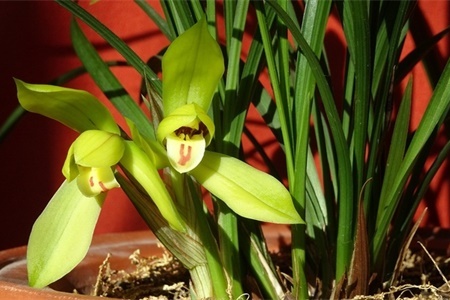
2. Cymbidium kanran (Cold Orchid): The leaves of Cymbidium kanran are slender, delicate and graceful. Cymbidium kanran blooms from October to December, with yellow-green flowers tinged with light reddish-brown and a strong fragrance.
3. Cymbidium sinense (Chinese Cymbidium): The leaves of Cymbidium sinense are very wide, and some leaves even have golden edges, making it highly ornamental. Cymbidium sinense blooms from September to February of the following year, with flowers mostly dark purple or purple-brown, and the flowers are fragrant.
4. Cymbidium ensifolium (Four-season Orchid): The leaves of Cymbidium ensifolium are slightly wide, with fine small teeth along the leaf edges, and the leaves are fairly upright. Cymbidium ensifolium blooms from June to October, with pale yellow-green flowers marked with purple spots and a rich fragrance.
5. Cymbidium faberi (Faber's Cymbidium): The leaves of Cymbidium faberi are slender and very upright. Cymbidium faberi blooms from March to May, with yellow-green or emerald-green flowers, purple-red spots on the lip petals, and a rich fragrance.
II. Foreign orchids
1. Phalaenopsis (Moth Orchid): The leaves of Phalaenopsis are broad and thick, arranged alternately, and the number of leaves is not large. Phalaenopsis is now mostly a Lunar New Year flower, with its flowering period controlled artificially, blooming around the Chinese New Year each year, and the flowers are brightly colored.
2. Cymbidium hybridum (Large-flowered Cymbidium): The leaves of Cymbidium hybridum are slender, and the number of leaves is relatively large. Like Phalaenopsis, Cymbidium hybridum is mostly used as a Lunar New Year flower, with its flowering period controlled artificially, blooming around the Chinese New Year each year, and the flowers are brightly colored.