How often should potted orchids be watered after being potted in the "old three" potting mix?
For orchids grown indoors in the north, when using the "old three" mix, with relatively low ambient humidity and no good ventilation measures, the watering frequency for orchid pots cannot be measured by days alone. Instead, the watering frequency for orchid plants should be determined based on the particle size of the potting mix, the mixing ratio of the potting materials, and the actual humidity inside the pot.
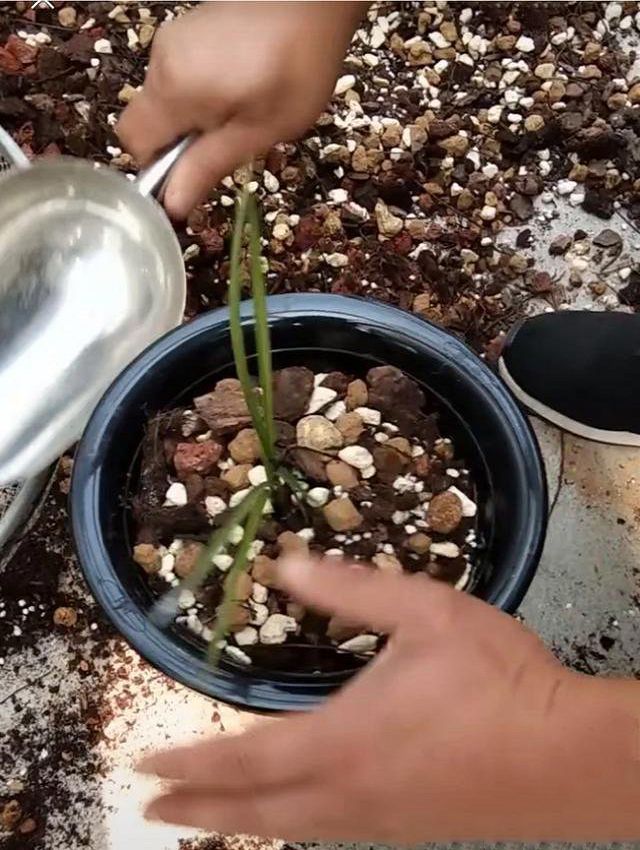
Normally, choosing an orchid potting mix must first meet three selection criteria. One, the potting material must have a certain nutritional performance. Two, the potting material must have strong water absorption and water retention. Three, the potting material must also have strong drainage and air permeability. The latter two seem somewhat contradictory. This is also an important reason why watering orchid plants is difficult to master. The basic "old three" cultivation potting mix includes: volcanic stone, Kanuma soil, and pine bark chunks. When using these materials to make a potting mix, particles of about 0.5 to 1 cm are generally used. With this particle size, if the potting mix is blended at 1:1:1, when growing orchids indoors in the north where the environment is relatively dry and ventilation is somewhat poor, after one thorough watering, it generally takes about half a month for the potting mix in the pot to become relatively dry.
And if volcanic stone, Kanuma soil, and bark chunks are likewise used at a particle size of about 0.5 to 1 cm in diameter, but blended at a ratio of 1:1:3. Because bark chunks have better water absorption and retention, the more bark chunks are used, the more its water retention performance will improve greatly. Therefore, the watering interval can be appropriately extended by a few days according to the actual situation.
If the particle size of these three materials is about 0.3-0.7-0.8 cm, then its moisture retention and water retention performance is far higher than that of a potting mix with a particle size of about 0.5 to 1 cm. In other words, the smaller the particle size, the stronger the water retention performance, and the higher the proportion of humus materials (soft potting materials), the stronger the water retention performance as well.
Conversely, the larger the particle size, the more soft materials and the less hard potting materials. Its drainage and air permeability will be better, and the potting mix in the pot will dry more easily. The watering frequency should be appropriately increased. In summary, when growing orchids in a relatively dry environment with poor ventilation, even if using the relatively loose and breathable "old three" potting mix, the watering frequency must be determined according to the actual humidity of the potting mix in the pot. A fixed number of days must absolutely not be used to determine the watering time and watering frequency.