How to grow clivia indoors? A detailed guide to cultivation methods
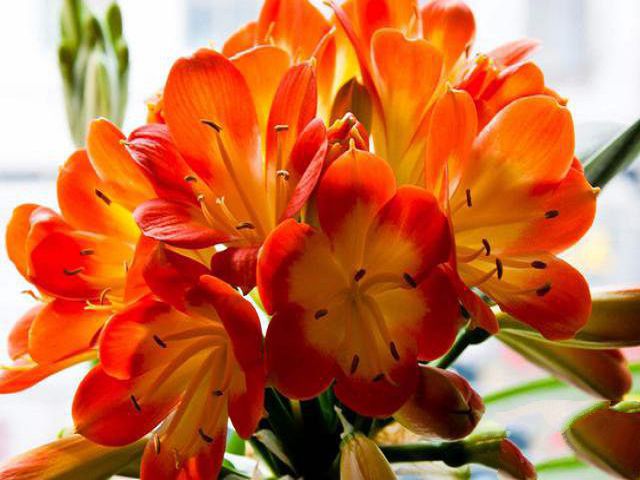
Clivia has thick, fleshy leaves with a glossy deep green color, and its flowering performance is very strong, so it is grown by many people. In fact, clivia is very easy to grow, but most flower lovers who grow clivia at home, indoors, often run into the problem of poor growth and root rot. Let me teach you the best methods for growing clivia indoors.
When growing clivia indoors, the problem that most easily arises is poor ventilation indoors in winter, or stuffy heat with poor ventilation in summer. Because ventilation is hard to guarantee, we just need to follow the care methods below.
When growing clivia indoors, the first thing is to mix soil for it. The soil mix must be loose and breathable, because indoors there is no ventilation, and if the soil is even slightly waterlogged it will easily cause root rot. So you must prepare a loose, breathable soil mix. You can choose half granular soil; the granules can be bark, or coal cinder or clay pebbles, all of which work. The simplest method is to use bark plus granular peat moss, or add a few small clay pebbles, then mix the three in a 1:1 ratio. If you don't have these things on hand, you can directly use leaf mold plus coal cinder granules about 3 mm in size, mixed in a 1:1 ratio. This ensures water permeability and ensures its nutrients are not lacking. When indoor ventilation is poor, water flows straight through after watering, and the potting soil will not retain too much moisture, so it is not easy to cause waterlogging and root rot.
Watering must also be controlled well. When watering clivia, wait until the potting soil is half dry, then water it thoroughly. We can find a bamboo skewer and insert it to the halfway point of the pot. Whenever you want to water, pull out the bamboo skewer and take a look; when there is no moisture at the bottom of the skewer, just water it thoroughly. When growing clivia, absolutely avoid letting the potting soil get too dry; if the potting soil dries out completely, its root tips will inevitably be damaged. As long as you make sure the potting soil is half dry, just water it thoroughly.
The third point is light. When growing clivia, it must receive appropriate light. If light is insufficient, the leaves will be pale, and clivia will find it very hard to bloom. So in spring, autumn and winter, when the light is not very strong, you can put it in the spot with the most abundant light. In summer, you must shade it, or you can let it receive some scattered light, or bright light, and just keep it indoors. So growing it indoors in summer is very good.
Another point is fertilizing. As long as your clivia is growing normally and it is not its flowering season, give it a nitrogen-based fertilizer two to three times a month as a supplement. Nitrogen-based fertilizer promotes leaf growth, making the leaves grow thick and fleshy with a deep color. Because after clivia finishes flowering, it is mainly grown for its foliage, so try as much as possible to grow the leaves thick, fleshy and deep in color, so that it has good ornamental value.
When growing clivia indoors, as long as you ensure good ventilation, a loose and breathable soil mix, give it appropriate light, and fertilize it adequately, it will grow very well. After autumn arrives, switch to supplementing with phosphorus and potassium fertilizer, create a certain temperature difference, and give it plenty of light, and it will directly send up a flower scape and bloom, as long as your clivia plant is large enough. Whether grown indoors or outdoors, as long as these points are met, clivia can be grown very well, and there is no difficulty to it. The most basic thing is that the soil mix must be loose and breathable, and next, the potting soil must not lack moisture. These two points are the key among keys to growing clivia well and preventing it from developing root rot and dying. Another point is that good ventilation must be ensured.
Growing clivia is not difficult; you need to figure it out slowly yourself, and according to your local climate, choose to prepare a good soil mix and choose the watering frequency. Do not follow what others say about watering several times a day; that may not suit you. Choosing the watering frequency according to your potting soil mix, as well as light intensity and ventilation effect, is the best approach, that is, inserting a bamboo skewer.