What are the breeding selection methods for colorful clivia?
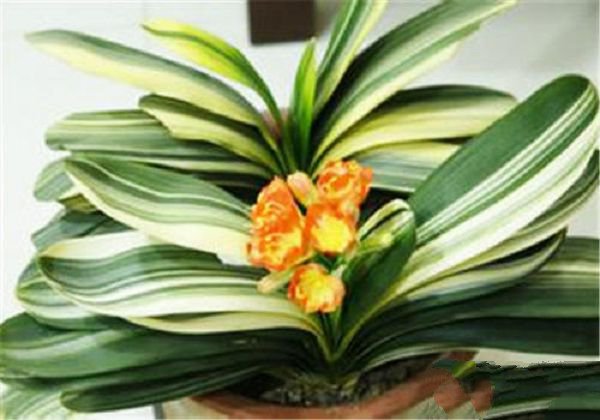
Colorful clivia is obtained through continuous propagation and cultivation. The earliest colorful clivia only needed yellow stripes and white stripes, but as appreciation standards have changed, the appearance standards for colorful clivia have also changed a great deal. So how can colorful clivia be bred correctly?
Colorful clivia
I. Selection of parents
From the appearance of colorful clivia in the 1980s to today, the seedling rate from hybridization is 15%-20%. Only when a plant with fairly uniform colorful stripes is selected as the female parent can the seedling rate possibly reach 70%. Therefore, when selecting parents, the traits of the male and female parents must be considered comprehensively so that the traits complement each other, and only then is it possible to obtain excellent clivia seedlings.
II. Selection of the female parent
According to the experience of predecessors, when selecting the female parent, first choose a striped clivia with very transparent stripes, where the front and back stripes can shine through, and require the colorful stripes to be evenly distributed with high color purity; the greater the contrast between porcelain white and dark green, the better. Next, consider other traits, such as leaf length, width, length-to-width ratio, leaf veins, head shape, rosette shape, brightness, thickness, stiffness and other conditions. Under the condition of ensuring the seedling rate of the offspring and a relatively high proportion of colorful clivia among the offspring, the more other aspects conform to the standards of clivia, the better.
III. Selection of the male parent
When selecting the male parent, first choose a relatively transparent striped clivia. Next, consider addressing the defects in the female parent's traits, so as to compensate for, improve and enhance the female parent's traits. In production practice, it is found that some male parents are of very good quality, but the offspring obtained when pollinated onto different female parent clivia are not the same. Therefore, the selection of an excellent male parent requires long-term practice, records, observation and summarization before it can be determined.