Why are there many crystal-like beads appearing on orchid leaves?
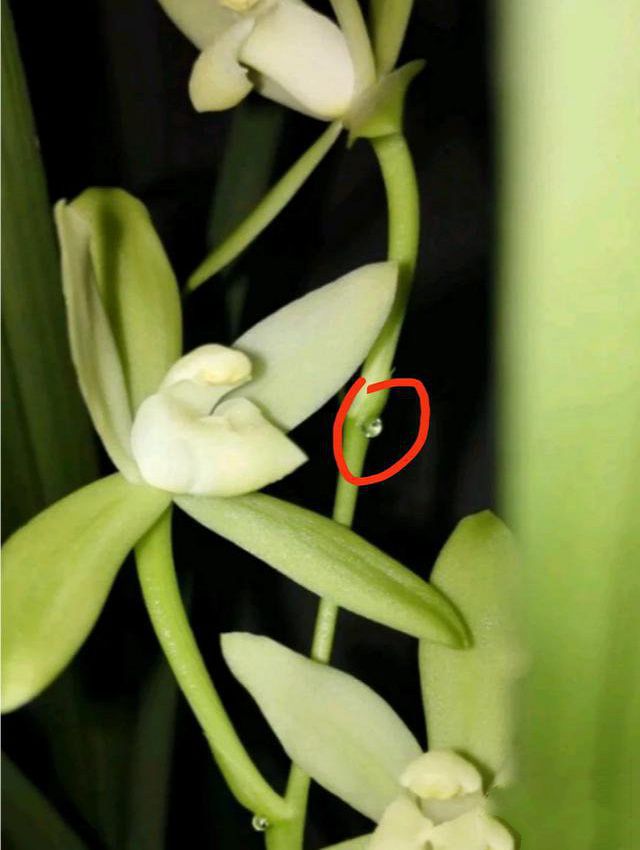
When orchids bloom, a transparent liquid resembling crystal beads is secreted on the leaves; this is a flowering characteristic of orchids. We orchid lovers call it orchid cream or life dew.
Orchid cream is a liquid naturally secreted by orchids as they grow. It tastes sweet and fragrant, and is a survival means orchids use for their own reproduction. Ants and other insects that like sweet tastes will come after smelling it. This is because orchid flowers are small and pale in color, making them hard for insects to notice, so by secreting the sweet-smelling life dew, the orchid attracts insects and increases the chance of pollination. When the life dew disappears, it means the flower is about to fade. Cymbidium faberi in particular secretes it most easily when blooming; this is all part of the orchid's heredity from its native habitat.
How to grow orchids
When orchids are not grown well, the problem mostly lies in the medium having poor air permeability and poor water permeability, which leads to root rot, so the quality of the medium determines how well orchids grow. For beginners, the best medium is a mix of granular medium and sieved orchid soil; it must be disinfected and preserved against rot before use.
Good soil goes with a good pot. Clay pots are the first choice for beginners growing orchids, and orchid roots also need to breathe and get air. The good air permeability of clay pots is exactly what orchids need. You should know that the quality of ventilation and air permeability determines how well orchid roots grow, and the quality of the orchid roots determines how well the orchid grows.
The size of the flower pot should be proportional to the size of the plant. A small seedling in a large pot with too much medium will have poor air permeability and easily accumulate water and rot roots; conversely, a large seedling in a small pot will have restricted root growth and likewise grow poorly.
Finally: orchids should not be planted deeply or heavily. If planted too deep, the base stays in a moist environment for a long time and is prone to soft rot, so the pseudobulb must be exposed and must not be buried in the medium. The roots must spread out naturally in all directions rather than being arbitrarily squeezed and bent, ensuring that every root can come into contact with the medium.
Growing orchids cannot be explained clearly in just a few words! It would be better for the questioner to first do the most basic homework and then practice more. Growing orchids well depends on practice plus experience, not on what others pass down by word of mouth. You should know that my environment and medium are different from yours, so what I say may not suit you. Other people's experience can only be used for reference; remember this point.