What Month Does Freesia Bloom? A Detailed Explanation of the Blooming Period
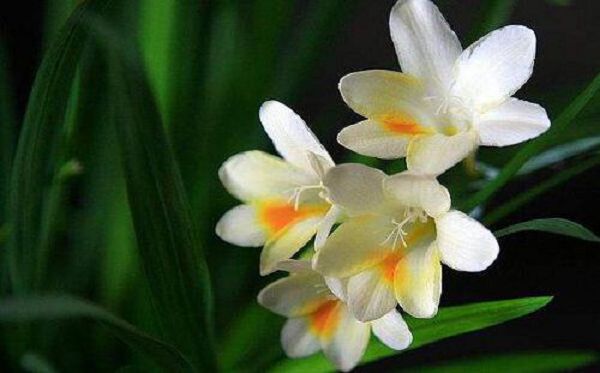
Freesia belongs to the Iridaceae family and is a perennial bulbous herbaceous flower of the genus Freesia. The corm is narrowly ovate or ovate, the leaves are sword-shaped or linear, the flowering stem is upright, the flowers are upright and sessile, pale yellow or yellow-green, fragrant, the bracts are broadly ovate or ovate, the perianth tube is trumpet-shaped, the perianth segments are ovate or elliptical, and the capsule is nearly ovate. So what month does freesia bloom? In which month is the freesia blooming period?
According to experienced freesia growers, freesia is a relatively common indoor ornamental flower in winter, so its blooming period is mostly in winter. Generally, freesia is planted in autumn and blooms in winter or spring. Of course, there are exceptions, and sometimes freesia also blooms in March to April. Overall, the blooming period of freesia is from February to May.
When freesia blooms, the blooming period generally lasts about 15 days. The flowering stem is single or branched, with spike-shaped flowers at the top, and each inflorescence bears about 5 to 7 flowers. After blooming, it produces fruit.
Factors Affecting the Blooming Time of Freesia
Although the blooming period of freesia is between February and May, the specific blooming time is actually very irregular.
In fact, the reason freesia's blooming period is so irregular is mainly the influence of the planting time, and also the influence of the temperature and light during care.
If planting is done in August or September, the blooming time is generally in winter; if planted in autumn, it may bloom in winter or spring. In fact, this planting time is also affected by the region. In northern regions, freesia can be planted in September, while in southern regions it can be done a little later.
The influence of temperature is mainly shown in flower bud differentiation, because when the temperature is kept at a low temperature of 8°C to 13°C, flower buds differentiate more easily. If during this period the temperature is lower than 18°C, the blooming period will be delayed, while higher temperatures can promote earlier blooming, but the plant tends to become weak.
The influence of light mainly refers to the duration of light. Under short-day conditions, freesia's flower bud differentiation is better. After flower bud differentiation, providing long-day conditions can also promote earlier blooming.
Origin and Habitat
Native to southern Africa. In China, it is mostly grown outdoors in the south and mostly in pots in the north.
Growth Habits
Freesia prefers a cool, moist environment with ample light, has poor cold tolerance, and its suitable growth temperature is 15°C to 20°C, with a minimum overwintering temperature of 3°C to 5°C. A large temperature difference between day and night is beneficial to growth and development; the nighttime temperature is best at 10°C to 15°C, and the daytime temperature must not exceed 20°C, otherwise growth will be poor. It prefers loose, well-drained soil rich in humus.
During the growth process of freesia, the corm can promote rooting and sprouting at 13.5°C to 15°C. Flower bud differentiation requires a low temperature of 8°C to 13°C. During the flower bud development stage, the suitable temperature is 13°C to 18°C. Below 18°C will delay the blooming period and shorten the flowering stem. Higher temperatures can promote earlier blooming, but the plant grows weakly. Under short-day conditions, freesia is favorably promoted in flower bud differentiation. After flower bud differentiation, long-day conditions can promote earlier blooming. Usually the corms are sown in September, flower bud differentiation begins in early November, and differentiation is completed in late November. After May of the following year, the leaves gradually wither and the corms enter a natural dormant period.
Cultivation Techniques
Soil
Freesia prefers well-drained, loose and fertile sandy loam or a culture soil mixed with 20% to 50% humus soil. Before planting, the soil should be sterilized, which can be done with 50 to 70 g/m2 of methyl bromide. After applying the chemical, rake and level it, and sowing can be done after 5 to 7 days. The potting culture soil can be made by mixing 1 part each of leaf mold, garden soil, fine river sand and decomposed organic fertilizer.
Planting
The planting time varies with the crop type and the market demand for fresh flowers. The ordinary planting period is September to October, with the main blooming period in March to April; for forcing cultivation it is early to mid-September to mid-to-late November, and for retarding cultivation it is January to March. Generally, the plant and row spacing is 8×12 cm, and the planting density is 80 to 110 plants per square meter. The planting depth is best when the top of the bulb is 1 to 2 cm from the soil surface, covered with 2 to 3 cm of soil, or pine needles, straw, sawdust, etc., to keep the soil moist.
Water and Fertilizer
Freesia has relatively fine roots and high soil requirements, so soil rich in organic matter and loose should be chosen for planting. Because the bulbs are relatively small and stored nutrients are limited, phosphorus and potassium liquid fertilizer should be added when there are 2-4 leaves. Afterward, netting should be set up or supports erected to prevent lodging. After budding, water should be properly controlled to make the plants grow robustly. Before planting, organic compost or coarse granular organic fertilizer should be applied early to improve soil fertility, soil looseness and aeration. The base fertilizer is mainly organic fertilizer, and some chemical fertilizer can also be applied appropriately, but the amount should not be too much, to prevent an increase in salt concentration in the soil that causes physiological disorders. Topdressing is mainly liquid fertilizer. Continuous cropping is very prone to disease, so it should be avoided as much as possible.
In the early stage after potting, not much water is needed; the potting soil should alternate between dry and wet, and watering thoroughly once a week is sufficient. By early February, when buds appear and stems are bolting, the plants grow rapidly and consume more water, so the pot should be kept moist at all times. One month after blooming, the water supply should be gradually reduced, and watering can be done once every 2 days to prevent bulb rot; by the end of February when the leaves turn yellow and wither, watering can be stopped.
Temperature
Both root formation and flower bud differentiation of freesia require a relatively cool environment. Roots grow best at 15 to 18°C, flower bud differentiation is best at 12 to 15°C, and inflorescence growth is fastest at 18 to 20°C. Therefore, keep the room temperature at 15 to 18°C in the early planting stage; at the 5 to 7 leaf stage, induce flower primordia at 12 to 15°C, and maintain this temperature for 4 to 6 weeks so that inflorescence development will not reverse; then raise the temperature to 16 to 17°C to make the inflorescence elongate rapidly and enter the blooming period.
Light
During cultivation, appropriate shading is beneficial at the seedling stage and the blooming stage. During the first leaf growth period, appropriate shading can lower the soil temperature and promote root development. Before flower bud differentiation, giving about 10 hours of short-day treatment is beneficial for promoting flower bud differentiation and increasing the length of the flowering stem and the number of flowers and lateral spikes on the inflorescence.
After flower bud differentiation is completed, appropriately extending the photoperiod is beneficial for promoting good inflorescence development and earlier blooming. Although freesia likes light, strong light should also be avoided. Under conditions of excessively strong light and relatively high temperature, a shade net with 70% light transmittance can be used for shading.
Pest and Disease Control
Freesia is prone to mosaic disease, bulb rot, and so on. When planting, the soil and seed bulbs must be thoroughly sterilized, and the potting soil must be completely replaced every year. At the same time, attention should be paid to controlling aphids. In the early stage of aphid occurrence, spraying 40% omethoate 1500-fold solution or 90% trichlorfon solution can be used for control.