What type of orchid is Red General, and how should it be cared for?
In the world of orchids, there is an especially wide variety of species. Besides the seven major series of Chinese orchids: Cymbidium goeringii, Cymbidium ensifolium, Cymbidium faberi, Cymbidium sinense, Cymbidium kanran, Cymbidium tortisepalum, and Cymbidium tortisepalum var. longibracteatum, etc., there are also a large number of epiphytic orchid varieties. There are more than 20,000 species of orchids in the world, of which several thousand can be grown for ornamental purposes, including more than 1,000 varieties among the seven major series of Chinese orchids, as well as various epiphytic and hybrid orchid varieties.
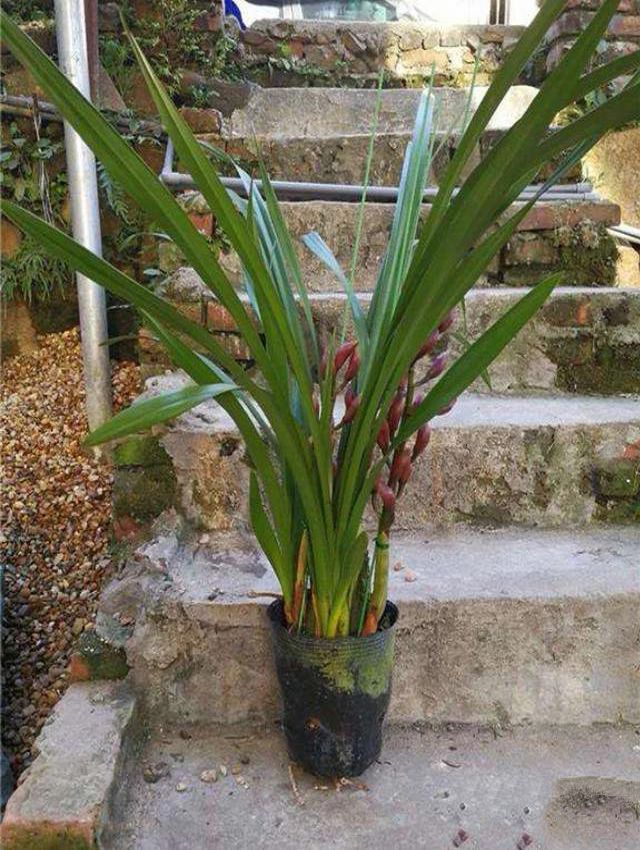
Red General is a red-series flower variety among hybrid orchids. Hybrid orchids are also what people commonly call large-flowered Cymbidium. They are varieties obtained by crossing Cymbidium iridioides, Cymbidium hookerianum, and Cymbidium faberi. The characteristics of hybrid orchids are tall plants, broad and long leaves, and relatively thick, fleshy texture. The flower scapes are sturdy, the flowers are large and showy, and the flowering rate on the scapes is relatively high. The pseudobulbs of the plant are goose-egg oval-shaped, very large, often around 4-6 cm. The flowers vary by variety and have a slight fragrance.
This kind of hybrid orchid usually begins flower bud differentiation in August and September each year. By the end of November, in an environment with suitable temperatures, they successively send up shoots and grow taller, and from mid-to-late December they bloom one after another. Because its growth period and flowering time are relatively long, fertilizer is indispensable in daily management. After the flowers fade in spring and summer, the plants entering the growth period must have sufficient fertilizer supply, otherwise the plants will find it very difficult to bloom again. When nursery bases propagate them in large quantities, they mostly use convenient, long-lasting slow-release granular fertilizer. For home cultivation, fully decomposed organic liquid fertilizer can also be used, or water-soluble fertilizers such as monopotassium phosphate. Only when fertilizer and water are continuously supplied and nutrients are sufficient will the plant's pseudobulbs be robust, and only then is it possible for flower buds to differentiate and bloom.