A detailed explanation of orchid classification methods: Are all flowers with "lan" in their names orchids?
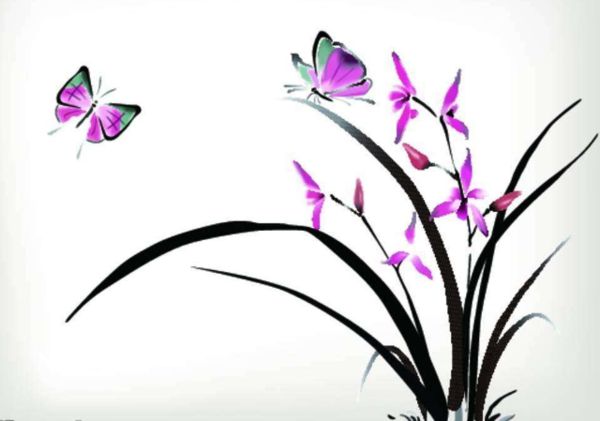
The orchid, known as "the finest fragrance under heaven," belongs to the family Orchidaceae. The orchid family comprises 650 genera and more than 30,000 species, with even more hybrid varieties - over 60,000 have already been formally identified - showing that the orchid family is a very large one.
Based on their ecological habits, orchids can be divided into two major categories: terrestrial orchids and epiphytic orchids. The orchids traditionally cultivated in China are collectively called "guolan" (Chinese orchids), such as Cymbidium goeringii (spring orchid), Cymbidium faberi (cimu orchid), Cymbidium ensifolium (jian orchid), and Cymbidium sinense (mo orchid). They have elegant forms and rich, delicate fragrance, and because they grow directly in soil they are called terrestrial orchids. Epiphytic orchids mainly attach to tree trunks or rocks in tropical or subtropical forests, with large blooms and gorgeous colors, and are collectively called "yanglan" (foreign orchids).
Although many flowers are not orchids, they are often given the fine name "lan." There are two reasons for this. First, some flowers have leaves similar to orchid leaves, hence the name. These include Clivia miniata (clivia), Crinum asiaticum (crinum lily), Haemanthus (blood lily), Sansevieria (snake plant), Chlorophytum comosum (spider plant), Hypoxis aurea (spider lily), Zephyranthes (rain lily), Freesia (freesia), Convallaria majalis (lily of the valley), Agave (agave), Strelitzia reginae (bird of paradise), and Narcissus (narcissus), among others. Second, some flowers such as Chloranthus (zhu lan) and Aglaia odorata (mi zai lan) have fragrances that resemble orchid fragrance, so they are also named "lan."