When does the rabbit-ear orchid bloom? Which months is the rabbit-ear orchid's flowering season?
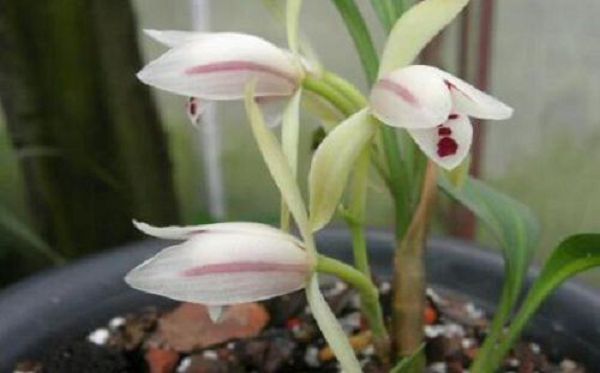
Rabbit-ear orchid: a semi-epiphytic plant, with pseudobulbs nearly flattened cylindrical or narrowly spindle-shaped, jointed, more or less bare, with 2-4 leaves clustered at the apex, leaves oblanceolate-oblong to narrowly elliptic, petioles 3-18 cm long, the flower scape emerging from the nodes on the lower side of the pseudobulb, erect, the inflorescence bearing 2-6 flowers. So when does the rabbit-ear orchid bloom? Which months is the rabbit-ear orchid's flowering season?
According to experienced rabbit-ear orchid growers, the rabbit-ear orchid's flowering season is May to August.
Origin and habitat
It grows under open woods, under bamboo forests, at forest edges, under broad-leaved forests, or on rocks, trees or the ground beside stream valleys, at an altitude of 300-2200 m. It is found in southern Zhejiang, Fujian, Taiwan, China, southern Hunan, Guangdong, Hainan, Guangxi, southern Sichuan, Guizhou, Yunnan and southeastern Tibet in China. It is also distributed from the Himalayan region to Southeast Asia, as well as southern Japan and the island of New Guinea. The type specimen was collected in Nepal.
Growth habits
Orchids generally grow on mountain slopes and valley walls in deep mountains and secluded valleys, on sloped hillsides or in rock crevices with good water permeability and water retention, beside sparse mountain grasses, and in the shade of secondary mixed woods. Or in places with shade, short sunshine hours or only scattered filtered light. In places with high air humidity and good air circulation, they sometimes also grow on cliffs beside mountain streams.
Orchids are best planted in an environment with good air circulation. They like shade and must avoid direct sunlight; they like moisture and must avoid dryness, and 15°C to 30°C is most suitable for growth. Growth is poor above 35°C. Severe cold below 5°C will affect their growth vigor, and at this time orchids are often in a dormant state. If the temperature is too high and combined with exposure to the sun, leaf scorching or withering may appear within one or two days. If the temperature is too low and they are not moved indoors in time, frost damage will occur.
Orchids have fleshy roots and are suitable for sandy loam rich in humus, and drainage must be good; leaf mold or mountain soil with more humus should be chosen. Slightly acidic loose soil or iron-containing soil is suitable, with a pH value of 5.5-6.5.
Propagation methods
Division
This can be done in both spring and autumn, generally dividing once every three years. Any plant that grows robustly and has densely clustered pseudobulbs can be divided, and after division each clump must keep at least 5 pseudobulbs connected together. Before division, watering should be reduced so that the potting soil is relatively dry. When potting after division, first cover the drainage hole at the bottom of the pot with broken tile pieces, then spread coarse stone, taking up 1/5 to 1/4 of the pot depth, then add coarse-grained soil and a small amount of fine soil, and then plant with sandy loam rich in humus. The planting depth should be such that the pseudobulbs are just buried in the soil, leaving a 2 cm rim at the edge of the pot, topped with Selaginella uncinata or fine stone, and finally water thoroughly, place in a shady spot for 10-15 days, keep the soil moist, gradually reduce watering, and carry out normal care.
Sowing
Orchid seeds are extremely fine, and the seed contains only one incompletely developed embryo, with very low germination ability. In addition, the seed coat does not easily absorb water, so sowing by conventional methods cannot lead to germination; therefore orchid mycorrhizal fungi or artificial culture medium are needed to supply nutrients for germination to occur. For sowing, it is best to choose fruit that has not yet split open, sterilize the surface with 75% alcohol, take out the seeds, soak them in 10% sodium hypochlorite for 5-10 minutes, take them out and rinse 3 times with sterile water, then sow them in a culture bottle containing medium, and then place them in a dark culture room, keeping the temperature at about 25°C; after they begin to sprout, move them into the light and they can form protocorms. From sowing to transplanting takes half a year to one year. Tissue culture has already been successfully achieved, and this method can be used for propagation where conditions permit.