What are the key points to note in locust farming? These few points are crucial
As a type of insect, locusts are being farmed on an increasingly large scale, but because they are quite fragile themselves, problems easily arise during farming. Many details of locust farming often need to be handled well, so let's take a look below at what to pay attention to when farming locusts!
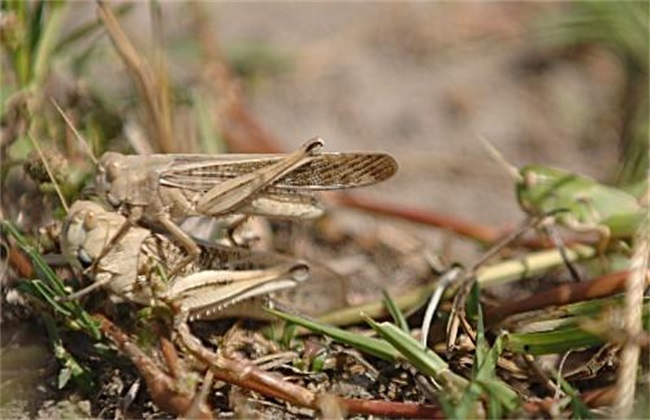
1. Prevent natural enemies
The first thing to note is some of the natural enemies of locusts. Although the farming site will not have adult locust natural enemies such as birds, there are quite a few enemies of larvae and eggs. The most common ones are ants, mole crickets, and so on. If there is an ant nest nearby, the ants will gradually treat this farming site as an endless source of food, causing the locust eggs to become fewer and fewer, so these ant nests must be cleared away in time. Next are the mole crickets hiding underground. As long as there are plenty of locust eggs, mole crickets will reproduce rapidly in a short time, and in severe cases this will directly lead to farming failure.
2. Soil layer improvement
Locusts do not lay eggs arbitrarily; they have certain requirements for the soil in which they lay eggs. Without suitable soil, locusts will lay very few eggs. A sand-soil mixture is the high-quality choice for the farming site, as it is not easy for it to become compacted over time. The sand and soil should preferably both be screened through a filter mesh; this makes them finer, which is beneficial for egg laying. After screening, they must be fully and evenly mixed, with the ratio controlled at about three parts sand to seven parts soil, and then evenly spread to fill the farming site to about three cm. It is best that there are no larger stones or the like beneath the sand-soil layer, and it should be fairly level.
3. Do a good job of enclosed management
Sealing the farming site requires special attention. Locust farming is generally done indoors for ease of management. The lower half meter or so of the locust farming pool should be built up with wooden boards or cement boards, so that locust larvae cannot easily escape, while the top is covered with gauze netting. The height can be set according to your own needs, and fine-mesh gauze netting must be chosen. Just leave a feeding opening in advance. As for the netting, it is best to stretch about two layers, because gauze netting is easily damaged, and having an extra layer is a form of preparation.
4. Control the temperature
Special attention must be paid to temperature management during the incubation period. The temperature level will largely affect the small locusts that hatch. Starting from 20°C, the eggs will gradually stop developing, and at 16°C they will basically not hatch, so the farming pool must have good temperature control. The ideal incubation temperature is generally around 26-30°C. Hatching efficiency is basically highest in this temperature range, and hatching is mostly concentrated during the daytime. Farmers need to observe more carefully so they can adjust in time.
The above are some of the issues to note when farming locusts. Locusts themselves are relatively fragile, so more attention is needed. Everyone should adjust the various precautions according to actual conditions to better adapt to farming.