What are the technical key points for raising ducks in orchards?
Raising ducks in orchards is a currently popular duck-raising method that combines planting and breeding. Fruit trees and ducks can coexist for mutual benefit, while reducing the costs of both the fruit trees and the ducks. Duck droppings can serve as fertilizer for the fruit trees, and the orchard can provide shade and feed for the ducks. So if you want to raise ducks in an orchard, how should you do it? Today, the editor brings you the technical key points for raising ducks in orchards. Let's take a look below!
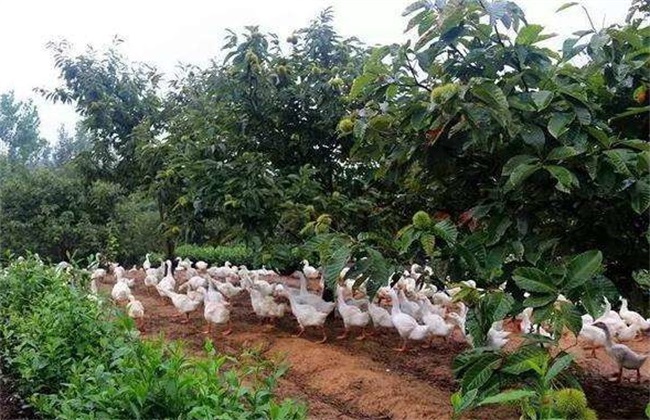
1. Site selection
Ducks move rather slowly and cannot climb up trees to feed, so low-fence grazing can be carried out in orchards. As long as the orchard's soil structure is good and water sources are sufficient, orchards with tall trunks and older trees, such as apple orchards, pear orchards, or persimmon orchards, can all be used for free-range raising. Raising ducks in an orchard can control weed growth, and duck manure can provide nutrients for the fruit trees. For orchards with extensive management, severe pests and diseases, and low yield and low efficiency, it can also help improve conditions and increase the benefits of both the orchard and the ducks.
2. Stocking time
When raising ducks in an orchard, we should divide the methods into mainly free-range and mainly confined raising according to the amount of natural feed in the orchard. When mainly free-range, the best time should be when the animals and plants in the orchard are most active, that is, from Qingming Festival until October. During this period, weeds grow vigorously and there are many by-products from the fruit trees. Ducks can eat various plant feeds such as weeds and wild vegetables, and can also feed on animal feeds such as insect eggs and insects. If the ducks are already adults, then free-range raising can be carried out all year round.
3. Timely supplementary feeding
When free-range raising ducks in an orchard, the natural feed is certainly unable to meet the growth needs of all the ducks. Therefore, we must do a good job of supplementary feeding for free-range ducks. Generally, ducklings can be released for raising at one month of age. Ducklings need to be supplementarily fed twice a day to provide them with sufficient energy. Then, as the ducks' age in days increases, appropriately reduce the feeding frequency and feeding amount, and let them feed freely. After they become adults, determine the supplementary feeding amount for the ducks according to the free intake of the free-range ducks. If mainly free-range, then generally carry out supplementary feeding after the ducks return to the coop at night, and maintain sufficient drinking water.
4. Health assurance
Raising ducks in orchards, like traditional duck raising, requires good epidemic prevention work. It should also follow the principle of giving priority to prevention, and according to the usual epidemic prevention procedures, do a good job of vaccinating the ducks to avoid outbreaks of epidemic diseases. And when the fruit trees reach the season when pesticides need to be sprayed, we should pay attention to pesticide toxicity and must not spray highly toxic pesticides. Low-toxicity and high-efficiency pesticides should be given priority. After spraying pesticides, restricted-area stocking should be carried out to prevent the ducks from accidentally eating pesticides and being poisoned. They can also be confined for about 4 days before being released for raising.
The above is a brief introduction to the technical key points for raising ducks in orchards. That is all for today's introduction. This article is for reference only. Friends who want to learn more related information, please continue to follow us!