How to Identify Good and Bad Orchids and Tips for Buying Orchid Growing Medium
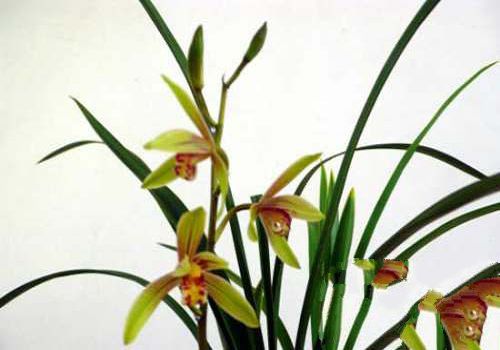
The orchid family has a total of 750 genera and more than 35,000 species, while the genus Cymbidium has more than 70 species. Chinese orchid varieties include seven major categories: Cymbidium goeringii (spring orchid), Cymbidium ensifolium (four-season orchid), Cymbidium faberi (Huilan), Cymbidium tortisepalum (spring sword), Cymbidium sinense (ink orchid), Cymbidium kanran (cold orchid), and Cymbidium lianpan (lotus-petal orchid), as well as some hybrid varieties (for example, "Golden Little Prodigy" among the Cymbidium ensifolium is a cross between Cymbidium faberi and Cymbidium ensifolium). Each species also contains many varieties; for example, among the spring orchids there are Song Mei, Green Cloud, and many others.
According to differences in flowering season, Chinese orchids can generally be divided into:
1. Spring-flowering type, also called spring orchid. Main varieties include: Song Mei, Xi Shen Mei, Long Zi, Cui Yi Pin, Wang Zi, Cui Gai He, Ying Chun Die, Xiao Die, Wen Tuan Su, Yue Pei Su Lu, and others.
2. Summer-flowering type, also called summer orchid. Main varieties include: Cymbidium faberi, Taiwan orchid, and others.
3. Autumn-flowering type, also called Cymbidium ensifolium. Main varieties include: Cymbidium ensifolium, Zhang orchid, � orchid, and others.
4. Winter-flowering type. Main varieties include Cymbidium sinense, Cymbidium kanran, and others.
As for orchid varieties, some are chosen for their fragrance, some for their names, some for their plain colors, some for their brilliance, and some for their novelty. Orchids should be evaluated by the six characters: color, form, rarity, fragrance, plainness, and charm.
Color means the flower color is bright and pretty, with a strong contrast between flower color and leaf color;
Form includes plum-petal, lotus-petal, bamboo-leaf-petal, willow-leaf-petal, linear-petal, and butterfly-petal;
Rarity means the number, shape, and color of the petals are unusual;
Fragrance is compared to the pupil of a dragon;
Plainness means the flower's lip has a single-color white, green, or yellow tongue;
Charm means the overall posture has a rhythmic beauty.
The outer whorl of an orchid flower consists of three sepals: the upper one is the top sepal, and the two on the sides are the lateral sepals. The upper two pieces of the inner whorl are the column petals, called the column heart, and the lower one is the tongue, called the lip.
Beginners can start growing orchids with Cymbidium ensifolium and Cymbidium sinense; they are low in price and easy to grow. In the north, choosing Cymbidium tortisepalum, Cymbidium faberi, and Cymbidium ensifolium is more suitable, with extensive management. Cymbidium sinense has high temperature requirements, and its flowering period is right in the severe winter season in the north, so the overwintering temperature must be guaranteed. Varieties can be reasonably matched according to the sequence of orchid flowering periods:
Spring sword: Tonghai spring sword, Big Red Cinnabar. Four-season spring sword, Pocket, Peach Red, Dwarf spring sword.
Spring orchid: Chun Song, Green Orchid, Douban Orchid, Double Flying Swallow, Yang Lao, Guo Hua, Dragon and Phoenix Bring Auspiciousness, Ai Guo, Jin Ding, Da Shi Men, Da Xue Yuan, Lightning, Sunrise, Crane's Splendor, and Big Tiger Spot.
Cymbidium ensifolium: Xiao Tao Hong, Tie Gu Su, Four-Season Su, Golden-Edged Da Gong, Imperial Concubine Su, Golden Silk Horse Tail, Lotus Su, Longyan Su, Renhua White, Golden Lotus.
Cymbidium sinense: Jade Lion, Da Tun Qi Lin, Green Cloud, Tao Ji, Golden Bird, Wenshan Jia Long, Dwarf King, Black King Kong, Black Pearl, Pan Long.
For beginners growing orchids, choose Cymbidium sinense. On the market there are potted seedlings and bare-root seedlings. Potted seedlings come in purple clay pots and black plastic pots. Orchid seedlings in black plastic pots grow vigorously, usually 5~8 shoots, with each shoot having 2~5 leaves clustered on an oval pseudobulb. The leaves are upright like swords, thick, dark green, and glossy. The flower scape is upright, sturdy, light brown, 50~80 cm tall, with 10 flowers per scape. The petals are brown, fragrant, and at the junction of the flower and flower scape there are white transparent nectar dots the size of sorghum grains, sticky. Orchid roots exposed at the bottom and outer side of the pot indicate that it has been established in the pot for a long time.
The leaves should have no brown spots, rust color, black disease spots, stripes, or mechanical injury, and the leaf tips should not have been trimmed. For purple clay pots, in addition to the above conditions, check whether the medium is consistent from top to bottom. If the orchid pot is new and glossy, the medium color is new, and the surface soil has no small grass or moss, this is a newly potted plant, and purchasing should be done cautiously.
For bare-root seedlings, if they grow robustly, have complete root systems, no water damage, and no disease spots, and the leaves are longer than those of potted seedlings, with 3~5 shoots per clump, they can also be purchased from the end of February to the end of March. If the orchid seedlings are wrapped externally with moss, the root system is less than 10 cm long, and the pseudobulbs are connected with thin wire, they cannot be bought. For potted seedlings from early December to early March, 1~2 flower buds should be open so that authenticity can be distinguished.
For purchasing orchid growing medium, there are two kinds of Japanese pumice soil: one mixed with crushed red brick and one not mixed; both can be used directly in pots. It is breathable, prevents water accumulation, and can release nutrients slowly, and it works well for growing strong seedlings. But for growing weak seedlings, it easily causes fertilizer burn spots. Soilless media include sphagnum moss, coconut coir, gravel, and others. Sphagnum moss is light, absorbs water, makes orchid plants develop quickly, and is convenient to manage; it needs watering only once a month, roots grow relatively quickly, white, round, and straight, and it should be planted shallowly.
In winter, use coconut coir indoors for overwintering to prevent cold and dampness from damaging the roots; careless watering easily damages the roots. Growing orchids in gravel makes watering convenient, but deep planting is required. Humus mixed with sand helps seedlings establish, with sufficient nutrients, but newly planted orchids recover slowly; after they shift to normal growth, the seedlings are strong and the flowers are abundant. Sawtooth oak leaf humus soil is good, and phytolith is imported from Japan, with good cultivation results.
After purchasing orchid seedlings, it is best to choose special clay tile orchid pots, 20~23 cm in diameter, which can hold 2~3 clumps of spring orchids. Before planting, lay a layer of green window screen on the bottom of the pot, place 3~4 pot pieces on it, add 3 cm of crushed brick granules and charcoal, then put in the growing medium, spread the orchid plant's root system on top, and add more growing medium until it is 2~3 cm below the pot rim. The depth should be such that the soil is close to the base of the leaves. Press slightly firm so the pot surface forms a steamed bun shape, cover with Selaginella uncinata or green moss, and use the bottom-watering method through the pot bottom, with the pot surface 3~5 cm above the water surface, so that the potting soil becomes thoroughly wet. Place it in a cool place to recover for 7~10 days, then move to normal cultivation.