How to Grow Vanda Orchids? A Complete Guide to Care Methods
Vanda is a flowering plant belonging to the orchid family (Orchidaceae), and it still has considerable market demand in China. Vanda orchids have very high ornamental value, and as potted plants and floral design material they are favored by many for indoor decoration. Therefore, whether in growing bases or as potted plants, the cultivation area of Vanda orchids in China is still very large. So how exactly should Vanda orchids be grown? Below, the editor will give you a brief introduction. Let's take a look!
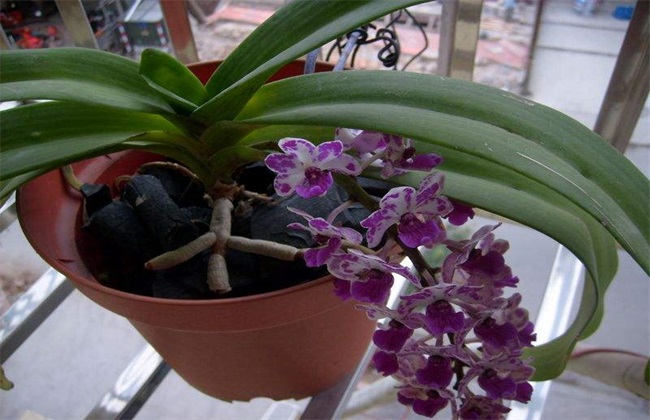
1. Growing Medium
The roots of Vanda orchids are relatively thick and long, and generally like to be exposed to the air. So when growing Vanda orchids, the growing medium must ensure good air permeability. It should be prepared with charcoal, brick pieces, bark chunks, etc., while common potting soil and leaf mold are not suitable for growing Vanda orchids. This is something everyone must pay close attention to. A suitable growing medium is the key to ensuring the normal growth of Vanda orchids. It will directly affect the flowering of Vanda orchids; if the medium is unsuitable, it will reduce the ornamental value of the Vanda orchid.
2. Propagation Methods
There are many propagation methods for Vanda orchids, among which division propagation and cutting propagation are commonly used. Vanda orchids grow relatively fast. When an old Vanda orchid produces aerial roots, division propagation can be carried out. Division propagation is generally carried out in spring when the temperature rises. Use a sharp knife to directly cut apart the aerial roots of the clump, taking care not to damage the root system. Then apply carbendazim to the wound to prevent infection. Then directly place the divided clumps in a place with high humidity and shade. Under normal management, they can bloom that same year. Cutting propagation is mainly based on stem cutting propagation.
3. Reasonable Watering
When caring for Vanda orchids, we should do a good job of watering according to seasonal changes. In spring and summer, because the temperature is relatively high, water about twice a day, and also spray water appropriately to increase humidity. After autumn arrives, watering once every morning is enough, while in winter the amount of watering can be reduced, and watering should also be done at noon when the temperature is relatively high, to avoid low temperature and high humidity causing the roots of the Vanda orchid to rot. And when watering in winter, special attention must be paid not to splash water onto the leaves. Because the leaves easily retain water, it can easily cause the leaves to rot, leading to leaf drop or even death.
4. Scientific Fertilization
Vanda orchids also have a relatively large demand for fertilizer during growth. During the peak growth period of Vanda orchids, apply liquid fertilizer once a week, and orchid-specific fertilizer can be used, applied to the roots or the whole plant. In summer, it can be applied once a month. And after the flowering period of the Vanda orchid, the withered flower stems should be cut off to promote the vegetative growth of the Vanda orchid. If during the growth period the Vanda orchid does not absorb enough nutrients, its growth will be noticeably reduced, causing the stems and leaves to become thin and weak, and very prone to lodging. In winter, because the temperature is relatively low, topdressing may not be needed.
The above is a brief introduction to how to grow Vanda orchids. That's all for today's introduction. This article is for reference only, and I hope it can help everyone!