A Detailed Guide to the Four-Season Care Management and Pruning Methods of the White Orchid Tree
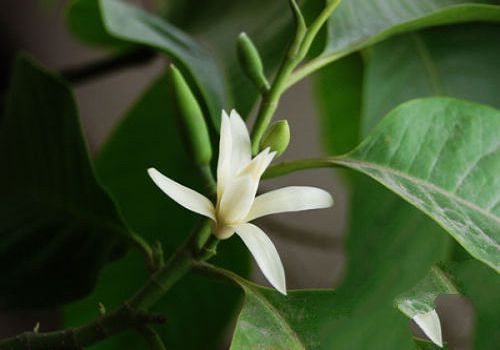
The white orchid tree, also known as bai lan, yulan magnolia, and white Burmese orchid, is a plant in the genus Michelia of the family Magnoliaceae. It is an evergreen tree with large, long-elliptical leaves, green on the upper surface and pale green beneath. Its flowering period is from June to October, with flowers borne singly in the leaf axils, white or slightly yellow, and intensely fragrant. It is native to the Himalayan region and the Malay Peninsula, and prefers warm, hot and humid environments with ample light; it is not shade-tolerant. The optimum temperature for growth is 15-30°C.
The white orchid tree's flowers are pure and flawless, with an alluring fragrance. The flowers can be used to scent flower tea. It can be placed in a spot with light. Because of its large stature, it is suitable for placing in a sunlit corner, or combined with other plants.
Four-Season Care Management
(1) In spring, it is suitable for placement on east-, south-, or west-facing balconies. After the temperature rises in spring, repot it (young white orchid trees are repotted once a year, while mature plants are repotted once every 2-3 years). The potting soil should ideally be a sandy soil rich in humus, fertile, loose and well-drained. When repotting, it is best to retain the core soil around the roots. The roots of the white orchid tree are fleshy roots, which tolerate neither drought nor waterlogging, and are especially afraid of standing water. After the new buds begin to swell, the soil must not be allowed to dry out. When the outdoor temperature stabilizes above 15°C, the white orchid tree can be moved out to a spot with light outside the balcony for cultivation, keeping the potting soil moist, and fertilizing can begin once new leaves appear.
(2) In summer, it is suitable for placement on east-, south-, or west-facing balconies.
The white orchid tree tolerates high temperatures and also tolerates strong light. However, when summer light is too intense, the leaves tend to age, and the potting soil dries out easily, so watering cannot keep up; therefore, in summer the white orchid tree should be moved to a spot with morning and evening light or partial shade for cultivation, keeping the potting soil moist and applying light fertilizer frequently. Sprinkle water around it often to increase air humidity, and at the same time pay attention to ventilation. After the temperature turns cool in late summer, the white orchid tree should be moved to a spot with ample light for cultivation.
(3) In autumn, it is suitable for placement on east-, south-, or west-facing balconies. In autumn, the white orchid tree should be given ample light, and water and fertilizer management should keep pace. After October, when the weather turns cool, the water supply can be gradually reduced and fertilizing stopped. In autumn, to enhance its cold resistance and reduce the occurrence of pests, the white orchid tree should be hardened off outdoors at low temperatures for a period, but it must not be exposed to frost. Before frost falls, it should be promptly moved into a balcony with light for cultivation. If the outdoor temperature drops sharply, it should be moved into the balcony promptly.
(4) In winter, it is suitable for placement on east-, south-, or west-facing balconies. The white orchid tree does not tolerate low temperatures, and the winter temperature should be kept above 5°C. At this time the white orchid tree is in a semi-dormant state, and ample light should be ensured, the potting soil should be kept on the dry side, watering only when the soil is dry, and fertilizing should be stopped. When grown at home, the temperature should preferably be kept above 8°C. At this time, keep the potting soil moist and provide ample light, and do not fertilize. A balcony environment without ventilation in winter is prone to scale insects, so appropriate ventilation should be provided.
Pruning
The white orchid tree produces three flushes of new branches and leaves in one year. The first leaf flush occurs from early to mid-April, the second from mid-to-late June to early July, and the third from mid-to-late August. Because the white orchid tree only has flower buds in the leaf axils of new branches and leaves, it only blooms when new branches and leaves grow. Appropriately removing some old leaves during the growing season is beneficial to the growth and sprouting of new branches and leaves, and also helps it bloom more. After a white orchid tree has successfully propagated and survived, it should be pinched back 1-2 times to induce branching, which is beneficial for dwarfing and shaping it as a potted plant.